• Home
  • Shop
  • About
  • Exhibits
  • Contact me

jeanweaves

~ Jean Williams, Handweaver

jeanweaves

Category Archives: Planning

Happiness Is…

17 Thursday Dec 2015

Posted by jeanweaves in creating, Looms, Planning

≈ 1 Comment

Tags

Creativity, Handweaving, Projects, Table Runners

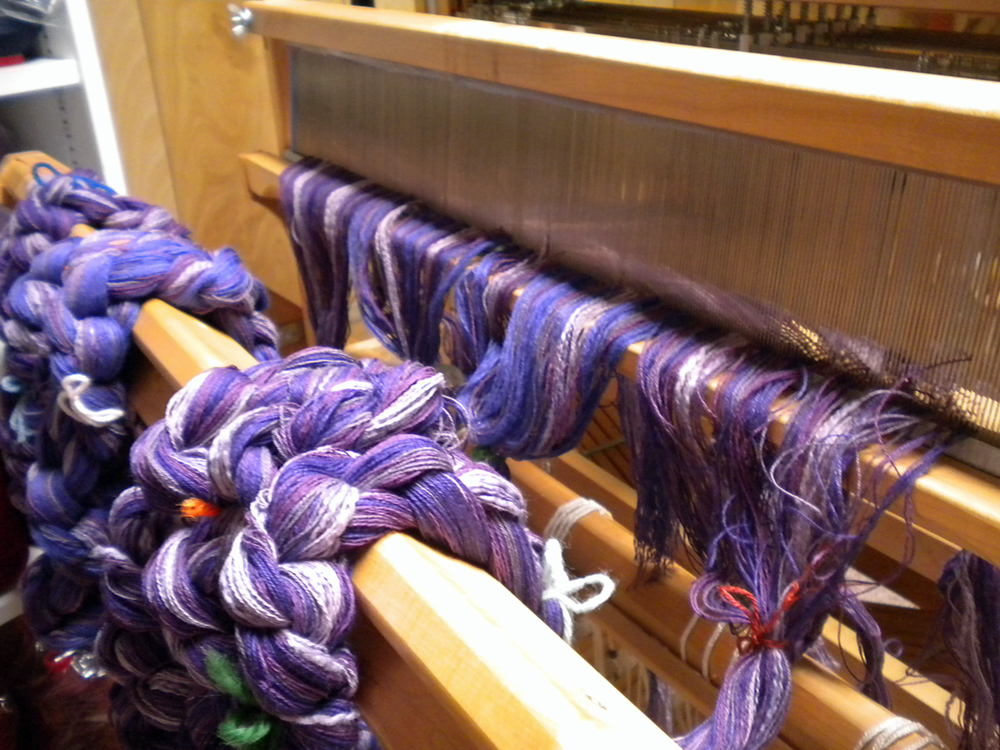
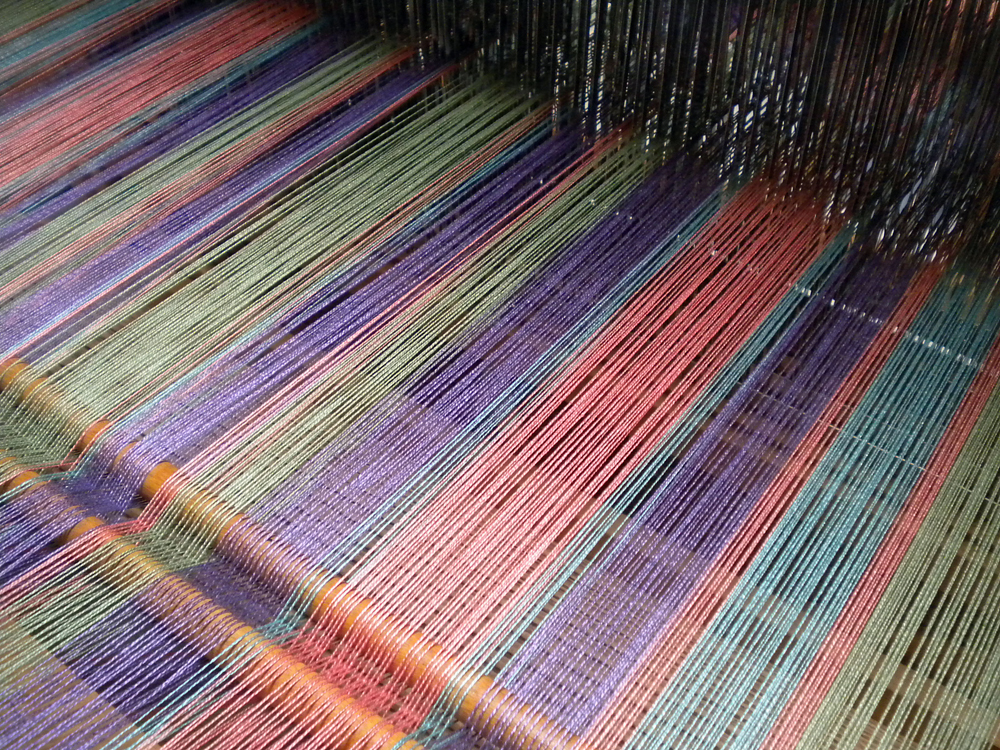
View from the front, warp chains threaded through the reed.

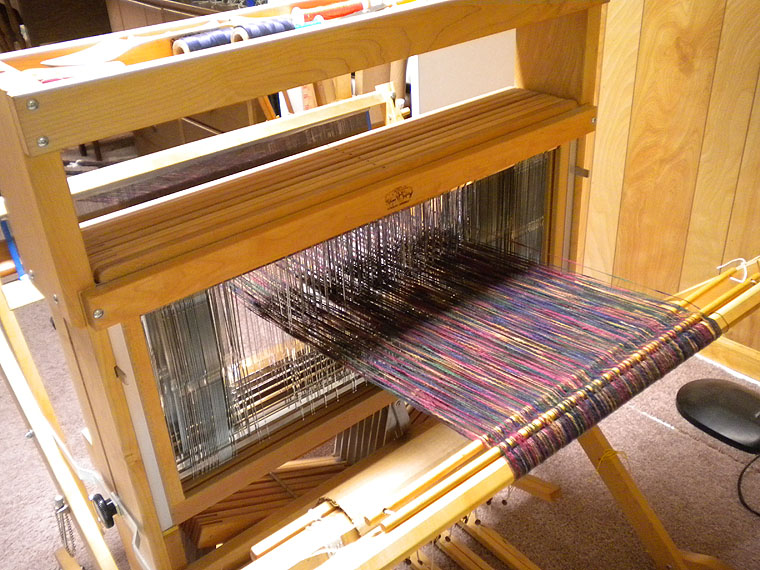
8-shaft loom, ready to thread

Happiness is discovering that the runner ordered to match a previous purchase was woven on the 8-shaft loom, not the draw loom.

This is a game-changer in terms of how long it will take to weave the order. The draw loom takes way longer to thread than the 8-shaft loom. The current project on the 8-shaft loom takes way less time to weave off than the damask on the draw loom.

The draw loom with damask project

The draw loom with damask project

You would think I’d remember which loom I used to weave a project. After all, I only have the two looms. But once I take one warp off and put another on, my mind moves to the next combination of colors, weaves, and threads.

Throw in the holidays, family obligations out of state, along with another weaving order, and the difference in looms makes me very happy indeed. This is indeed doable!

I hope you find similar fortuitous discoveries during this busy season!

Merry Christmas and Happy New Year!

How Long?

22 Thursday Oct 2015

Posted by jeanweaves in creating, Planning, Towels

≈ 1 Comment

Tags

creative inspiration, Towels, Weaving

View from the front, warp chains threaded through the reed.

View from the front, warp chains threaded through the reed.

“How long does it take to weave that?

It’s a common question I hear. So, do you want the long answer or the short answer?

The short answer to the question? “About an hour per towel.” The long answer? “It depends.”

I have tried to time projects just to get a better idea on how to answer, but where do I start?

The seed for each warp often springs from an earlier project. As I weave, I consider how I could choose a slightly different colorway or wonder what would happen if I treadle this threading as if it were a different structure entirely, weaving an overshot as if it were a lace weave for instance. So the planning is sort of fluid and therefore, hard to “time.” Putting it into an actual planning sheet doesn’t take long in itself, but my indecision can really take a while to ferment into a cohesive plan.

Then there’s the time it takes to measure the warp. I typically weave 8 or 9 towels at a time. This can run anywhere from 9 to 10 yards. If I use a finer thread, I will need more of them to get a towel 20-24” wide. The warp I measured the other day needed 568 threads, each 10 yards, 8” long. And if there are multiple color changes, that takes time too. To make it easier to handle, I break that number into four or five “bouts” or groups of threads, chain them up and take them to the loom. It took maybe about 3 hours to wind that warp. (You see? Not very exact.)
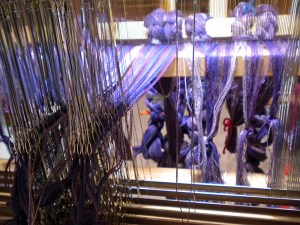
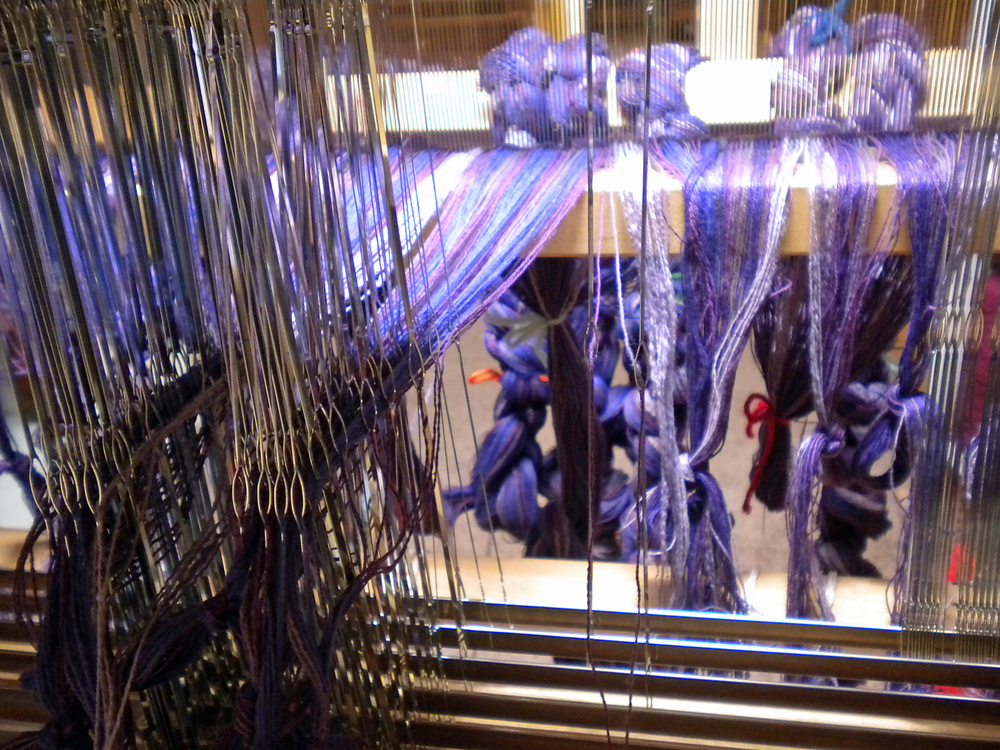
View from the back of the threads coming through the reed and the heddles.

View from the back of the threads coming through the reed and the heddles.

Once at the loom, every thread has to go through the reed and a heddle—in the right order!  Sleying the reed usually doesn’t take as long, typically about an hour or so, again depending on the fineness of the threads and how many go through each dent (slot). Threading the heddles, though, can take the better part of a day and half. Not as young as I used to be and I have to get up and stretch more often.

After the warp is threaded, it has to be wound onto the warp beam. Here is where I find out if I’ve inadvertently crossed any threads between the reed and the heddles. If I don’t have tangles, the winding on goes pretty quickly—about an hour or so, depending on the length of the warp. After I tie it onto the breast beam, spread the warp, and adjust the tension, I’m ready to weave. This is the fun part.DSCN1466
So the next question, sometime spoken, sometimes not, is “Why do you do something by hand that can be done so much cheaper commercially?”

There is a value in the connection between the hand and the product. We’ve gotten so far away of an item’s source that we don’t care about it anymore. But if we know that a person took the time to choose the colors and plan how those threads will cross, will we not see that cloth in a different light? Will we not appreciate that item more and elevate the task it’s used in to be more than it was? Whether it’s a handmade quilt, or homemade jam, or handspun yarn, or handwoven towel, it’s the “hand-“ and the “home-“ that make those items more valuable because someone took the time.

Besides I love to weave.

How long does it take you to do what you love?
Hmm…Does that work?

23 Tuesday Jun 2015

Posted by jeanweaves in Color, creating, Planning, Weaving Inspiration

≈ 5 Comments

Tags

Color, creative inspiration, Textiles, Weaving, Yarn

Winding my new warp gives me pause—do these colors work?

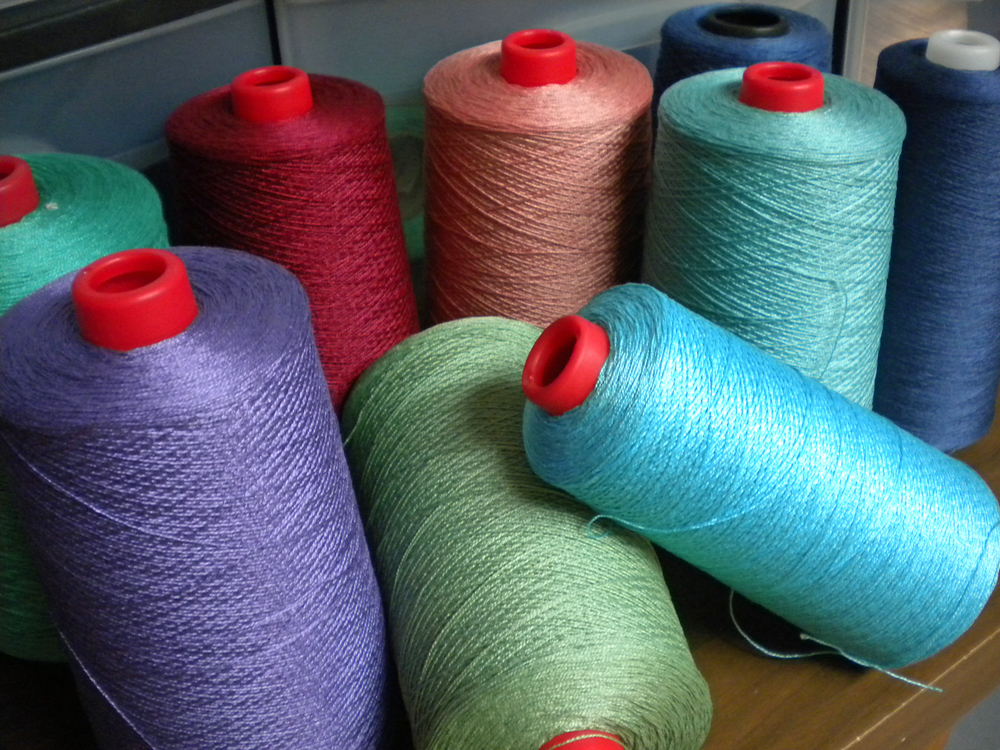
A choice of colors

A choice of colors

Planning colors can be one of the most difficult parts of the weaving process for me. I’ve designed some real ‘dogs’ in my years at the loom, and other times, the colors just glow. I’m definitely more of a “pattern/structure” weaver and a “color/texture” weaver.

Recently I’ve been weaving workshop samples and neutral colors, and really, this week I needed some color. So I went to my shelf and started pulling out cones. Reds, purples, blues, peach, turquoise, green. Which should I choose? Which colors will play nicely together?

Sampling would be the wise route to take, but I’m very impatient to get this one the loom. That may come back to haunt me.

Threaded warp from the back

Threaded warp from the back

I remember hearing Sharon Alderman talk about color—look at what Mother Nature puts together and use that as a starting point.

Okay. I can see some of these colors in my flower garden, but not all of them on the same stem. After some sorting, I settle on UKI’s Quince (a dark peach), Duck (close to turquoise), Lavender, and Scarab (a soft sage green) for towels. (Color names are interesting—can you just imagine someone saying “We’ve already got a green. What should we call this shade?”) As I wind the warp, I have second thoughts, but it’s too late now. Such indecision!

I sley the reed. Hmm…I hope this works.

It takes the better part of a day to thread a broken twill that will make up a vibrant towel warp—I hope! Lots of time to wonder…

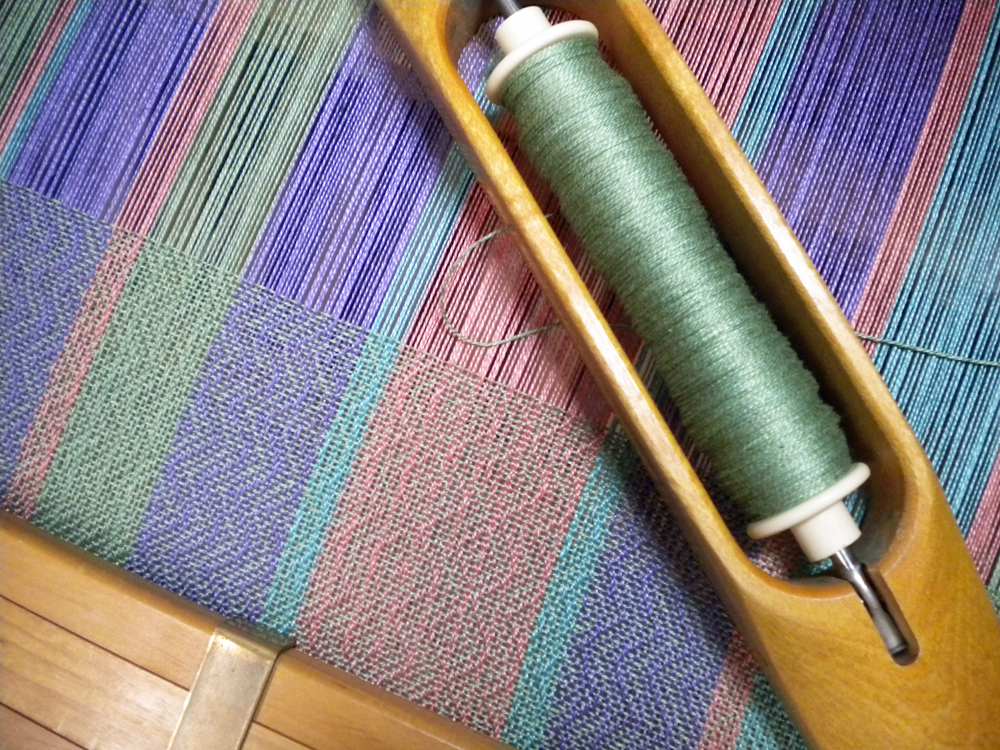
Okay, today I wound the warp onto the back beam and tied the warp to the breast beam—all 642 threads, each 7 yards, 21 inches. The colors of the mercerized cotton glow. A few inches woven show that hey, this might work after all.

Testing the Warp

Testing the Warp

With house guests for the next week and a family wedding to follow, the warp will wait for confirmation. And I will still need to decide on weft colors, but every time I walk by the loom, I’ll think about these colors and dream about some nice colorful towels.

How do you choose the colors for your next project?

New Year, Revisiting Old Techniques

16 Friday Jan 2015

Posted by jeanweaves in Doubleweave, Planning, Weaving Inspiration

≈ Leave a comment

Tags

creative inspiration, Double Weave, Handwoven Magazine, Table Runners, Weaver's, Weaving

January holds all sorts of possibilities. Old deadlines are past and there’s time now to consider more carefully what goes on the loom rather than assuming it will be another towel run. This is a great time to revisit those weave structures that I don’t get to work on usually.

Last January I sampled some Finn weave and figured double weave. That was a small project just to see if I could do it. But all through the year, a thought was niggling at the back of my mind: what if I set up the draw loom for double weave? I’ve done it before, although it’s been many years ago. Can I do it again?

Double weave articles abound in Weaver's and Handwoven.

Double weave articles abound in Weaver’s and Handwoven.

The first step for now was to review what resources I have on double weave. I have many back issues of Weaver’s and Handwoven. “Colonial Double Weave” by Madelyn Van der Hoogt in Weaver’s Issue 12 has great cross-section drawings of what the threads are actually doing and how to weave an overshot pattern as double weave. Then Weaver’s Issue 17 has several articles on double weave color and design. Weaver’s Issue 32 has articles by Bonnie Inouye and Doramay Keasbey on manipulating double weave drafts. And the November/December 2011 Handwoven has an article by Judith Yamamoto and Patricia Stewart on two different takes of one draft.

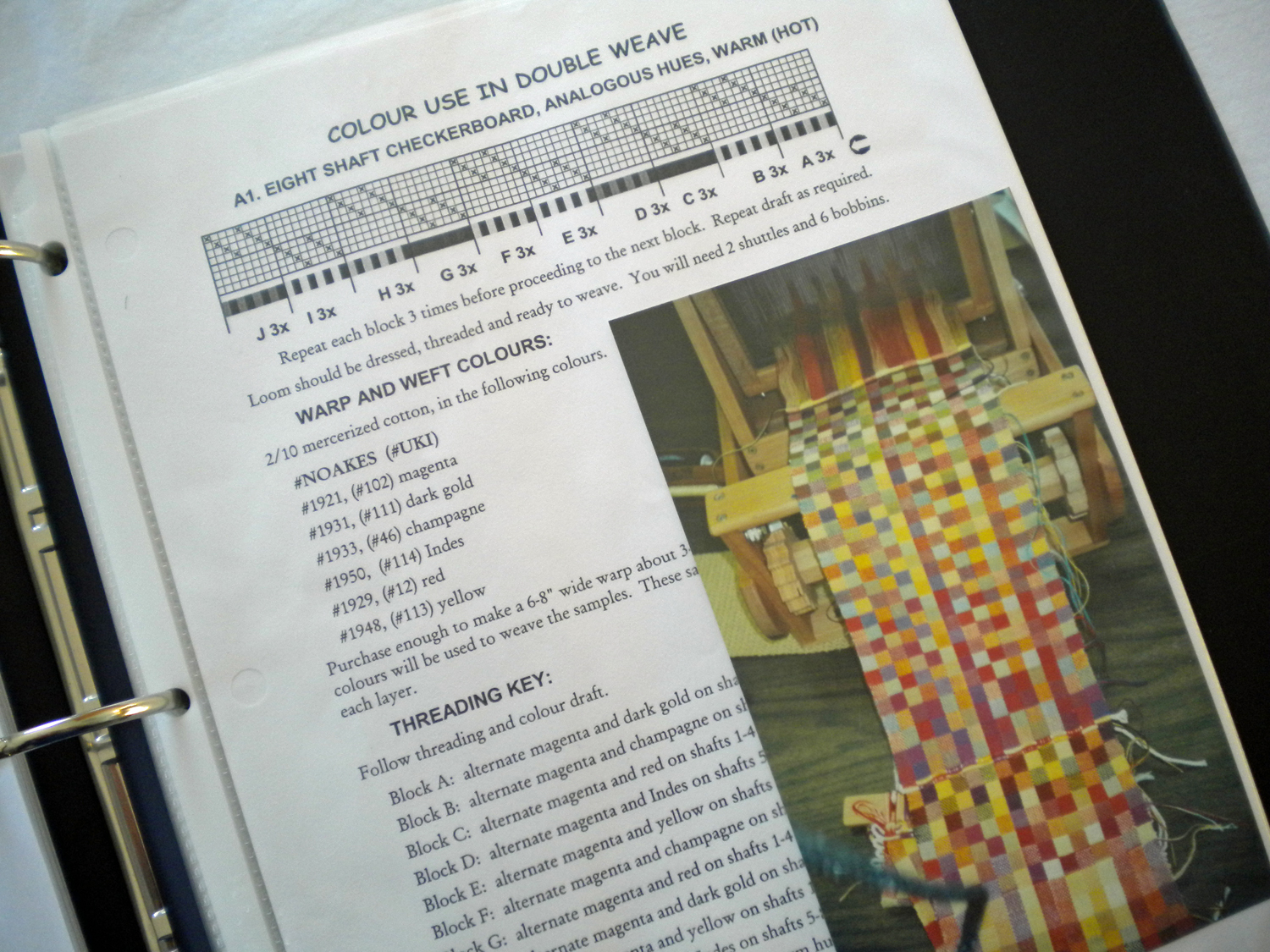
A page from a 2002 double weave workshop

A page from a 2002 double weave workshop

I’ve also attended numerous workshops over the years, one of which was entirely on double weave. Ingrid Boesel visited our guild in 2002 to teach about color in double weave. My binder included photos of our round-robin projects along with the drafts. It’s fascinating to see how different colors affect the look of a fabric.

Looking through these articles and studies was just the jump start I needed. A warp of dark blue and medium blues went on my small loom to refresh my memory. I sampled a selection of weft colors, settled on one, and took off.

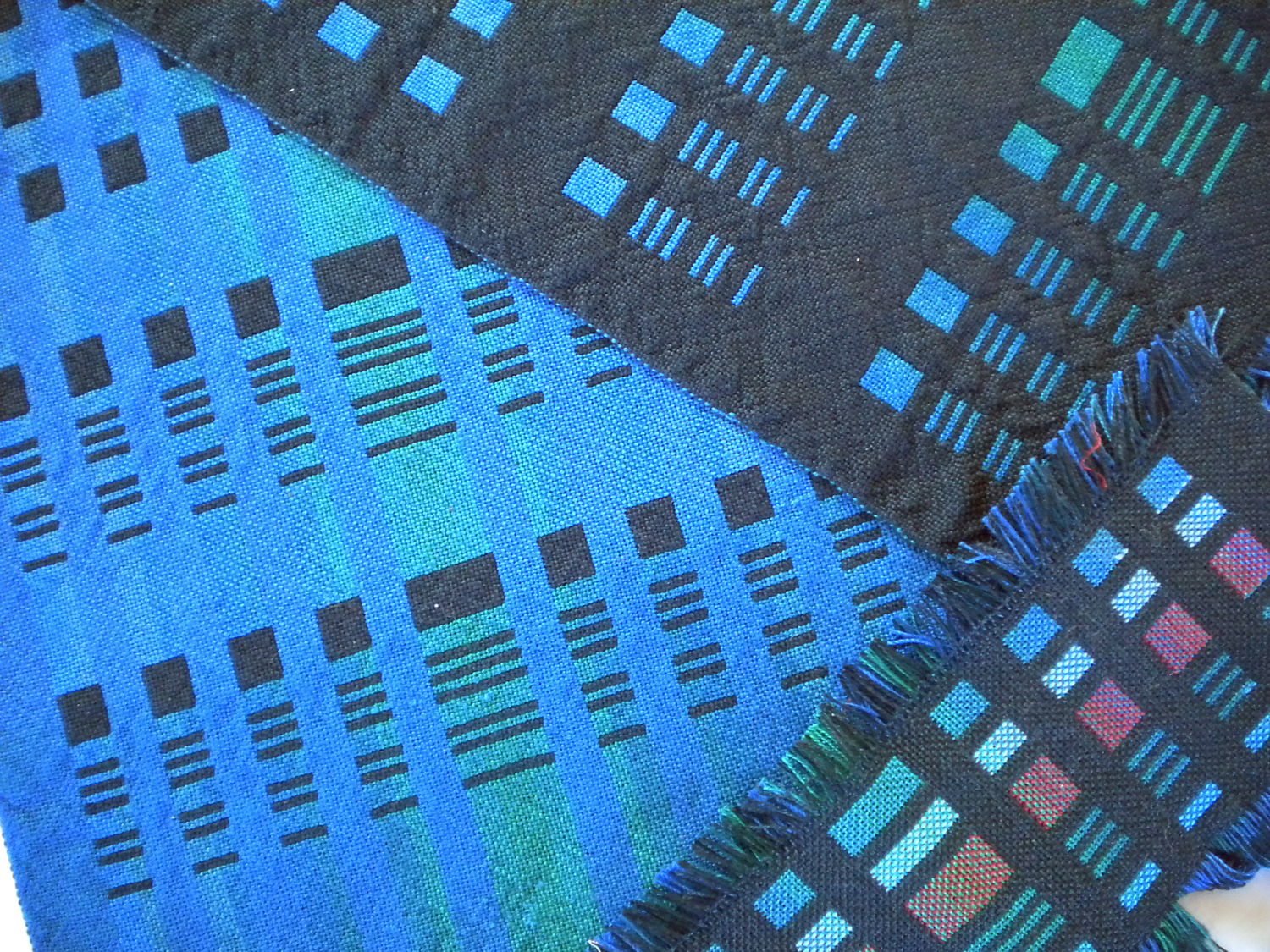
Double weave sample (lower right) and resulting runner

Double weave sample (lower right) and resulting runner

Overall I’m pleased with the result and am already winding a follow-up warp with improvements. My “light” side doesn’t have to be stripes to match block arrangements; I’m blending the light colors to see how that looks. I’m also going to sett the warp closer (48 epi for 10/2 mercerized cotton vs. 40 epi as in the first warp). And I do have to be careful about weft skips on the underside, but because this is plain weave, the repairs are not difficult. And then there’s the question of whether or not to join at the edges. I chose to join on this runner, but it puckers a little because of that, meaning one layer pulled in more. I’ll have to leave the edges open next time. An ounce of prevention…

Once I get warmed up, my plan is to expand to the draw loom. With my 20 pattern shafts, I think I can weave five pattern blocks of double weave compared to just two blocks on my 8-shaft loom. An exploration of block arrangement and manipulation is in the wings!

Juggling Projects

17 Friday Oct 2014

Posted by jeanweaves in Napkins, Placemats, Planning, Scarves

≈ 4 Comments

Tags

Handweaving, Napkins, Placemats, Projects, Scarves, Weaving, Yarn

Designing Spot Bronson

Designing Spot Bronson

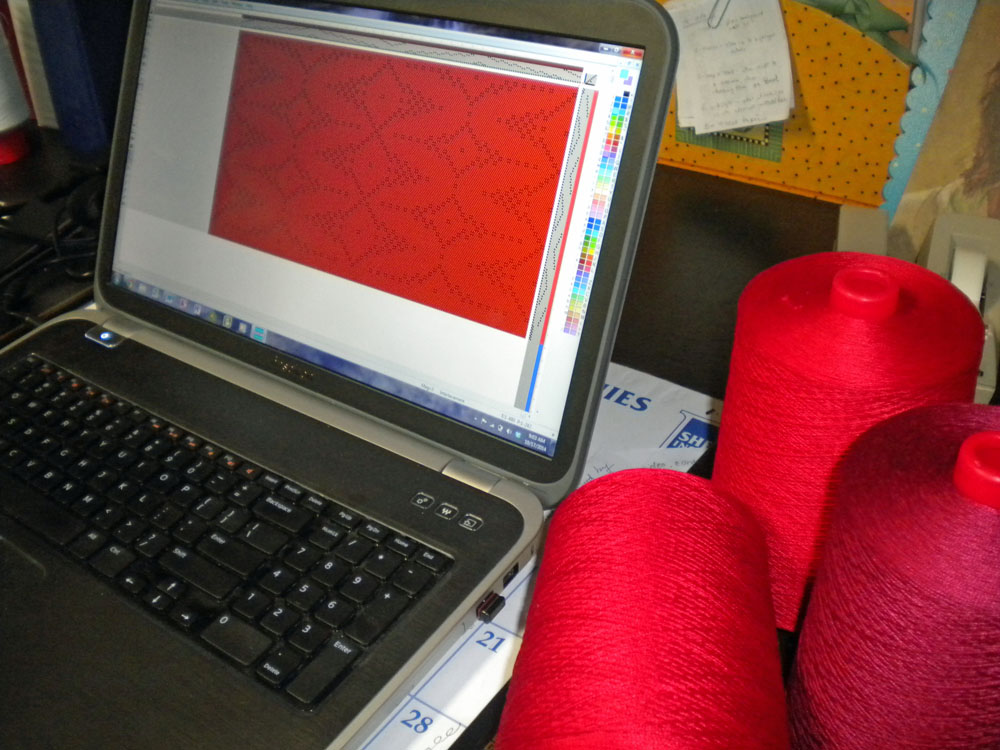
The other day, I asked a friend for some suggestions on how to design something in spot bronson, a weave that combines plain weave with spots of lace. I’m not very experienced with lace weaves and I want to make some placemats without directly using a design from a book or a magazine. I have several shades of red mercerized cotton that will shine in a spot bronson weave, so those are the colors in the draft. (That’s one project.)

Point Twill Napkins on the Loom

Point Twill Napkins on the Loom

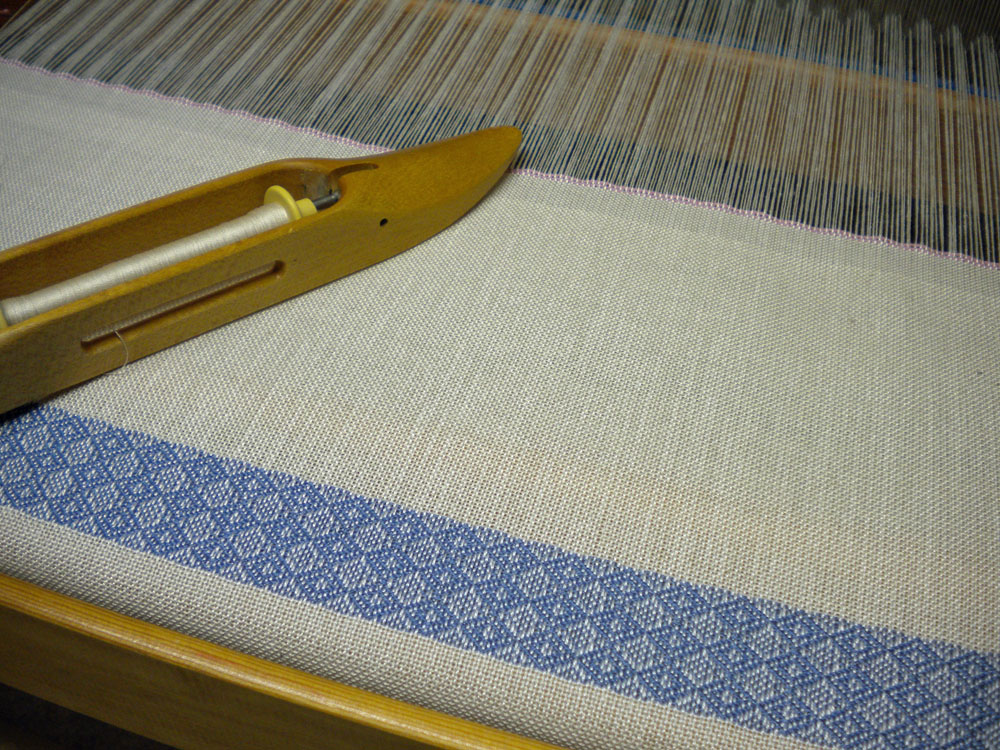
These placemats are to go with some point twill napkins I’m currently weaving. The warp has enough for 12 napkins. The first four have a blue border, but I will use red for the next ones so they will go with the placemats. (That’s two projects, although this one precedes the placemats.)

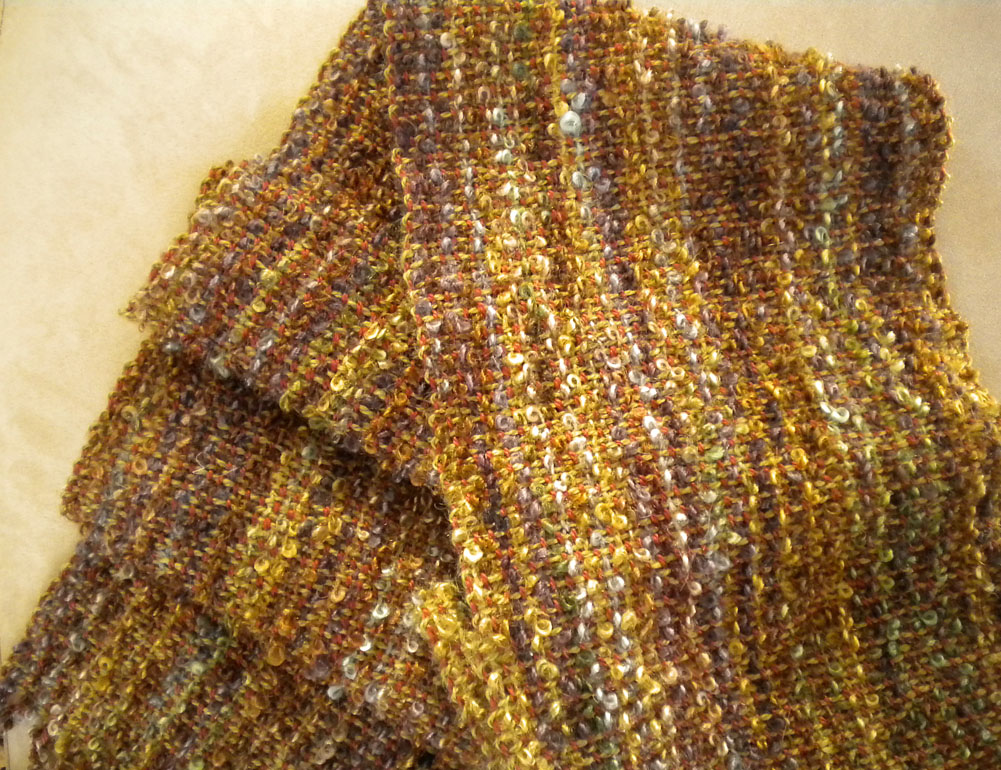
The next day when we got together, I launched in with my adventures weaving a mohair bouclé scarf. I usually weave with smooth, finer yarns and this mohair bouclé was a bit out of my comfort zone. (That’s three projects.) What happened to the spot bronson placemats? They are still in the planning stage. And the napkins are still on the loom, eight more to weave.

Mohair Bouclé Scarf in Autumn Colors

Mohair Bouclé Scarf in Autumn Colors

It seems I’m always juggling projects, each one at a different stage. There’s the planning stage, then warping, active weaving, and finally finishing.

The planning stage of a project takes lots of thought. I mull over the colors, the pattern, the yarns sometimes for several days. Then one morning, it will pull together and the project is on its way. Usually while I’m pondering, I will be weaving or finishing something else.

I learned this process from Anita Luvera Mayer, a weaving teacher and artist. She said to always have three things going at once: something being planned, something on the loom, and something in a basket waiting to be hemmed.

There will always be something to do, no matter how much — or how little — time I have. If there’s only half an hour before an appointment, I can still pick up a needle and finish a hem. If I get stiff from weaving for a long period, I can get up and wind the next warp, a process that requires lots of arm movement to loosen me up. And sometimes it’s just nice to have something different to work on. It moves each project along and keeps my perspective fresh.

This process works for me. What’s your process?

Production Weaving

26 Friday Sep 2014

Posted by jeanweaves in Planning, Weaving Inspiration

≈ 3 Comments

Tags

Creativity, Production, Textiles, Weaving

There are some weaving terms that may mean different things to different people. I think “production weaving” falls into that category.

My Weaving Goal

My Weaving Goal

Sometimes production weaving means putting on long warps to maximize weaving versus set-up time. The longer the warp, the more you can weave before you have to rethread the loom. Other times, it means weaving A LOT of one type of thing. I have come to understand production weaving as weaving with an eye toward time and cost efficiency.

I have friends who put on long warps for towels and then challenge themselves to weave every towel differently. They change the treadling. They change the weft color. They change something in each towel so that they are all related, but different. That takes some planning, but once you get going, it’s exciting to see the warp growing like a flower bed of multi-colored zinnias. And when that warp comes off the loom, it’s fun to see how all the towels work together.

Related but different towels

Related but different towels

My mother once suggested that I weave one item in several different color choices like commercial stores offer. In a way, that’s what those long warps do. They produce several different towels, but all related. However, the difference between the handwoven and the commercial towels is the weaver has the freedom to make small changes in increments, whereas textile factories set up each loom to do one thing and one thing only. Small changes cannot be made without significant effort.

Sometimes I will weave related items as sets. I intentionally combine four different but related napkins in a set. Once I wove a long warp all of different napkins and sold them individually so people could choose what they liked. Some liked this freedom. Others wanted sets of identical items.

I am working on training myself to economize on my time: longer warps, tying on when I can instead of rethreading from scratch for every warp, weaving items in batches. But in the quest to become more efficient in my production, I don’t want to sacrifice the artistry that makes handweaving stand out over commercial fabric.

When you shop, do you like to see a set that has identical members, or do you like variety in your “sets”? Tell me what attracts you.

“The Good One”

11 Thursday Sep 2014

Posted by jeanweaves in Planning, Towels, Yarn Stash

≈ 5 Comments

Tags

Color, Cotton, Handweaving, Towels

Cotton Lace Kitchen Towel

Cotton Lace Kitchen Towel

One of my sons-in-law made me laugh recently. Here’s the story.

Many years ago, more years than I’d like to admit, I decided to make Roman shades for my daughters’ room. I had some commercial fabric with red and blue flowers on a pale pink background. That was my starting point. I chose yarn to match those colors and chose lace as the weave structure. I wound the warp and started weaving, but the colors just didn’t “sing” the way I had envisioned them. Being a new weaver, I thought they would grow on me. Not so. After 11 yards, the cloth came off the loom and still, no “song.” I was so disenchanted that I folded the fabric and stowed it away. The curtains never came to be.

Fast forward to this past winter when I decided to clear some of my stash. At the time, I was thinking about using yarn that had been on the shelf too long, but my curtain fabric still haunted my linen closet.

Because I had used cotton in a lace weave, this fabric was actually a good candidate for towels. So I put scissors to fabric, cut the yardage into several towels and gave them out to my family. They aren’t pretty–the colors still don’t sing after all these years–but they work as towels.

And this is how my son-in-law made me laugh–my daughter has been using her towel and on laundry day, put it in the wash. Her husband happened to be washing up in the kitchen and looking for something to dry his hands, asked her, “Where’s the good one?”

One weaver’s failed project is another family’s “good one!”

Now I am working on towels in the same weave structure, but with colors that work much better than my original ones. Can you hear the song?

Two Trains left the station traveling in opposite directions….

07 Tuesday Jan 2014

Posted by jeanweaves in Planning, Uncategorized

≈ Leave a comment

Tags

Arithmatic, Weaving

Word problems. We all had to do them in elementary school. Some people I know can arrive at an answer before I even mentally map out what is going on. Just give me straight numbers and what you want done with them; that’s all I ask. Good old arithmetic!

I’ve been doing some arithmetic this week. I planning to weave a small table cloth. Let’s see, 48″ square sounds good. In order for the cloth to lay flat, I’ll need fine yarn. The yarns I have on hand need to be threaded 48 threads for each inch.

48″ x 48 threads per inch = 2304 threads

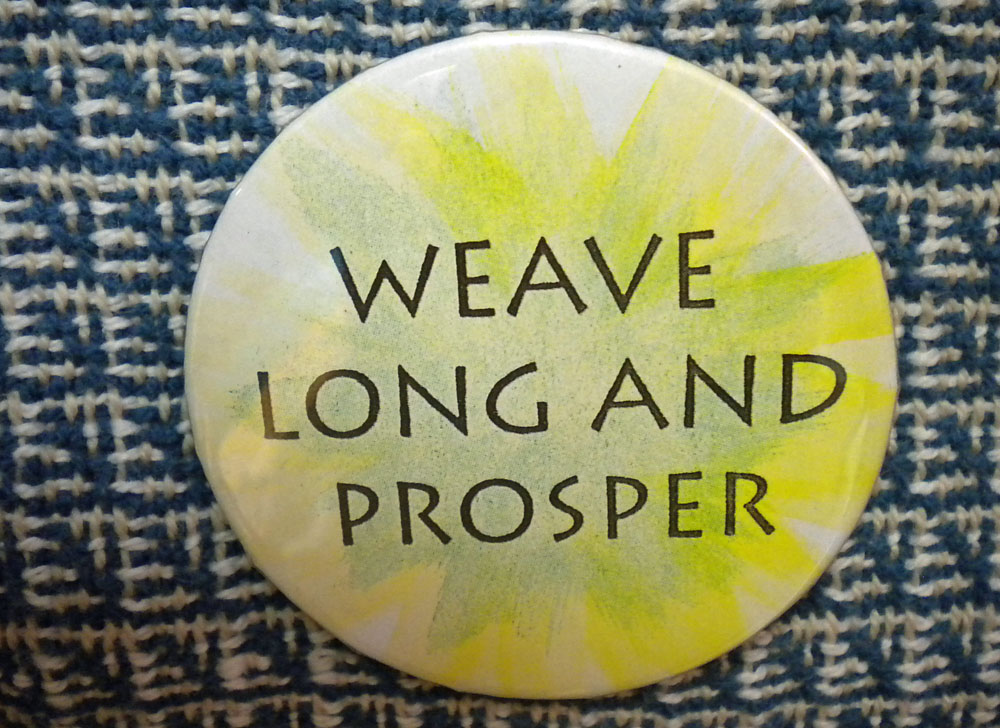
But how long do each of those threads need be? Okay, here’s a variable: If I’m going to all the trouble of threading 2304 threads, why make only one table cloth? (I have a pin from the Lunatic Fringe shop that says “Weave Long and Prosper”–sound familiar?) So in this case, I’m going to weave four table cloths. There are all sorts of conditions that come into play in planning a warp length but to cut to the chase, I’ll need 7.5 yards for each thread.

2304 threads x 7.5 yards each = 17,280 yards of warp

That’s a lot of warp! My next question is: do I have enough yarn on hand to do this? Each size of yarn has a standard weight per pound. The yarn I’m using comes to 8400 yards per pound. How many pounds will I need?

17,280 / 8400 = 2.057 pounds

But this is just for the warp, the threads that travel lengthwise from the front to the back of the loom. What about the weft, the yarn that crosses the warp? That, too, is variable and depends on how hard I beat it in and how much the woven cloth draws in, but a good guess would be to estimate the same amount of yarn for the weft as for the warp. So now how much yarn will I need?

2.057 x 2 = 4.114 pounds of yarn.

Good old arithmetic!


Happy New Year!

28 Saturday Dec 2013

Posted by jeanweaves in Planning, Uncategorized, Weaving Inspiration, Yarn Stash

≈ Leave a comment

Tags

Weaving, Yarn

I hope all of you have had a joyful and peaceful holiday season with those you love. In our house, the holidays continue through January 6, so I’m still breathing balsam scent and eating cookies. The thoughts of what projects to start next are just tickling the back of my mind.

As I think about what to put on my looms next, the supply in house is the obvious place to start. January is a good time to look at the stash, those drawers and shelves of yarn that sparked my interest sometime in the past and now await fulfillment. How can I creatively combine the colors and fibers? What patterns will let those hues shine?

Among the cones I have purchased are others that I have inherited from weavers moving on to other things. Sometimes these yarns just don’t fit my style anymore and have languished on the shelf for who knows how long. If you have some of these, consider donating them to a local craft studio and fellow weaver. Maybe someone else is looking for just that fiber to finish a fabulous project.

Whatever your next project is, I wish you happy creating, and a Happy New Year! May you have a healthy and fiber-filled 2014!

Newer posts →
Shop!

Follow Us

  • Facebook

Galleries

  • Towels to Use and to Give
  • Runners
  • Scarves for Him and Her
  • For the Table
  • Note Cards
  • Animals
  • Throws
  • The Linen Press
  • Privacy Policy

Subscribe

  • RSS - Posts
  • RSS - Comments

Archives

  • September 2020 (2)
  • October 2019 (1)
  • August 2019 (1)
  • July 2019 (2)
  • June 2019 (2)
  • March 2019 (1)
  • November 2018 (2)
  • September 2018 (1)
  • July 2018 (2)
  • May 2018 (2)
  • April 2018 (1)
  • February 2018 (2)
  • January 2018 (1)
  • December 2017 (1)
  • November 2017 (2)
  • October 2017 (3)
  • August 2017 (1)
  • July 2017 (1)
  • June 2017 (2)
  • May 2017 (2)
  • March 2017 (2)
  • February 2017 (2)
  • January 2017 (2)
  • December 2016 (1)
  • November 2016 (1)
  • October 2016 (2)
  • August 2016 (3)
  • June 2016 (1)
  • May 2016 (1)
  • March 2016 (2)
  • February 2016 (1)
  • January 2016 (1)
  • December 2015 (1)
  • November 2015 (3)
  • October 2015 (1)
  • September 2015 (4)
  • August 2015 (1)
  • July 2015 (2)
  • June 2015 (1)
  • May 2015 (1)
  • April 2015 (2)
  • March 2015 (2)
  • February 2015 (2)
  • January 2015 (2)
  • December 2014 (1)
  • November 2014 (3)
  • October 2014 (1)
  • September 2014 (2)
  • August 2014 (1)
  • July 2014 (3)
  • June 2014 (1)
  • May 2014 (2)
  • April 2014 (2)
  • March 2014 (2)
  • February 2014 (2)
  • January 2014 (2)
  • December 2013 (2)
  • November 2013 (1)
  • October 2013 (1)
  • September 2013 (3)
  • August 2013 (1)

Create a free website or blog at WordPress.com.

Privacy & Cookies: This site uses cookies. By continuing to use this website, you agree to their use.
To find out more, including how to control cookies, see here: Cookie Policy
  • Subscribe Subscribed
    • jeanweaves
    • Join 62 other subscribers
    • Already have a WordPress.com account? Log in now.
    • jeanweaves
    • Subscribe Subscribed
    • Sign up
    • Log in
    • Report this content
    • View site in Reader
    • Manage subscriptions
    • Collapse this bar
 

Loading Comments...