• Home
  • Shop
  • About
  • Exhibits
  • Contact me

jeanweaves

~ Jean Williams, Handweaver

jeanweaves

Tag Archives: Craft History

What Goes Around…

12 Wednesday Aug 2015

Posted by jeanweaves in Craft History, Towels, Weaving Inspiration

≈ 2 Comments

Tags

Craft History, Early American Weaving, Towels

Red Cotton Towel woven "as drawn in."

Red Cotton Towel woven “as drawn in.”

You know the old saying : What goes around, comes around.  This is certainly true in weaving, but I can always learn more from early weavers.

For some time, I have belonged to the Early Weaving Books and Manuscripts study group through Complex Weavers. Through the years, members of this group have worked to find and preserve old weaving drafts and manuscripts. The eastern United States had quite a number of professional weavers in its early days and they often kept account books, recording not only what they charged for weaving, spinning, and dying, but also often their patterns. Apprentices began their studies by copying their masters’ draft books, sometimes even including doodles in the margins. These manuscripts are treasured when they are found. And often, they are digitized so others can study and weave them.

Handweaving.net is a wonderful archive of over 60,000 weaving drafts and documents, many of which are public domain according to the site. I can get lost browsing through these patterns; they offer a glimpse into what weavers were doing 100 or more years ago.
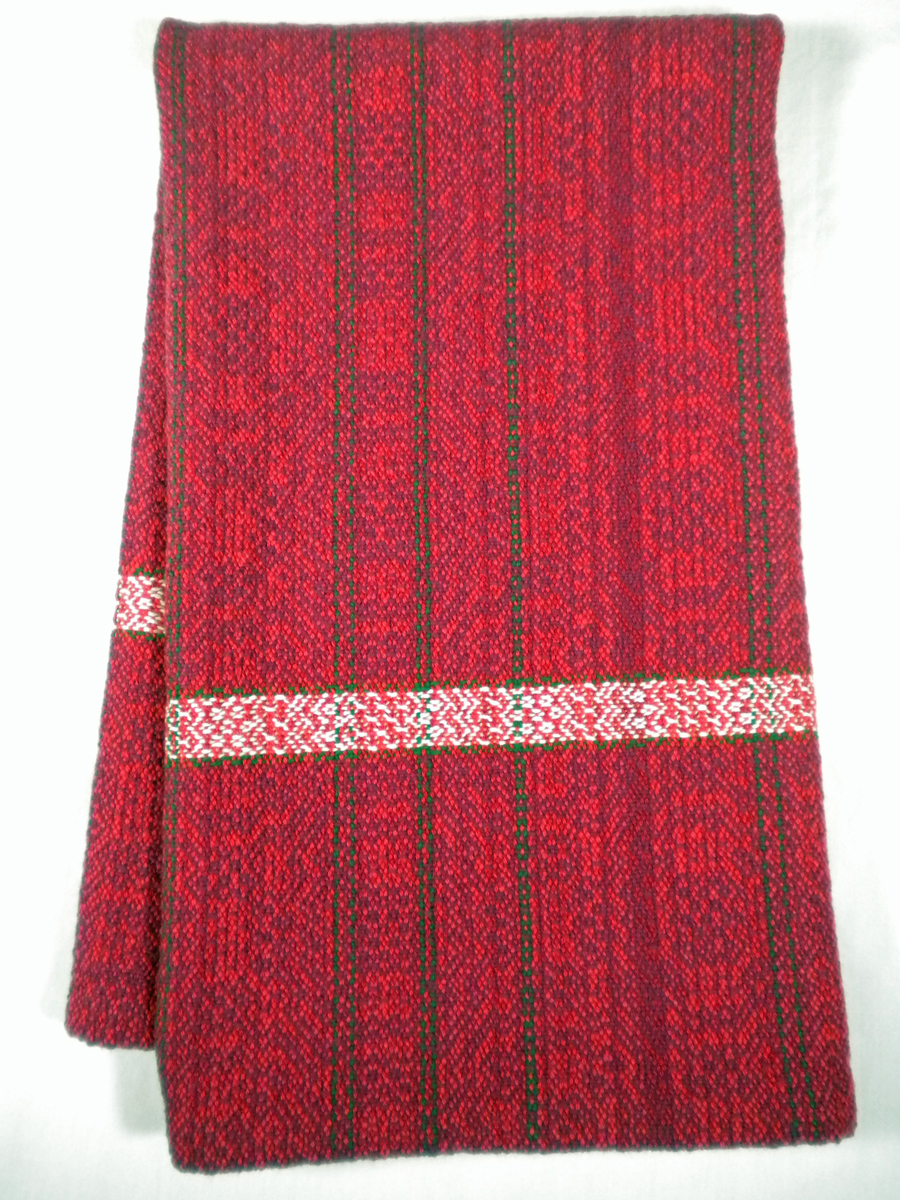
Red and Plum Towel woven "as drawn in."

Red and Plum Towel woven “as drawn in.”

And these drafts do take study. Weaving notation is pretty consistent now, but early weavers had their own notation conventions and it isn’t always apparent to us in the 21st century what the weaver of the 1700’s meant by his marks. Does the pattern go from left to right, or right to left? Does the first line represent the closest shaft or the farthest? Many times, all that is shown is more like a musical staff than a pattern, a set of horizontal lines with a series of tick marks. Sometimes there is a tie-up, many times not. Rarely are there any directions on the treadling.

This is what makes these early drafts fascinating.

I particularly like the fancy twills that often show up in these old manuscripts. I picked one from the Jacob Snavely manuscript for my recent towel warp. It’s called variously Ms and Ws, or hin und wieder. I’m told that’s German for “back and forth” which is really quite descriptive of the motifs. They are characterized by fancy diamonds within diamonds, crosses, and stars.

Tangerine and Reg Towel woven in point twill.

Tangerine and Reg Towel woven in point twill.

The draft I picked was just a series of lines over lines, but it did have a tie-up included. After making some adjustments to suit my taste and yarn, I had to decide how to treadle this draft. Often these old drafts were treadled in the same order as they were threaded (woven “as drawn in” or “trompt as writ”). But there are other possibilities. In some of my towels, I did weave as drawn in, but in the orange one, I treadled a simpler point – just back and forth. Both designs are pleasing.

Now the warp is off the loom, but I don’t want to leave the design just yet. I’m in the process of tying on another warp so I can play some more. This new warp will feature blue, rose, and natural. We’ll see how far I can go with this early draft.
Old Books, New Friends

21 Wednesday Jan 2015

Posted by jeanweaves in Craft History, Weaving Inspiration

≈ 3 Comments

Tags

Craft History, Swedish History, Weaving, Weaving Books

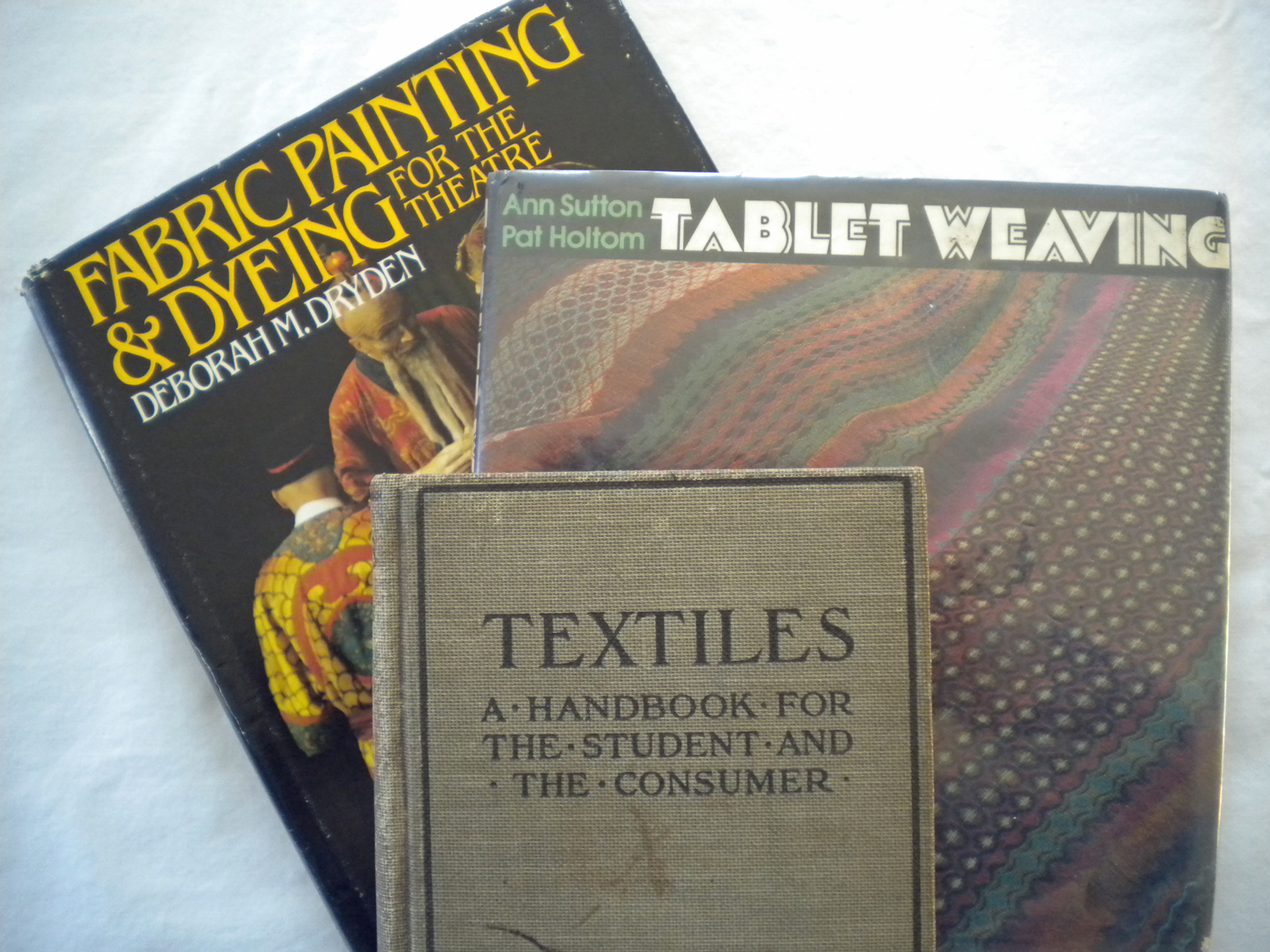
Old books, new friends

Old books, new friends

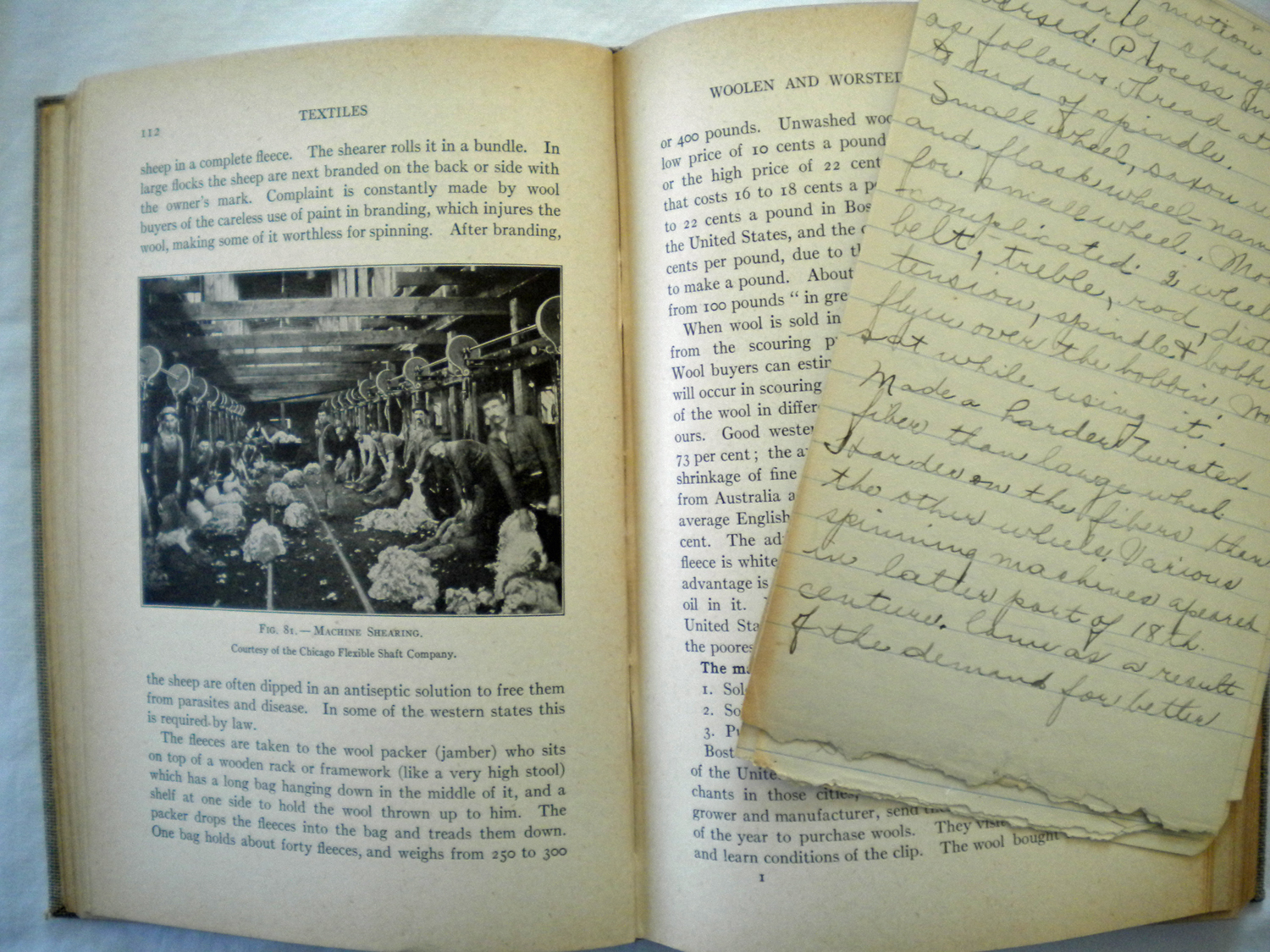
I love old books! It’s a trait I get from my mother, who loves nothing better than browsing through the thrift store book bins, looking for treasures. Whenever she finds anything remotely related to weaving, she picks it up for me. Sometimes these finds introduce me to different techniques, like the Ann Sutton/Pat Holtom classic Tablet Weaving. Sometimes it’s just a really old book that looks interesting, like the 1917 edition of Textiles: A Handbook for the Student and the Consumer by Wollman and McGowan complete with somebody’s handwritten class notes. She got that one for $1.00.

1917 Textiles book with notes

1917 Textiles book with notes

I can get lost in these books, skimming the yellowed pages and trying to figure out the convoluted sentence structure and arcane references to equipment long out of use. But the study is worth it. There are skills these weavers used that we’ve forgotten and I want to glean everything I can from these early teachers.

This past Christmas, I acquired two “new” old books. Our guild’s holiday party includes a gift exchange and I was gifted with Fabric Painting and Dyeing for the Theatre by Deborah M. Dryden (thank you, Patti!), a 1981 study of fabric manipulation for theatre productions. Fascinating what can be done!

Then on Christmas morning, my husband gave me the 1956 edition of Manual of Swedish Hand Weaving by Ulla Cyrus. This is a classic!

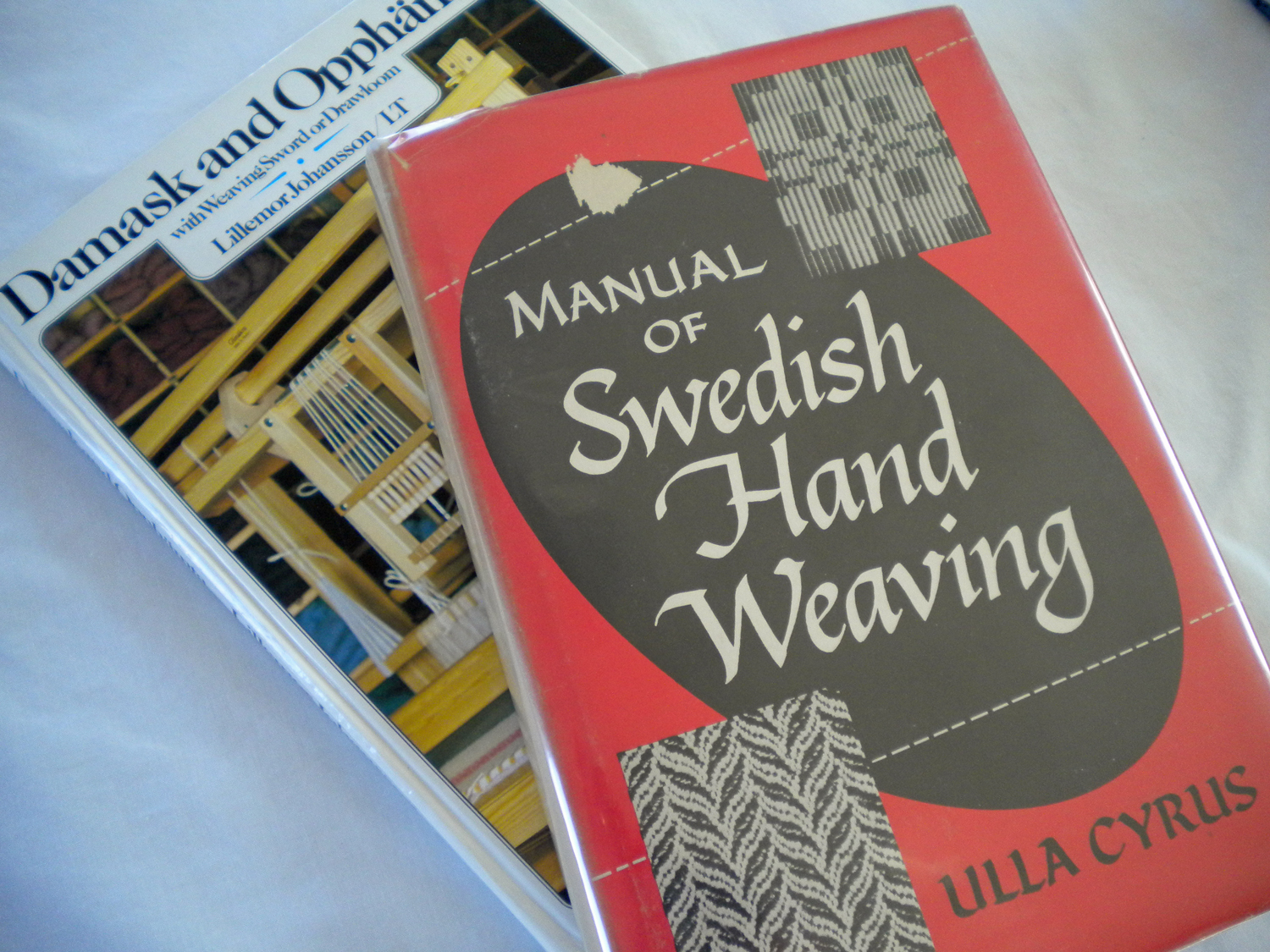
Swedish weaving classics

Swedish weaving classics

When I bought my Swedish loom in 1993, there were two books experienced weavers recommended: Damask and Opphämta by Lillemor Johansson and Manual of Swedish Hand Weaving by Ulla Cyrus-Zetterström. Johansson’s book quickly joined my library; the step-by-step instructions for damask weaving guided me through many a warp. However,  the Manual of Swedish Hand Weaving was out of print. So I waited. Good books are often reprinted at some point. Now my wait is over. I have a new friend!

Since Christmas, I have been poring over the pages of this early edition, deciphering the details of weave structures and studying techniques I’ve practiced without understanding. (I admit to being able to follow a “recipe” without understanding the basis for it.) I hope to glean new understanding as I study this classic further.

Loom Envy

02 Wednesday Jul 2014

Posted by jeanweaves in Craft History, Looms, Terminology

≈ Leave a comment

Tags

Craft History, Early American Weaving, Loom, Weaving

Many years ago, I heard a well-known weaver speaking at a conference. He joked that whenever he wanted to change threadings, he just went out and bought another loom. At least I thought he was joking and all us in the audience laughed with him. But now I wonder if, indeed, he was just being honest.

You see one of the most time-consuming tasks of weaving is threading the loom. Each thread has to go through a heddle and a dent (a slot) in the reed (the beater). Patterns weaves like damask and double go through two heddles and the reed. Some warps have hundreds of threads. So for that conference speaker, it was more cost-effective to buy another loom than to keep rethreading every time he needed to change patterns. I don’t think I can make the same argument.

One alternative is to put on very long warps. For me, “very long” is defined as 20 yards. One of my friends routinely puts on 21 yards. Some weavers put on 50 or more yards. The longer the warp, the more fabric you can weave before you have to re-thread.  But what if I get bored with the pattern after 10 yards and there are 20 more to go? What if I get an order for something that needs that width, but there are 20 more yards to weave before I can change warps?

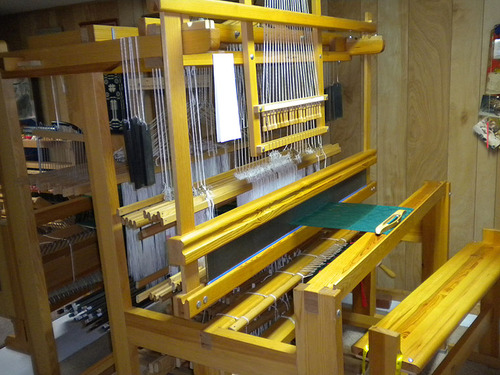
Loom threaded with damask, using drawloom shafts.

Loom threaded with damask, using drawloom shafts.

Earlier weavers had a solution for this. Their looms had pieces that could be interchanged. There are references in their records to “gears” which controlled the pattern. When they needed to weave an overshot coverlet, they put that “gear” into the loom frame and tied on a new warp. If they needed to weave dimity, they stalled that “gear.” So it sounds like they had a limited number of loom frames and multiple “gears” to weave the various patterns they offered.

I’ve tried to imagine what these gears were. I have an antique Newcomb loom which has a cast-iron device that changes the shed and advances the warp every time the beater is pulled. Is this what they are talking about? If so, it would be pretty heavy to change out when a new order came in. Or are they referring to the actual shafts with heddles? I can see bundling my threaded shafts and carefully rolling them up to preserve a threading, but it would work better if I kept the threads in the reed and bundled the reed with the shafts. That requires extra reeds.

All this discussion is really an attempt on my part to fend off “loom envy.” For the past year, I’ve vacillated about getting another loom. I’ve pretty much decided that it’s not necessary, but there are times when I really could use another wide loom. A girl can dream!

Crafts Yesterday and Today

23 Friday May 2014

Posted by jeanweaves in Craft History, Tatting

≈ Leave a comment

Tags

Craft History, Piecework Magazine, Tatting, Weaving

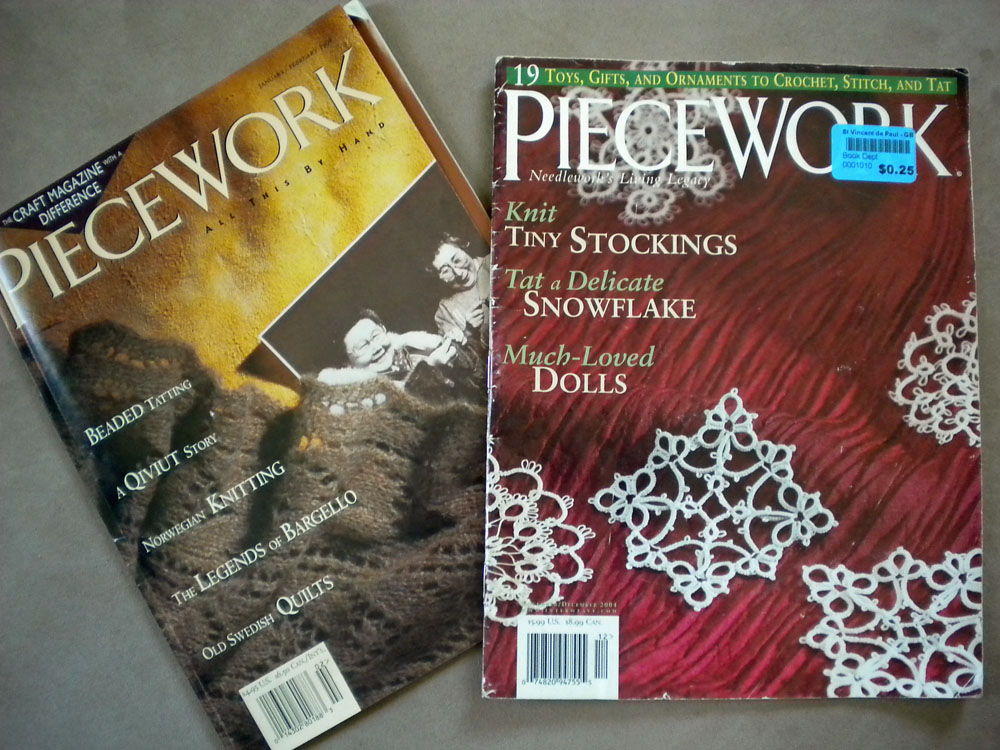
My parents visited this past week and as usual, we enjoyed many conversations revolving around our UFOs (unfinished objects), current projects, and things we will get to one of these days. Mom patrols used book stores and thrift shops and came across some old Piecework magazines. This is a wonderful publication, covering every kind of needlework from around the world and giving the history to go with the projects. When she finished with these back issues, she passed them along to me.

Piecework Magazine Jan/Feb 1996 (left) and Nov/Dec 2004 (right)

Piecework Magazine Jan/Feb 1996 (left) and Nov/Dec 2004 (right)

I was delighted to see articles on tatting to follow up on my recent exploration of that craft. One even describes threading small beads into the tatting—now there’s something I have got to try!

But something else is intriguing in these back issues. Since I started reading the magazine, knitting has featured prominently in the projects—knitted lace, knitted mittens, knitted sweaters. These older issues do have knitting, but counted cross stitch is a central technique—embroidered yokes, embroidered ornaments, embroidered samplers—and more quilting than appears now.

Handwork is fluid. Crafts ebb and flow in popularity. When my grandmother told me that tatting was a dying art, little did she suspect that within 20 years, it would experience a resurgence. In the 60’s, 70’s, and 80’s, weaving and spinning were very popular. Many of us who are weaving now, learned then. In the past 10 years, though, it seems like there are fewer of us actively weaving and fewer weaving publications. Give it time though. Weaving is an ancient skill and those of us still weaving keep sharing what we know so that future generations can join the web in their own time.

Shop!

Follow Us

  • Facebook

Galleries

  • Towels to Use and to Give
  • Runners
  • Scarves for Him and Her
  • For the Table
  • Note Cards
  • Animals
  • Throws
  • The Linen Press
  • Privacy Policy

Subscribe

  • RSS - Posts
  • RSS - Comments

Archives

  • September 2020 (2)
  • October 2019 (1)
  • August 2019 (1)
  • July 2019 (2)
  • June 2019 (2)
  • March 2019 (1)
  • November 2018 (2)
  • September 2018 (1)
  • July 2018 (2)
  • May 2018 (2)
  • April 2018 (1)
  • February 2018 (2)
  • January 2018 (1)
  • December 2017 (1)
  • November 2017 (2)
  • October 2017 (3)
  • August 2017 (1)
  • July 2017 (1)
  • June 2017 (2)
  • May 2017 (2)
  • March 2017 (2)
  • February 2017 (2)
  • January 2017 (2)
  • December 2016 (1)
  • November 2016 (1)
  • October 2016 (2)
  • August 2016 (3)
  • June 2016 (1)
  • May 2016 (1)
  • March 2016 (2)
  • February 2016 (1)
  • January 2016 (1)
  • December 2015 (1)
  • November 2015 (3)
  • October 2015 (1)
  • September 2015 (4)
  • August 2015 (1)
  • July 2015 (2)
  • June 2015 (1)
  • May 2015 (1)
  • April 2015 (2)
  • March 2015 (2)
  • February 2015 (2)
  • January 2015 (2)
  • December 2014 (1)
  • November 2014 (3)
  • October 2014 (1)
  • September 2014 (2)
  • August 2014 (1)
  • July 2014 (3)
  • June 2014 (1)
  • May 2014 (2)
  • April 2014 (2)
  • March 2014 (2)
  • February 2014 (2)
  • January 2014 (2)
  • December 2013 (2)
  • November 2013 (1)
  • October 2013 (1)
  • September 2013 (3)
  • August 2013 (1)

Create a free website or blog at WordPress.com.

Privacy & Cookies: This site uses cookies. By continuing to use this website, you agree to their use.
To find out more, including how to control cookies, see here: Cookie Policy
  • Subscribe Subscribed
    • jeanweaves
    • Join 62 other subscribers
    • Already have a WordPress.com account? Log in now.
    • jeanweaves
    • Subscribe Subscribed
    • Sign up
    • Log in
    • Report this content
    • View site in Reader
    • Manage subscriptions
    • Collapse this bar
 

Loading Comments...