• Home
  • Shop
  • About
  • Exhibits
  • Contact me

jeanweaves

~ Jean Williams, Handweaver

jeanweaves

Tag Archives: Weaving

Loom Maintenance Day

05 Thursday Feb 2015

Posted by jeanweaves in Looms

≈ 4 Comments

Tags

Loom, Weaving

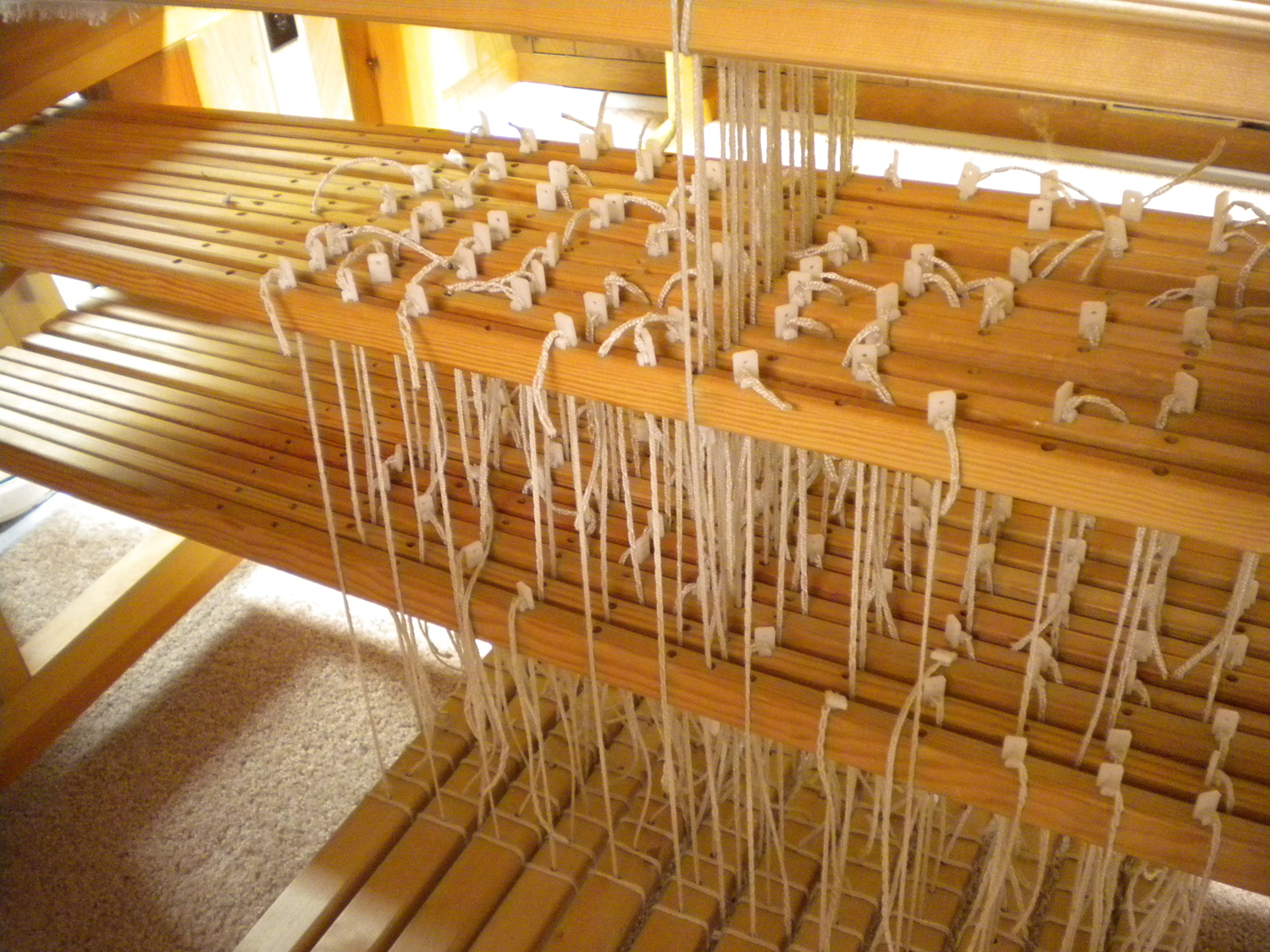
Top and bottom lamms on the countermarche

Top and bottom lamms on the countermarche

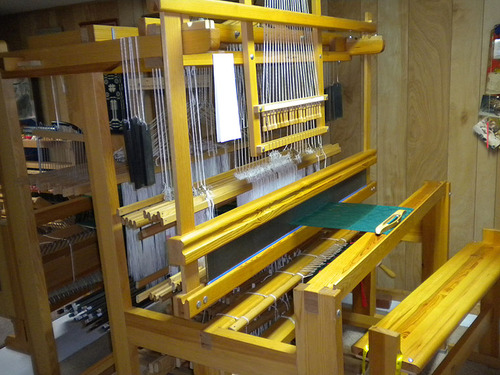
I just took warps off of both of my looms. Usually I try to alternate so that I always have a project in progress. There’s an old saying about not leaving a naked loom. However, I’ve been noticing squeaks and creaks in my looms that I hadn’t heard before. So this break is a great time for a “loom maintenance day.”
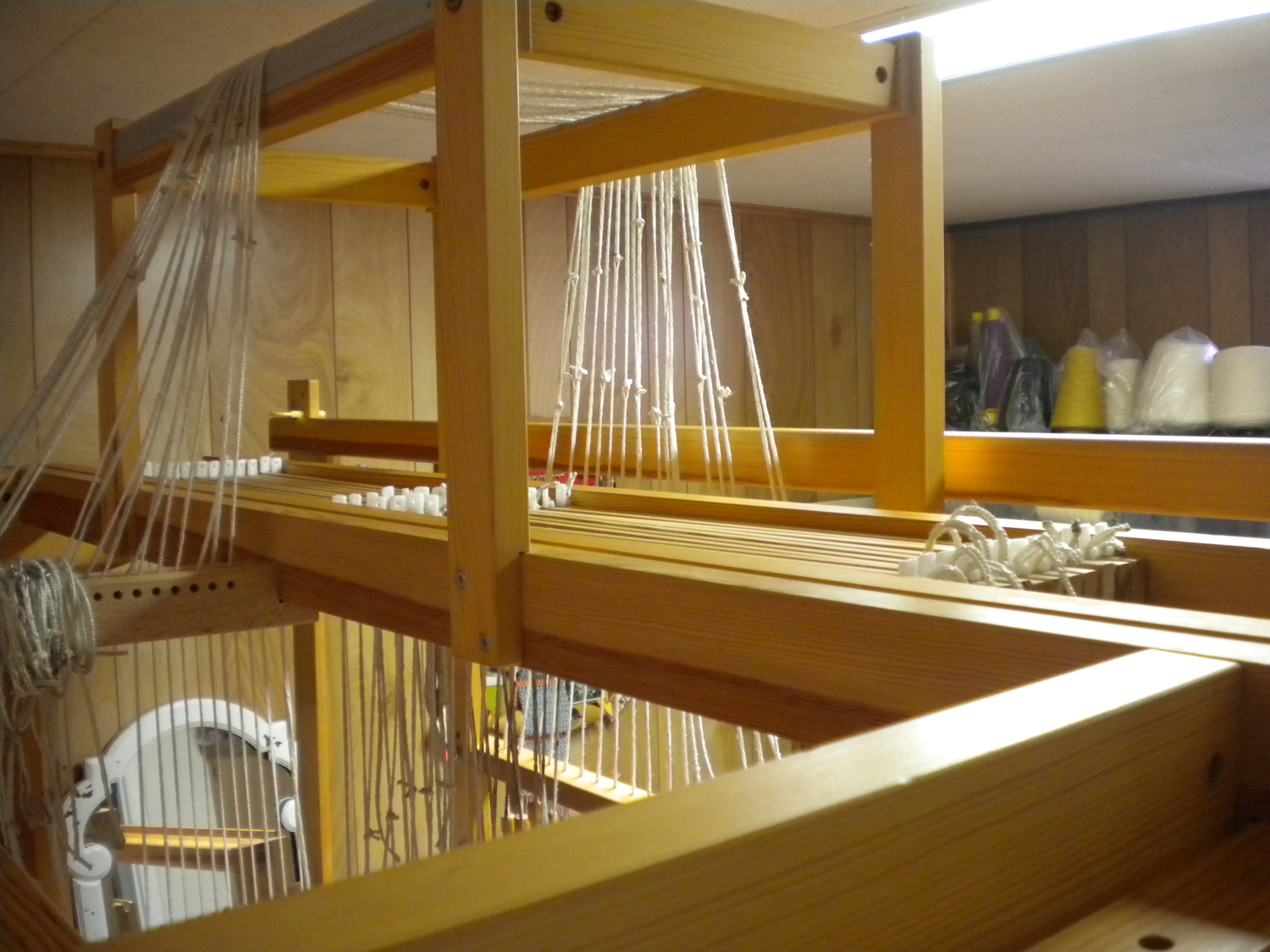
The top of the countermarche, from the back.


Looms are pretty amazing machines. There are many moving parts other than the shafts themselves. There are also the treadles, the lamms and jacks which make the shafts move. The cloth beam and the warp beam also move, just not as much. And like all machines with moving parts, you have to lubricate them from time to time. Most looms are also constructed of wood and wood needs “feeding”, especially in the winter when the air tends to be drier.
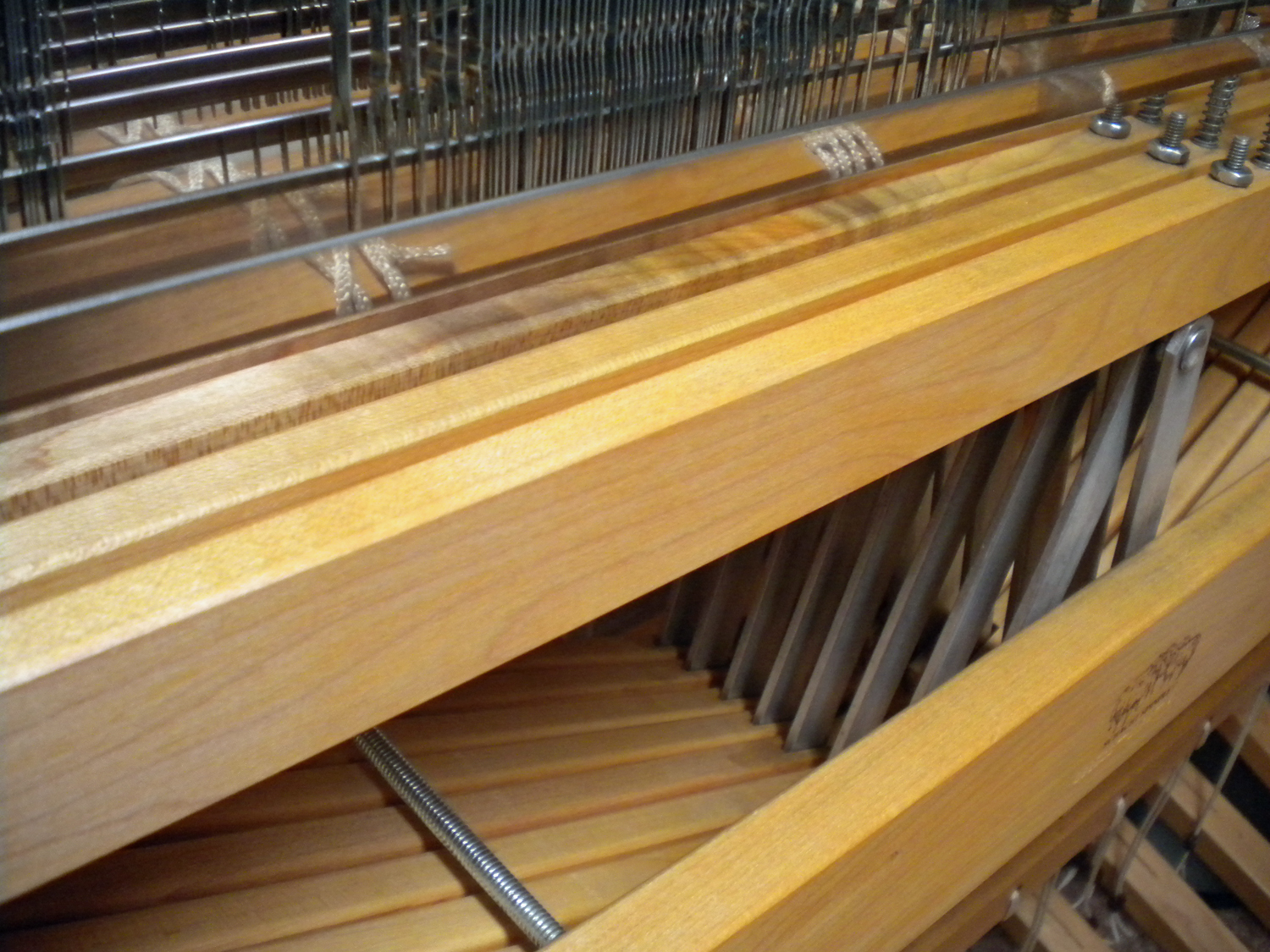
The jacks on the Baby Wolf

The jacks on the Baby Wolf

A couple years ago, Tom Knisely, the general manager and weaving instructor at the Mannings in Pennsylvania, came out with a video on this very topic:  “Loom Owners Companion.” He covers several different types and makes of looms, discusses how they work and how to keep them working well. It’s a great resource for anyone looking into getting a loom, but also good for those of us who need to keep our looms working well.
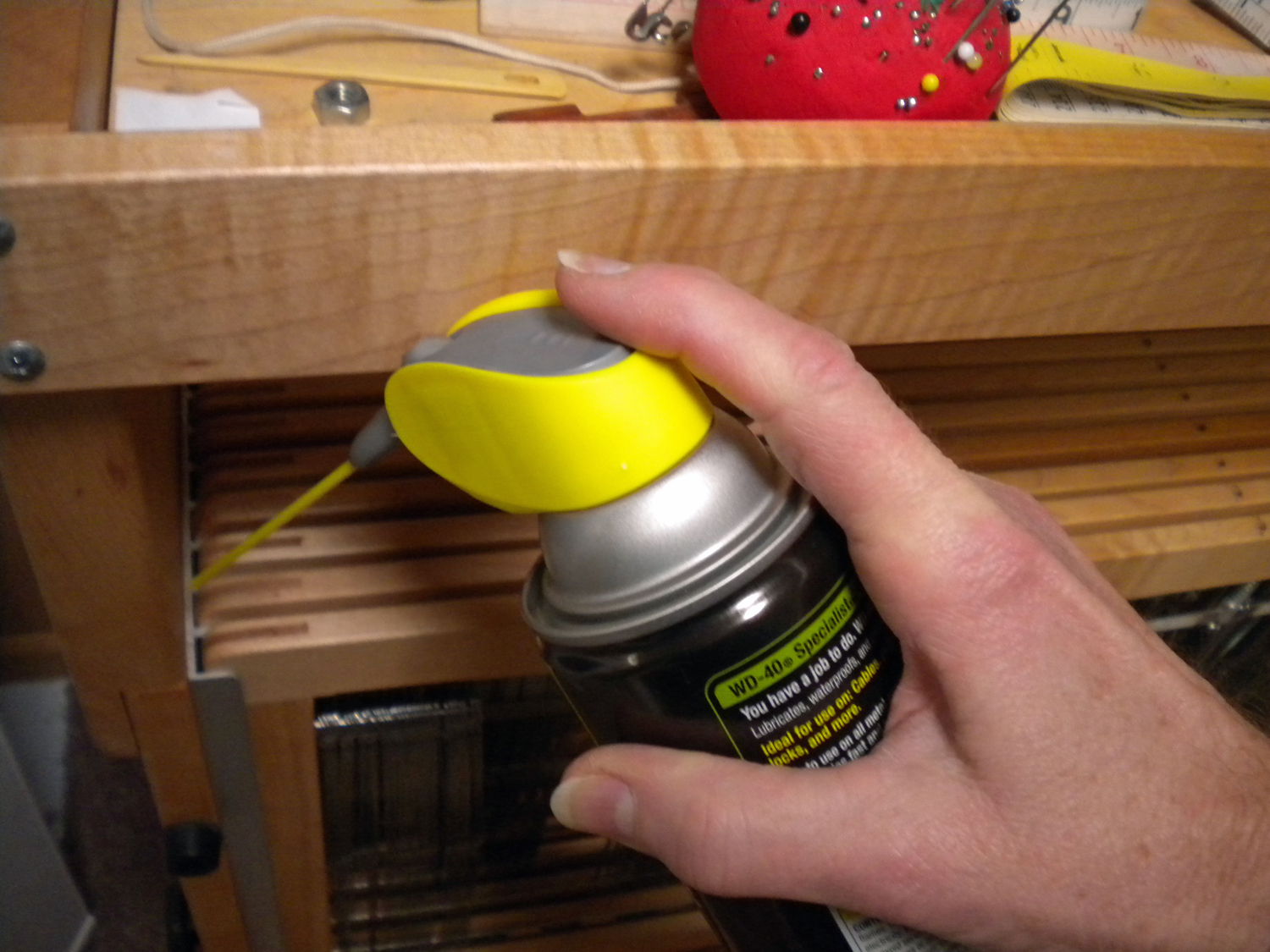
Lubricating the shaft channels

Lubricating the shaft channels

First step is to vacuum thoroughly in and around the working parts of the loom. I’m not talking just about the floor – that does get cleaned regularly—but inside the moving parts, between the shafts, by the lamms, over the jacks. It’s amazing how much lint accumulates inside a loom! Once the loose lint is removed, I can get to the joints and lubricate them. Following Tom’s suggestion, I use a silicon spray on the metal parts, especially where the shafts move up and down regularly on the small loom. Then I tighten all the nuts and bolts. Finally, I clean the wood and give it a good rub-down.
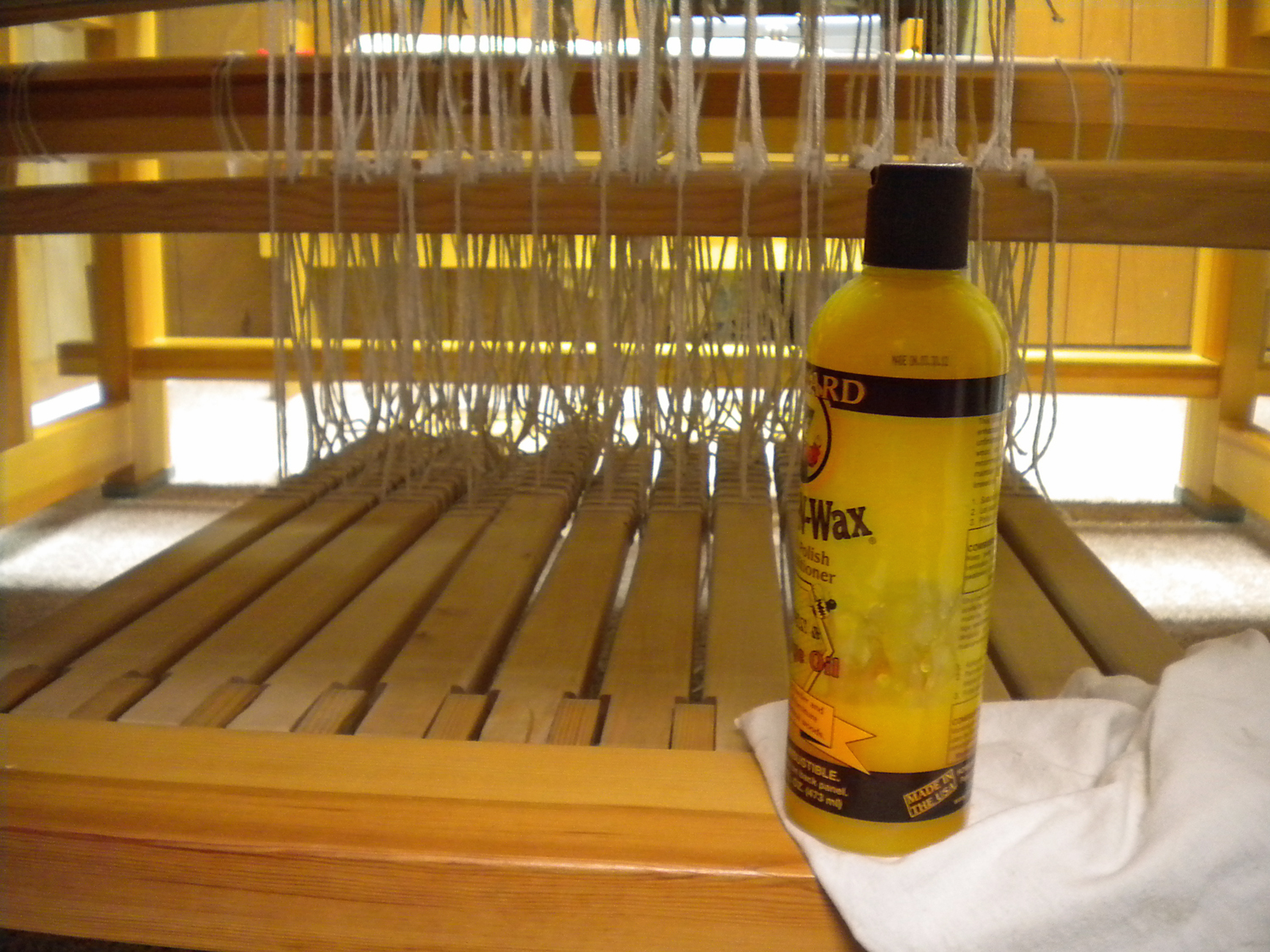
Feeding the wood

Feeding the wood

Now that I’ve cleaned and polished both of my “babies”, I’m ready for the next warps. With a little TLC once in a while, I hope my looms weave smoothly for many years to come.


Old Books, New Friends

21 Wednesday Jan 2015

Posted by jeanweaves in Craft History, Weaving Inspiration

≈ 3 Comments

Tags

Craft History, Swedish History, Weaving, Weaving Books

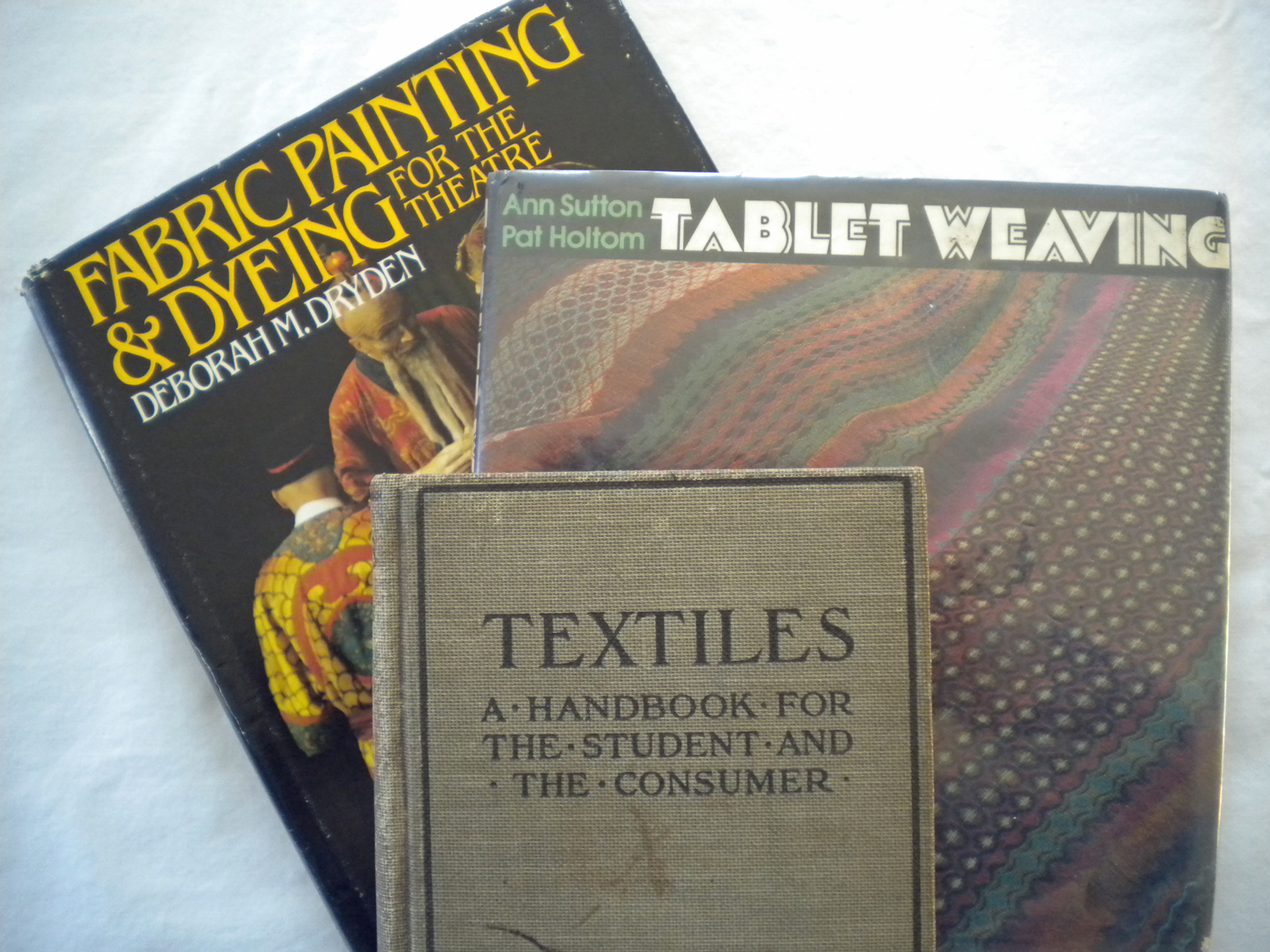
Old books, new friends

Old books, new friends

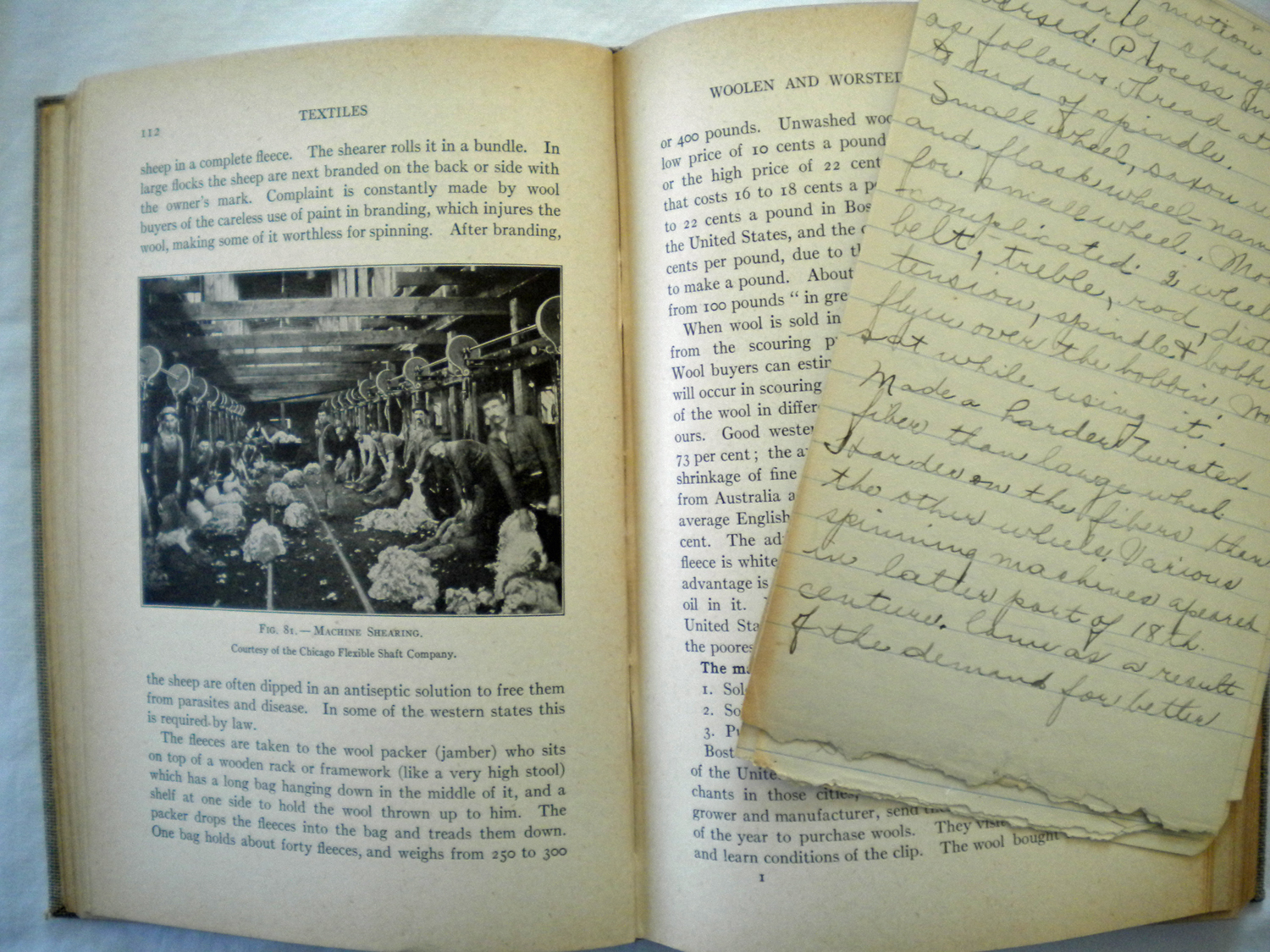
I love old books! It’s a trait I get from my mother, who loves nothing better than browsing through the thrift store book bins, looking for treasures. Whenever she finds anything remotely related to weaving, she picks it up for me. Sometimes these finds introduce me to different techniques, like the Ann Sutton/Pat Holtom classic Tablet Weaving. Sometimes it’s just a really old book that looks interesting, like the 1917 edition of Textiles: A Handbook for the Student and the Consumer by Wollman and McGowan complete with somebody’s handwritten class notes. She got that one for $1.00.

1917 Textiles book with notes

1917 Textiles book with notes

I can get lost in these books, skimming the yellowed pages and trying to figure out the convoluted sentence structure and arcane references to equipment long out of use. But the study is worth it. There are skills these weavers used that we’ve forgotten and I want to glean everything I can from these early teachers.

This past Christmas, I acquired two “new” old books. Our guild’s holiday party includes a gift exchange and I was gifted with Fabric Painting and Dyeing for the Theatre by Deborah M. Dryden (thank you, Patti!), a 1981 study of fabric manipulation for theatre productions. Fascinating what can be done!

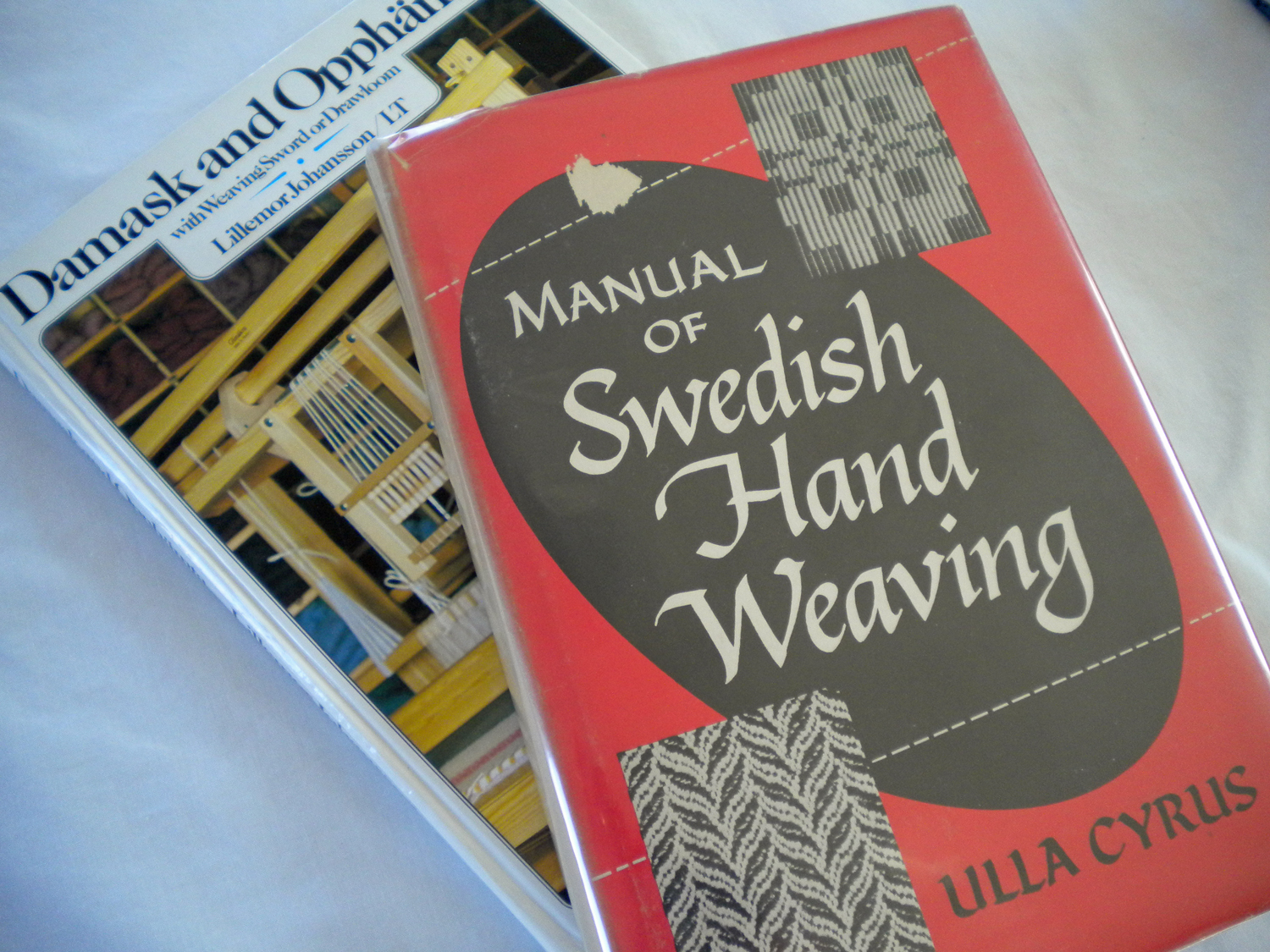
Then on Christmas morning, my husband gave me the 1956 edition of Manual of Swedish Hand Weaving by Ulla Cyrus. This is a classic!

Swedish weaving classics

Swedish weaving classics

When I bought my Swedish loom in 1993, there were two books experienced weavers recommended: Damask and Opphämta by Lillemor Johansson and Manual of Swedish Hand Weaving by Ulla Cyrus-Zetterström. Johansson’s book quickly joined my library; the step-by-step instructions for damask weaving guided me through many a warp. However,  the Manual of Swedish Hand Weaving was out of print. So I waited. Good books are often reprinted at some point. Now my wait is over. I have a new friend!

Since Christmas, I have been poring over the pages of this early edition, deciphering the details of weave structures and studying techniques I’ve practiced without understanding. (I admit to being able to follow a “recipe” without understanding the basis for it.) I hope to glean new understanding as I study this classic further.

New Year, Revisiting Old Techniques

16 Friday Jan 2015

Posted by jeanweaves in Doubleweave, Planning, Weaving Inspiration

≈ Leave a comment

Tags

creative inspiration, Double Weave, Handwoven Magazine, Table Runners, Weaver's, Weaving

January holds all sorts of possibilities. Old deadlines are past and there’s time now to consider more carefully what goes on the loom rather than assuming it will be another towel run. This is a great time to revisit those weave structures that I don’t get to work on usually.

Last January I sampled some Finn weave and figured double weave. That was a small project just to see if I could do it. But all through the year, a thought was niggling at the back of my mind: what if I set up the draw loom for double weave? I’ve done it before, although it’s been many years ago. Can I do it again?

Double weave articles abound in Weaver's and Handwoven.

Double weave articles abound in Weaver’s and Handwoven.

The first step for now was to review what resources I have on double weave. I have many back issues of Weaver’s and Handwoven. “Colonial Double Weave” by Madelyn Van der Hoogt in Weaver’s Issue 12 has great cross-section drawings of what the threads are actually doing and how to weave an overshot pattern as double weave. Then Weaver’s Issue 17 has several articles on double weave color and design. Weaver’s Issue 32 has articles by Bonnie Inouye and Doramay Keasbey on manipulating double weave drafts. And the November/December 2011 Handwoven has an article by Judith Yamamoto and Patricia Stewart on two different takes of one draft.

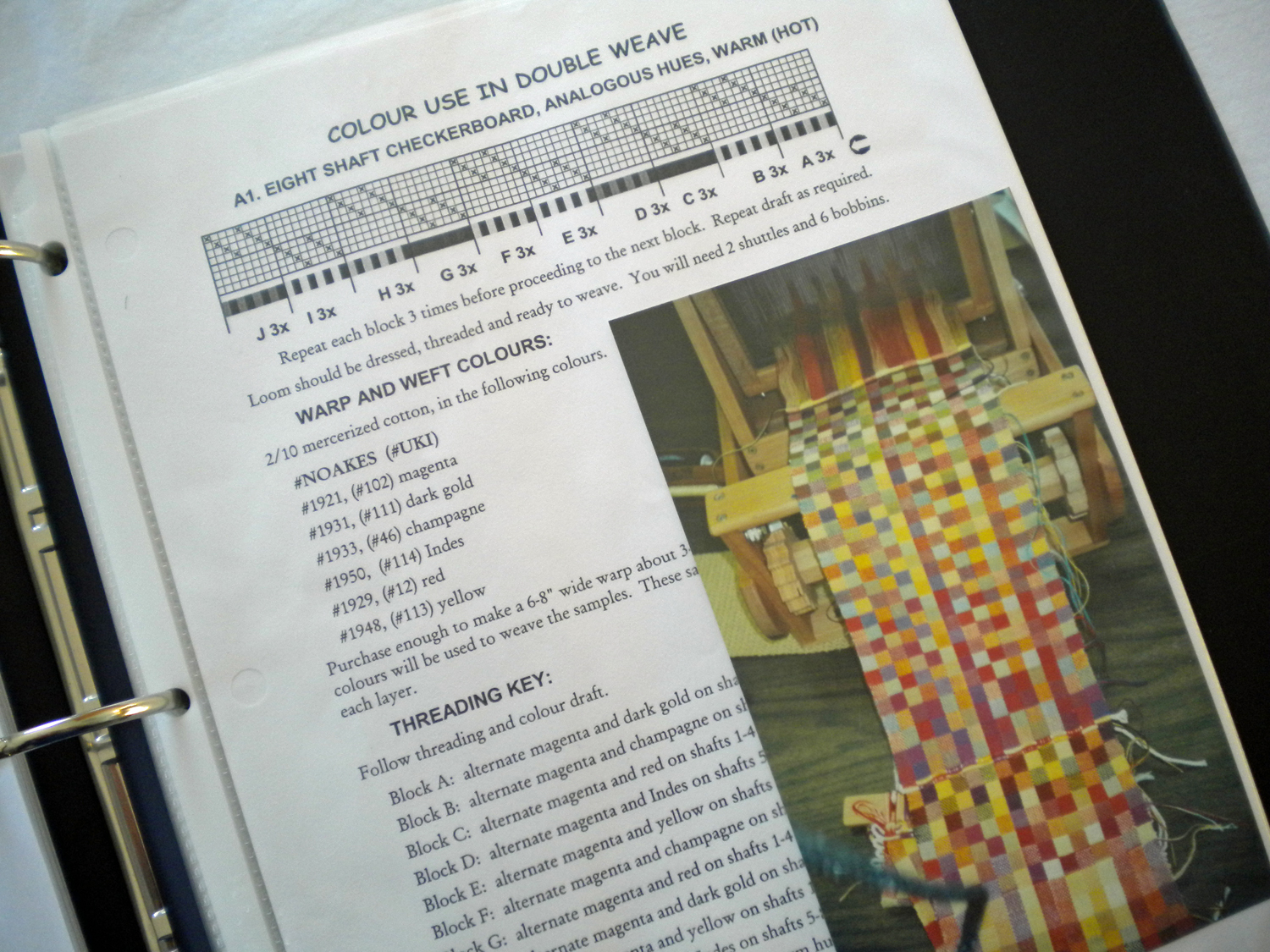
A page from a 2002 double weave workshop

A page from a 2002 double weave workshop

I’ve also attended numerous workshops over the years, one of which was entirely on double weave. Ingrid Boesel visited our guild in 2002 to teach about color in double weave. My binder included photos of our round-robin projects along with the drafts. It’s fascinating to see how different colors affect the look of a fabric.

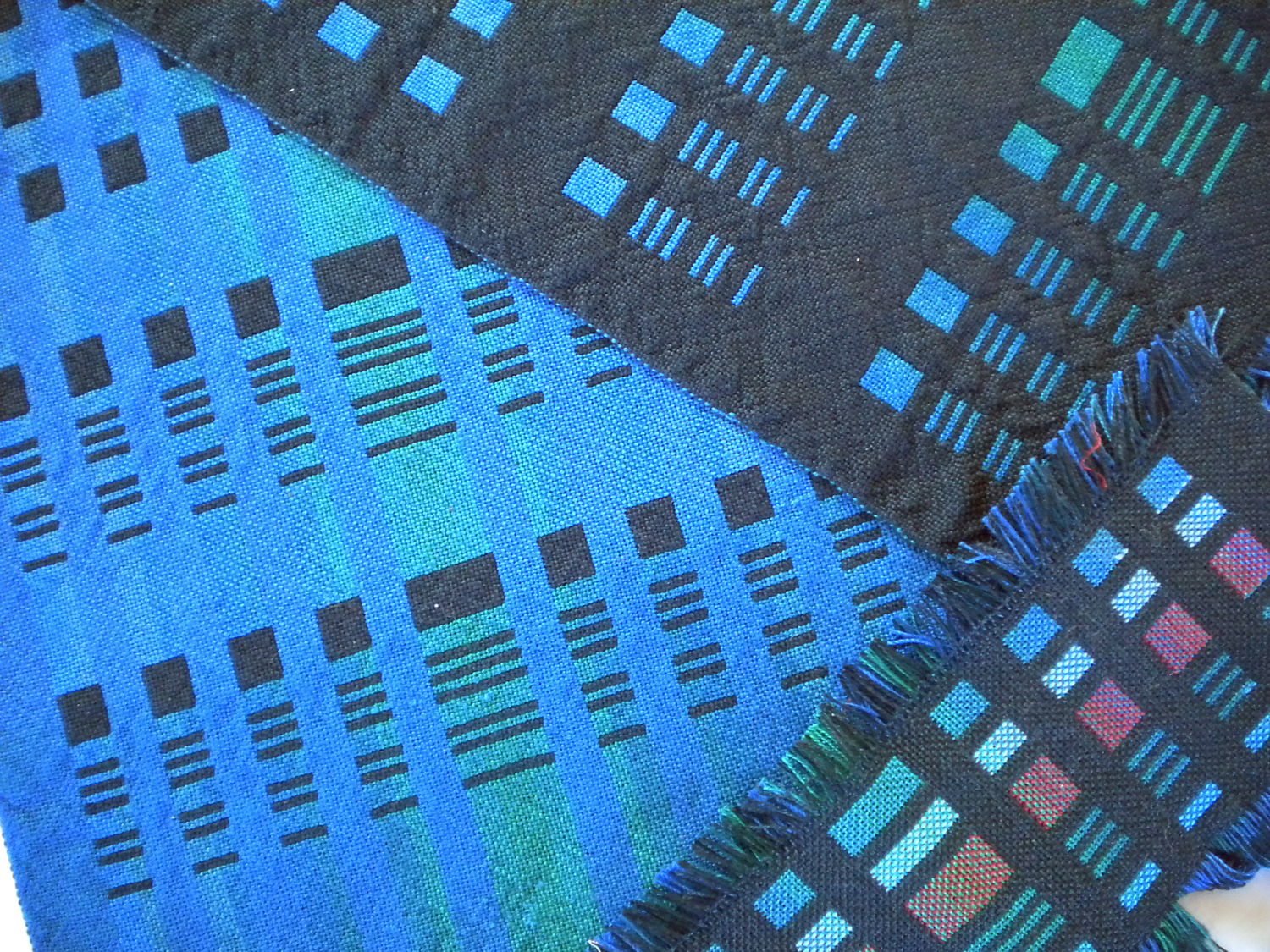
Looking through these articles and studies was just the jump start I needed. A warp of dark blue and medium blues went on my small loom to refresh my memory. I sampled a selection of weft colors, settled on one, and took off.

Double weave sample (lower right) and resulting runner

Double weave sample (lower right) and resulting runner

Overall I’m pleased with the result and am already winding a follow-up warp with improvements. My “light” side doesn’t have to be stripes to match block arrangements; I’m blending the light colors to see how that looks. I’m also going to sett the warp closer (48 epi for 10/2 mercerized cotton vs. 40 epi as in the first warp). And I do have to be careful about weft skips on the underside, but because this is plain weave, the repairs are not difficult. And then there’s the question of whether or not to join at the edges. I chose to join on this runner, but it puckers a little because of that, meaning one layer pulled in more. I’ll have to leave the edges open next time. An ounce of prevention…

Once I get warmed up, my plan is to expand to the draw loom. With my 20 pattern shafts, I think I can weave five pattern blocks of double weave compared to just two blocks on my 8-shaft loom. An exploration of block arrangement and manipulation is in the wings!

The Finish Line

16 Tuesday Dec 2014

Posted by jeanweaves in creating, Weaving Inspiration

≈ 3 Comments

Tags

creative inspiration, Finish Line, Holidays, Production, Weaving

I’ve noticed a trend in how winter unfolds in my studio. Through the course of the summer and fall, one warp after another dresses each loom and the hemming basket always has something in it. There’s always another project in the planning stages. November stands out on the calendar as a finish line of sorts; items have to be finished by then to be ready for holiday sales.

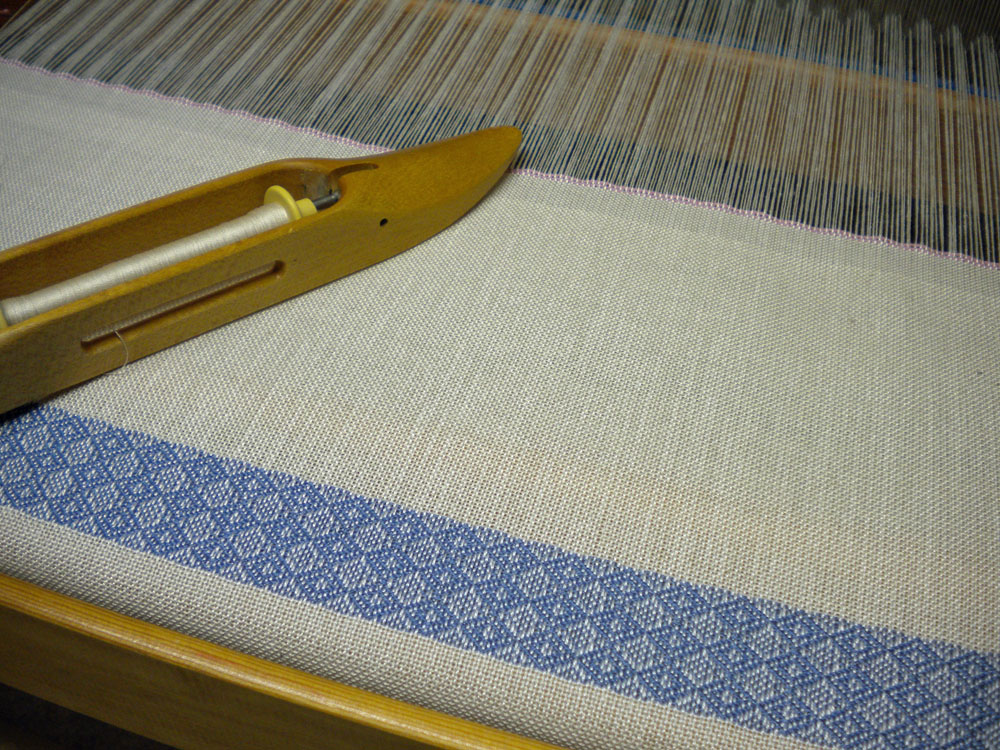
Kitchen Towel in Cotton and Linen

Kitchen Towel in Cotton and Linen

In the past, when I had an outside job, any items I wanted to put in our guild’s holiday sale had to be made over summer when I had shortened hours. If they weren’t finished by September, they weren’t going to be in the show. Now that I’m just in the studio, I can weave into October for that event, but I also have other venues to cover. Stocking up is the order of the season. I have to have enough inventory finished to get through the holidays.

However, by the third week of November, the pace changes.  The finish line approaches. The towels are hemmed. The scarves are fringed. The runners and napkins are pressed. And I have to admit that the unfinished items – and there are always some of those! – will have to wait patiently for another week. It’s at this point that my mind shifts to home and hearth.

Working at home gives the impression to most people that the line is blurred between home life and studio life, and to a certain degree that’s true. But in order to keep growing as a weaver, I have to discipline my time. My studio is “the office.” I go to the studio in the morning and work until lunch. I return in the afternoons and continue with whatever I was working on in the morning. With the occasional “let the dog in, let the dog out, let the dog in…”

By December, while I do spend time in the studio, I’m also making cookies, creating gifts, and planning menus. As I write, soup is simmering on the stove and bread is rising. In another week, grandkids will be running down the halls and pulling out the old toys.

I’m already pondering what will go on the looms in the coming year, what weave structure I want to learn more about, what market trends are emerging. Winter is a good time for reviewing the past year and looking forward to the next. More on that next time. For now, the holidays are just around the corner and there are things to be finished.

May your holidays be filled with grace, peace, and good times!

Juggling Projects

17 Friday Oct 2014

Posted by jeanweaves in Napkins, Placemats, Planning, Scarves

≈ 4 Comments

Tags

Handweaving, Napkins, Placemats, Projects, Scarves, Weaving, Yarn

Designing Spot Bronson

Designing Spot Bronson

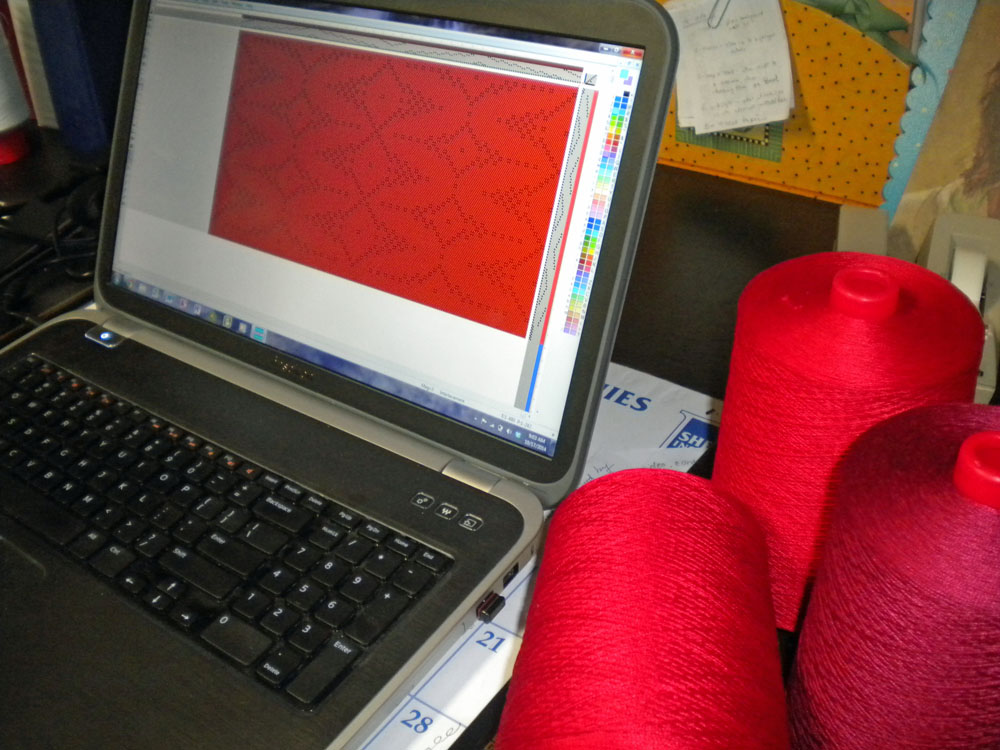
The other day, I asked a friend for some suggestions on how to design something in spot bronson, a weave that combines plain weave with spots of lace. I’m not very experienced with lace weaves and I want to make some placemats without directly using a design from a book or a magazine. I have several shades of red mercerized cotton that will shine in a spot bronson weave, so those are the colors in the draft. (That’s one project.)

Point Twill Napkins on the Loom

Point Twill Napkins on the Loom

These placemats are to go with some point twill napkins I’m currently weaving. The warp has enough for 12 napkins. The first four have a blue border, but I will use red for the next ones so they will go with the placemats. (That’s two projects, although this one precedes the placemats.)

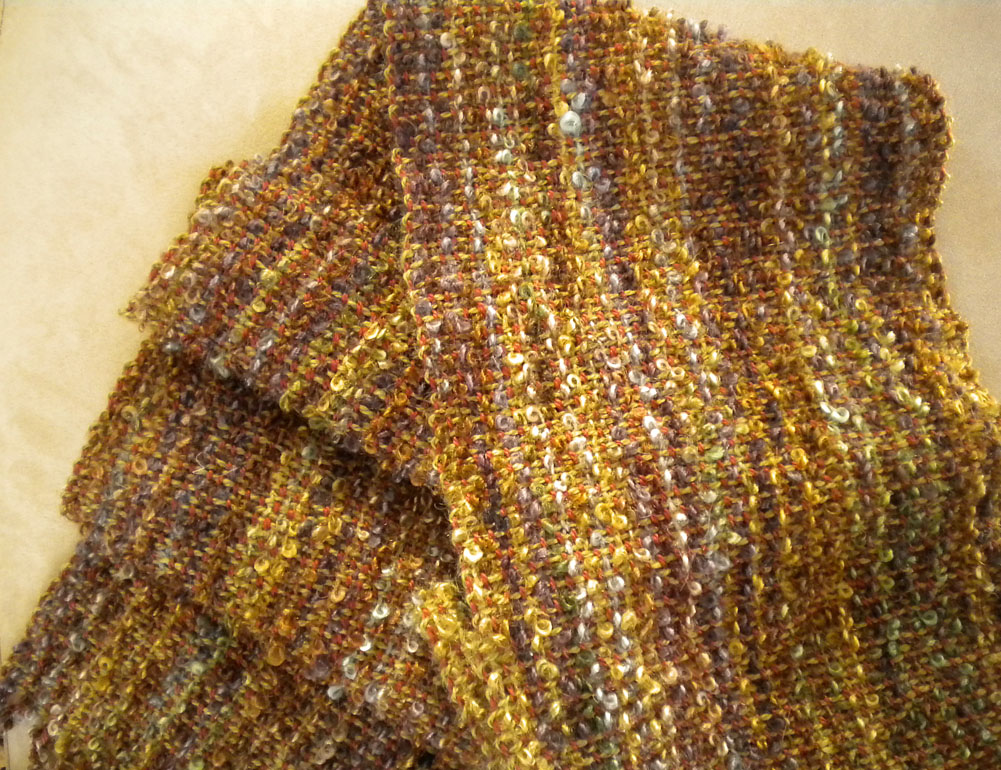
The next day when we got together, I launched in with my adventures weaving a mohair bouclé scarf. I usually weave with smooth, finer yarns and this mohair bouclé was a bit out of my comfort zone. (That’s three projects.) What happened to the spot bronson placemats? They are still in the planning stage. And the napkins are still on the loom, eight more to weave.

Mohair Bouclé Scarf in Autumn Colors

Mohair Bouclé Scarf in Autumn Colors

It seems I’m always juggling projects, each one at a different stage. There’s the planning stage, then warping, active weaving, and finally finishing.

The planning stage of a project takes lots of thought. I mull over the colors, the pattern, the yarns sometimes for several days. Then one morning, it will pull together and the project is on its way. Usually while I’m pondering, I will be weaving or finishing something else.

I learned this process from Anita Luvera Mayer, a weaving teacher and artist. She said to always have three things going at once: something being planned, something on the loom, and something in a basket waiting to be hemmed.

There will always be something to do, no matter how much — or how little — time I have. If there’s only half an hour before an appointment, I can still pick up a needle and finish a hem. If I get stiff from weaving for a long period, I can get up and wind the next warp, a process that requires lots of arm movement to loosen me up. And sometimes it’s just nice to have something different to work on. It moves each project along and keeps my perspective fresh.

This process works for me. What’s your process?

Production Weaving

26 Friday Sep 2014

Posted by jeanweaves in Planning, Weaving Inspiration

≈ 3 Comments

Tags

Creativity, Production, Textiles, Weaving

There are some weaving terms that may mean different things to different people. I think “production weaving” falls into that category.

My Weaving Goal

My Weaving Goal

Sometimes production weaving means putting on long warps to maximize weaving versus set-up time. The longer the warp, the more you can weave before you have to rethread the loom. Other times, it means weaving A LOT of one type of thing. I have come to understand production weaving as weaving with an eye toward time and cost efficiency.

I have friends who put on long warps for towels and then challenge themselves to weave every towel differently. They change the treadling. They change the weft color. They change something in each towel so that they are all related, but different. That takes some planning, but once you get going, it’s exciting to see the warp growing like a flower bed of multi-colored zinnias. And when that warp comes off the loom, it’s fun to see how all the towels work together.

Related but different towels

Related but different towels

My mother once suggested that I weave one item in several different color choices like commercial stores offer. In a way, that’s what those long warps do. They produce several different towels, but all related. However, the difference between the handwoven and the commercial towels is the weaver has the freedom to make small changes in increments, whereas textile factories set up each loom to do one thing and one thing only. Small changes cannot be made without significant effort.

Sometimes I will weave related items as sets. I intentionally combine four different but related napkins in a set. Once I wove a long warp all of different napkins and sold them individually so people could choose what they liked. Some liked this freedom. Others wanted sets of identical items.

I am working on training myself to economize on my time: longer warps, tying on when I can instead of rethreading from scratch for every warp, weaving items in batches. But in the quest to become more efficient in my production, I don’t want to sacrifice the artistry that makes handweaving stand out over commercial fabric.

When you shop, do you like to see a set that has identical members, or do you like variety in your “sets”? Tell me what attracts you.

Looking Ahead

19 Tuesday Aug 2014

Posted by jeanweaves in Weaving Inspiration

≈ Leave a comment

Tags

creative inspiration, CWSG, Fiber Arts, Spinning, Weaving

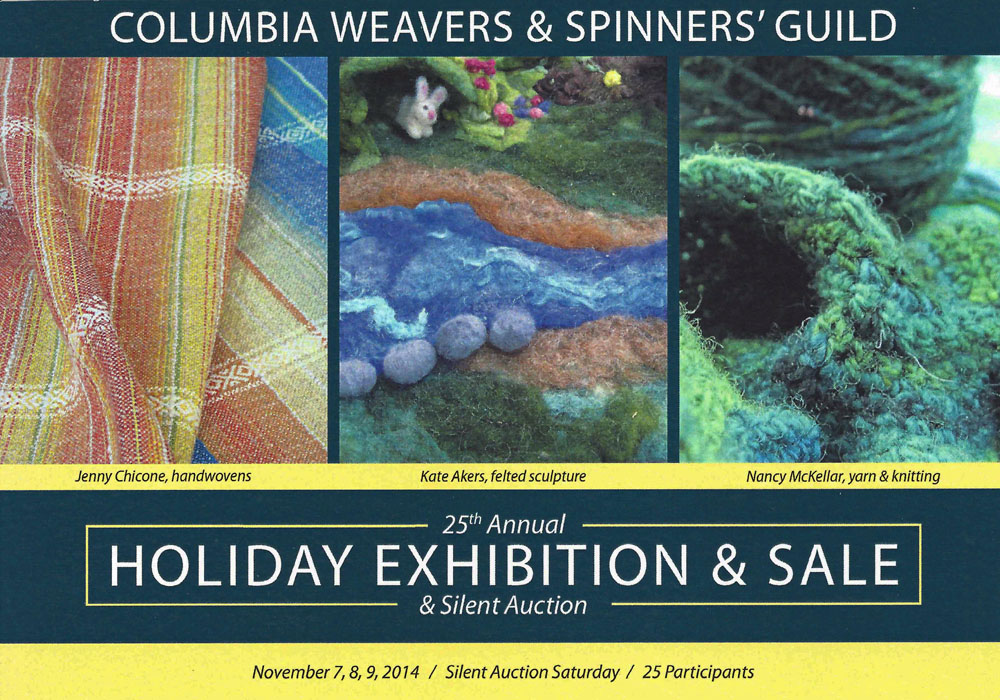
The Columbia Weavers and Spinners Guild is presenting its 25th Annual Holiday Exhibition and Sale this November. When we started in 1990, our goal was to build community, to education the public about fiber, and to learn better marketing skills.

Columbia Weavers and Spinners Guild Holiday Exhibition and Sale 2014

Columbia Weavers and Spinners Guild Holiday Exhibition and Sale 2014

Many members have participated in the HES as the guild itself has grown, and we have definitely built lasting friendships as we have worked together on this event. It takes a lot of planning and many hands to publicize the exhibition, make an inviting display, and demonstrate throughout a weekend. We plumb all our other skills, from record keeping, writing, marketing, and teaching, to pull it all together. (Many participants have “day jobs” in addition to being fiber artists.)

Over the years, we’ve had Girl Scouts, 4-H club members, college students, football fans, people of all ages and interests, come see the demonstrations of weaving, spinning, twining, felting, and knitting. One loom is warped for anyone to try.  It’s fun to watch people tentatively throw a shuttle for the first time and figure out how the cloth is formed.

And we continue to learn ourselves. How do we present our handwovens? What color is featured in the mass market each year? What is the best way to finish the fiber so the customer can more clearly see what it is? What makes a good display?

One of my favorite parts of the Holiday Exhibition and Sale is seeing what everyone else is making. There is so much talent out there, so much creativity, that it fires the imagination! Just look at what can be done!

So if you happen to be in Columbia, Missouri November 7, 8 or 9, stop by the Boone County Historical Society Museum and be inspired!

Inspiration on the Trail

30 Wednesday Jul 2014

Posted by jeanweaves in Weaving Inspiration

≈ 2 Comments

Tags

creative inspiration, Weaving

Chimney Rock in Nebraska

Chimney Rock in Nebraska

Like many, we’ve been on the road over the past couple weeks. It wasn’t a planned vacation per se–we were helping someone move across country and along the way, there was some wonderful scenery.

Our path followed the old Oregon Trail from Missouri through Nebraska and on into Wyoming. We reached Chimney Rock about the time we needed to stretch and spent a pleasant half hour in the Visitor Center. (Note the sign in the foreground–needless to say, we stuck to the sidewalks!)

Popo Agie River in Wyoming

Popo Agie River in Wyoming

The transition from plains to semi-arid scrub to mountain impressed us “flat-landers” as my husband called us. I thought often of how the American Indians and the settlers viewed the land they lived in and passed through. We had the luxury of an air-conditioned vehicle and could travel from state to state within two days. It took them many hot, long days by foot, horseback, or wagon.

We stood in awe at the foot of bluffs and mountain streams. I could have sat for hours soaking in the rock formations, the colors, the sounds. The Sinks State Park in Wyoming is worth the visit. The Popo Agie River “sinks” below the surface for 1/4 mile before “rising” back up and along its way to the Wind River. It was a lovely outing close to where we were staying and a hint of the grandeur further on down the road. We didn’t get to Yellowstone or the Grand Tetons on this trip but we’ll go back many times, I’m sure.

Sinks State Park in Wyoming

Sinks State Park in Wyoming

Now that I’m home, I’m pondering how to translate all of that beauty into fiber. I’m not a tapestry weaver but nature still influences what I weave. The play of color across the cliff face, the expanse of sagebrush, the shape of rock formations, all of these will echo in my mind as I plan new projects. Hopefully I can share something of the area’s beauty through weaving.

Loom Envy

02 Wednesday Jul 2014

Posted by jeanweaves in Craft History, Looms, Terminology

≈ Leave a comment

Tags

Craft History, Early American Weaving, Loom, Weaving

Many years ago, I heard a well-known weaver speaking at a conference. He joked that whenever he wanted to change threadings, he just went out and bought another loom. At least I thought he was joking and all us in the audience laughed with him. But now I wonder if, indeed, he was just being honest.

You see one of the most time-consuming tasks of weaving is threading the loom. Each thread has to go through a heddle and a dent (a slot) in the reed (the beater). Patterns weaves like damask and double go through two heddles and the reed. Some warps have hundreds of threads. So for that conference speaker, it was more cost-effective to buy another loom than to keep rethreading every time he needed to change patterns. I don’t think I can make the same argument.

One alternative is to put on very long warps. For me, “very long” is defined as 20 yards. One of my friends routinely puts on 21 yards. Some weavers put on 50 or more yards. The longer the warp, the more fabric you can weave before you have to re-thread.  But what if I get bored with the pattern after 10 yards and there are 20 more to go? What if I get an order for something that needs that width, but there are 20 more yards to weave before I can change warps?

Loom threaded with damask, using drawloom shafts.

Loom threaded with damask, using drawloom shafts.

Earlier weavers had a solution for this. Their looms had pieces that could be interchanged. There are references in their records to “gears” which controlled the pattern. When they needed to weave an overshot coverlet, they put that “gear” into the loom frame and tied on a new warp. If they needed to weave dimity, they stalled that “gear.” So it sounds like they had a limited number of loom frames and multiple “gears” to weave the various patterns they offered.

I’ve tried to imagine what these gears were. I have an antique Newcomb loom which has a cast-iron device that changes the shed and advances the warp every time the beater is pulled. Is this what they are talking about? If so, it would be pretty heavy to change out when a new order came in. Or are they referring to the actual shafts with heddles? I can see bundling my threaded shafts and carefully rolling them up to preserve a threading, but it would work better if I kept the threads in the reed and bundled the reed with the shafts. That requires extra reeds.

All this discussion is really an attempt on my part to fend off “loom envy.” For the past year, I’ve vacillated about getting another loom. I’ve pretty much decided that it’s not necessary, but there are times when I really could use another wide loom. A girl can dream!

Crafts Yesterday and Today

23 Friday May 2014

Posted by jeanweaves in Craft History, Tatting

≈ Leave a comment

Tags

Craft History, Piecework Magazine, Tatting, Weaving

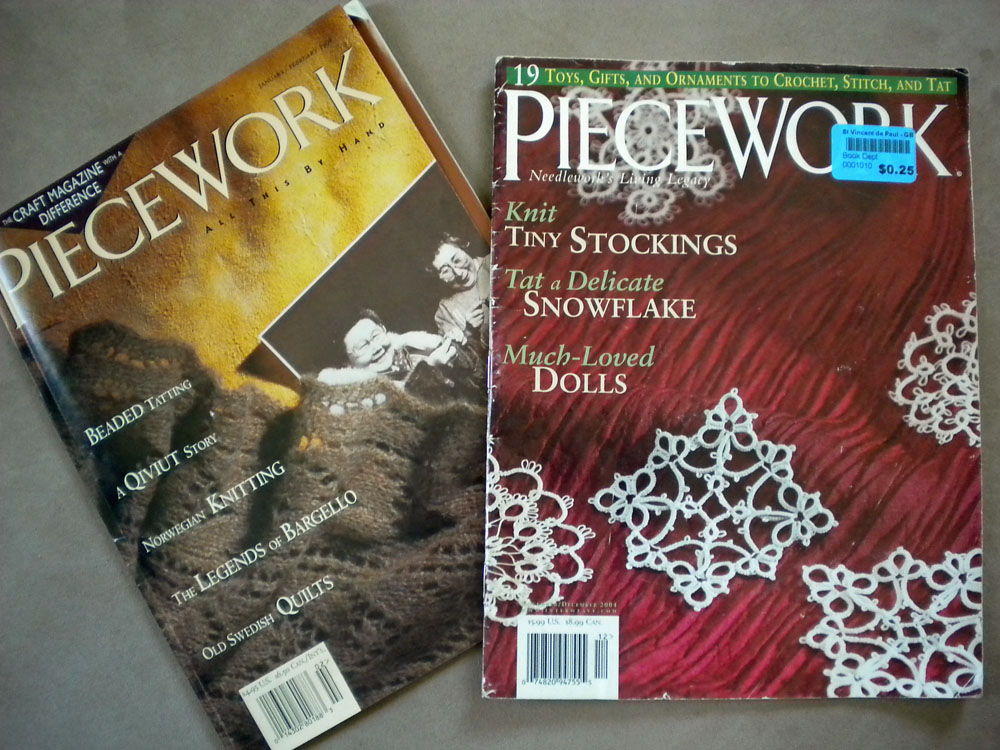
My parents visited this past week and as usual, we enjoyed many conversations revolving around our UFOs (unfinished objects), current projects, and things we will get to one of these days. Mom patrols used book stores and thrift shops and came across some old Piecework magazines. This is a wonderful publication, covering every kind of needlework from around the world and giving the history to go with the projects. When she finished with these back issues, she passed them along to me.

Piecework Magazine Jan/Feb 1996 (left) and Nov/Dec 2004 (right)

Piecework Magazine Jan/Feb 1996 (left) and Nov/Dec 2004 (right)

I was delighted to see articles on tatting to follow up on my recent exploration of that craft. One even describes threading small beads into the tatting—now there’s something I have got to try!

But something else is intriguing in these back issues. Since I started reading the magazine, knitting has featured prominently in the projects—knitted lace, knitted mittens, knitted sweaters. These older issues do have knitting, but counted cross stitch is a central technique—embroidered yokes, embroidered ornaments, embroidered samplers—and more quilting than appears now.

Handwork is fluid. Crafts ebb and flow in popularity. When my grandmother told me that tatting was a dying art, little did she suspect that within 20 years, it would experience a resurgence. In the 60’s, 70’s, and 80’s, weaving and spinning were very popular. Many of us who are weaving now, learned then. In the past 10 years, though, it seems like there are fewer of us actively weaving and fewer weaving publications. Give it time though. Weaving is an ancient skill and those of us still weaving keep sharing what we know so that future generations can join the web in their own time.

← Older posts
Newer posts →
Shop!

Follow Us

  • Facebook

Galleries

  • Towels to Use and to Give
  • Runners
  • Scarves for Him and Her
  • For the Table
  • Note Cards
  • Animals
  • Throws
  • The Linen Press
  • Privacy Policy

Subscribe

  • RSS - Posts
  • RSS - Comments

Archives

  • September 2020 (2)
  • October 2019 (1)
  • August 2019 (1)
  • July 2019 (2)
  • June 2019 (2)
  • March 2019 (1)
  • November 2018 (2)
  • September 2018 (1)
  • July 2018 (2)
  • May 2018 (2)
  • April 2018 (1)
  • February 2018 (2)
  • January 2018 (1)
  • December 2017 (1)
  • November 2017 (2)
  • October 2017 (3)
  • August 2017 (1)
  • July 2017 (1)
  • June 2017 (2)
  • May 2017 (2)
  • March 2017 (2)
  • February 2017 (2)
  • January 2017 (2)
  • December 2016 (1)
  • November 2016 (1)
  • October 2016 (2)
  • August 2016 (3)
  • June 2016 (1)
  • May 2016 (1)
  • March 2016 (2)
  • February 2016 (1)
  • January 2016 (1)
  • December 2015 (1)
  • November 2015 (3)
  • October 2015 (1)
  • September 2015 (4)
  • August 2015 (1)
  • July 2015 (2)
  • June 2015 (1)
  • May 2015 (1)
  • April 2015 (2)
  • March 2015 (2)
  • February 2015 (2)
  • January 2015 (2)
  • December 2014 (1)
  • November 2014 (3)
  • October 2014 (1)
  • September 2014 (2)
  • August 2014 (1)
  • July 2014 (3)
  • June 2014 (1)
  • May 2014 (2)
  • April 2014 (2)
  • March 2014 (2)
  • February 2014 (2)
  • January 2014 (2)
  • December 2013 (2)
  • November 2013 (1)
  • October 2013 (1)
  • September 2013 (3)
  • August 2013 (1)

Create a free website or blog at WordPress.com.

Privacy & Cookies: This site uses cookies. By continuing to use this website, you agree to their use.
To find out more, including how to control cookies, see here: Cookie Policy
  • Subscribe Subscribed
    • jeanweaves
    • Join 62 other subscribers
    • Already have a WordPress.com account? Log in now.
    • jeanweaves
    • Subscribe Subscribed
    • Sign up
    • Log in
    • Report this content
    • View site in Reader
    • Manage subscriptions
    • Collapse this bar
 

Loading Comments...