• Home
  • Shop
  • About
  • Exhibits
  • Contact me

jeanweaves

~ Jean Williams, Handweaver

jeanweaves

Author Archives: jeanweaves

What Goes Around…

12 Wednesday Aug 2015

Posted by jeanweaves in Craft History, Towels, Weaving Inspiration

≈ 2 Comments

Tags

Craft History, Early American Weaving, Towels

Red Cotton Towel woven "as drawn in."

Red Cotton Towel woven “as drawn in.”

You know the old saying : What goes around, comes around.  This is certainly true in weaving, but I can always learn more from early weavers.

For some time, I have belonged to the Early Weaving Books and Manuscripts study group through Complex Weavers. Through the years, members of this group have worked to find and preserve old weaving drafts and manuscripts. The eastern United States had quite a number of professional weavers in its early days and they often kept account books, recording not only what they charged for weaving, spinning, and dying, but also often their patterns. Apprentices began their studies by copying their masters’ draft books, sometimes even including doodles in the margins. These manuscripts are treasured when they are found. And often, they are digitized so others can study and weave them.

Handweaving.net is a wonderful archive of over 60,000 weaving drafts and documents, many of which are public domain according to the site. I can get lost browsing through these patterns; they offer a glimpse into what weavers were doing 100 or more years ago.
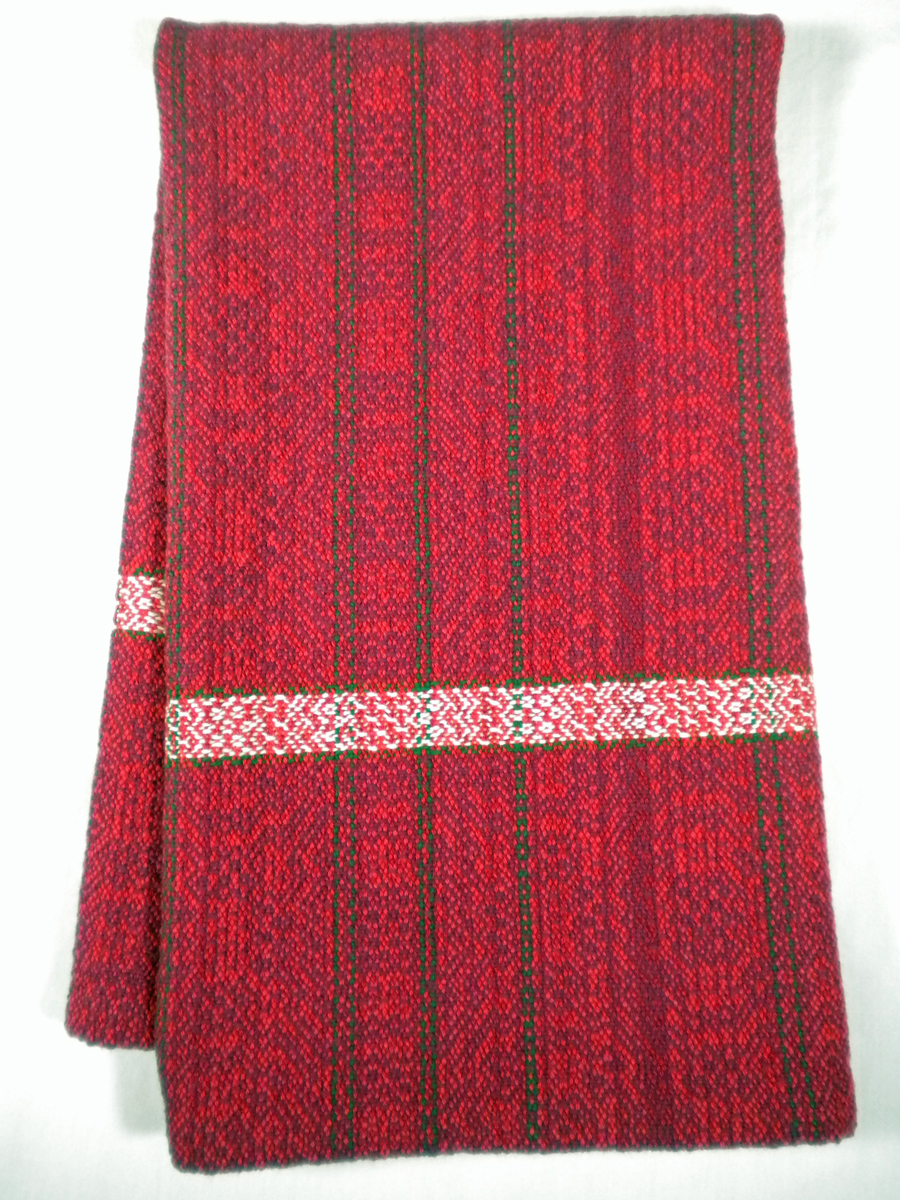
Red and Plum Towel woven "as drawn in."

Red and Plum Towel woven “as drawn in.”

And these drafts do take study. Weaving notation is pretty consistent now, but early weavers had their own notation conventions and it isn’t always apparent to us in the 21st century what the weaver of the 1700’s meant by his marks. Does the pattern go from left to right, or right to left? Does the first line represent the closest shaft or the farthest? Many times, all that is shown is more like a musical staff than a pattern, a set of horizontal lines with a series of tick marks. Sometimes there is a tie-up, many times not. Rarely are there any directions on the treadling.

This is what makes these early drafts fascinating.

I particularly like the fancy twills that often show up in these old manuscripts. I picked one from the Jacob Snavely manuscript for my recent towel warp. It’s called variously Ms and Ws, or hin und wieder. I’m told that’s German for “back and forth” which is really quite descriptive of the motifs. They are characterized by fancy diamonds within diamonds, crosses, and stars.

Tangerine and Reg Towel woven in point twill.

Tangerine and Reg Towel woven in point twill.

The draft I picked was just a series of lines over lines, but it did have a tie-up included. After making some adjustments to suit my taste and yarn, I had to decide how to treadle this draft. Often these old drafts were treadled in the same order as they were threaded (woven “as drawn in” or “trompt as writ”). But there are other possibilities. In some of my towels, I did weave as drawn in, but in the orange one, I treadled a simpler point – just back and forth. Both designs are pleasing.

Now the warp is off the loom, but I don’t want to leave the design just yet. I’m in the process of tying on another warp so I can play some more. This new warp will feature blue, rose, and natural. We’ll see how far I can go with this early draft.
The Color of Cotton

28 Tuesday Jul 2015

Posted by jeanweaves in Color, Towels

≈ 1 Comment

Tags

Color, Cotton, Handwoven, Towels

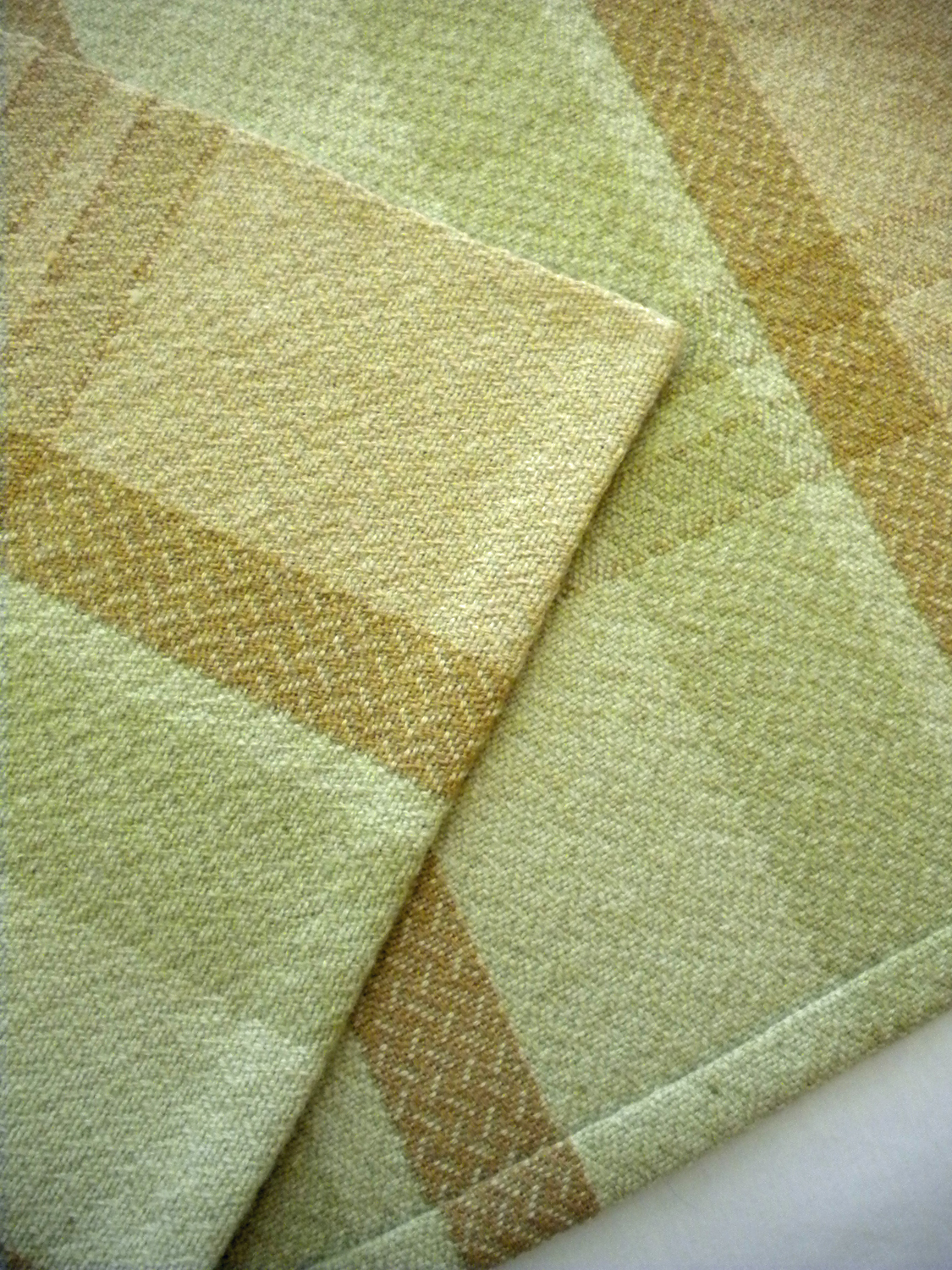
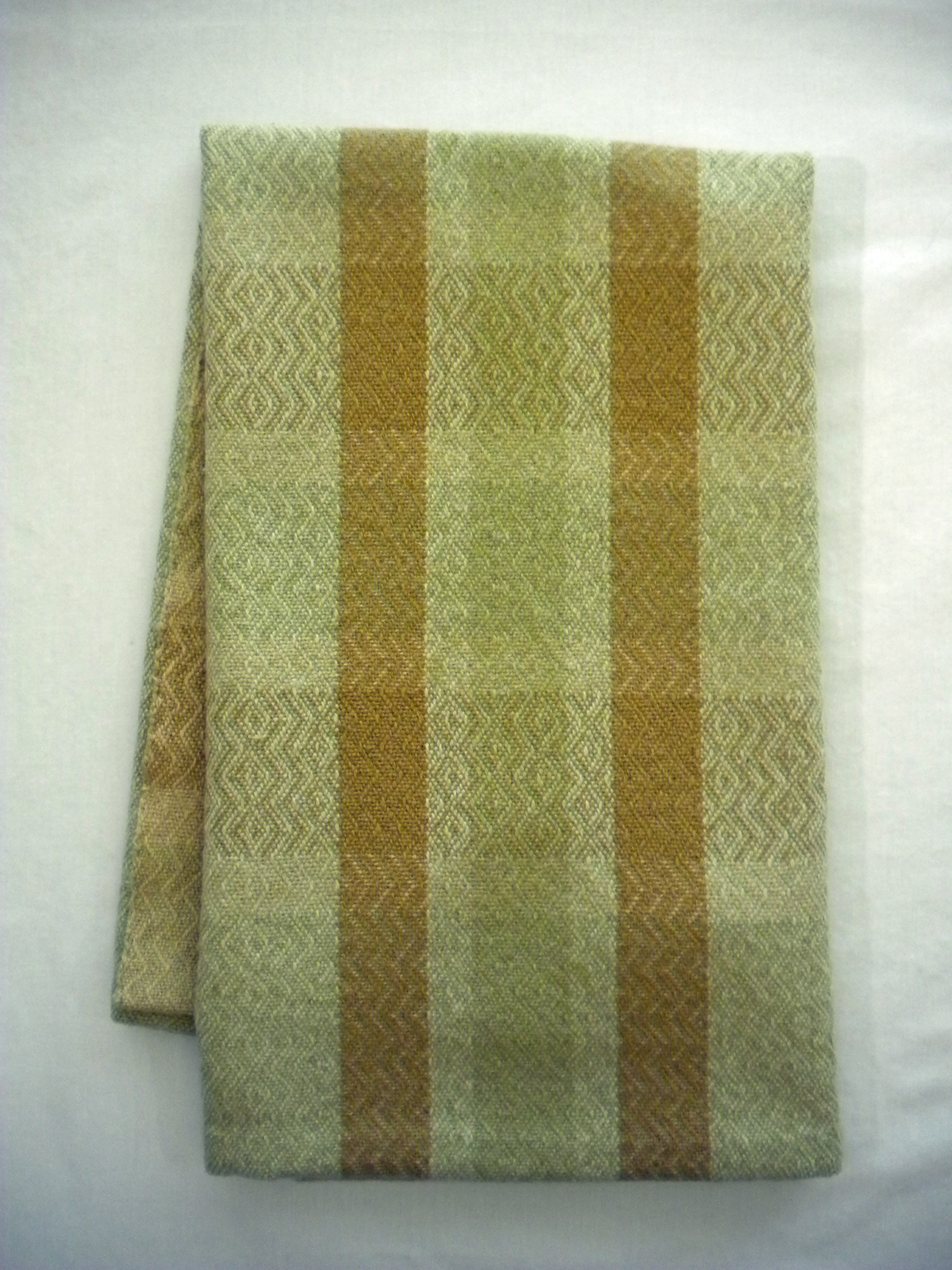
Twill Towel in Naturally Colored Cotton

Twill Towel in Naturally Colored Cotton

Before my weaving days, my exposure to cotton was limited to one color: white. White t-shirts, white sheets, white hotel towels. What color there was came from dyes. And many times, that color was fugitive—over time, red turned to pink, navy turned to powder blue, and yellow faded to cream.

Then I learned to weave and of course, needed yarn. I love shopping for yarn! There are so many different fibers, different spins, and hues to choose from. And that’s when I discovered that cotton is also available in colors that come from nature!

Kitchen Towel in Naturally Colored Cotton

Kitchen Towel in Naturally Colored Cotton

Cotton has always grown in a variety of browns, tans, greens, and even reds, and many peoples over time have spun and woven beautiful naturally colored textiles. It has a shorter  staple(fiber) length than white cotton and produces a softer cloth than white cotton. And the amazing thing to me is that the color deepens with washing. I wove a series of hand towels several years ago and had a small piece left over which I kept and use as a basket liner. This little towel is still the same soft green and brown as when I wove it.

The white cotton we are familiar with today was bred in response to the Industrial Revolution. The development of inexpensive dyes and improvements in spinning and weaving manufacturing led growers to breed just that one variety. Colored cotton became a novelty until the early 1980’s when a small number of cotton breeders began developing the line again.

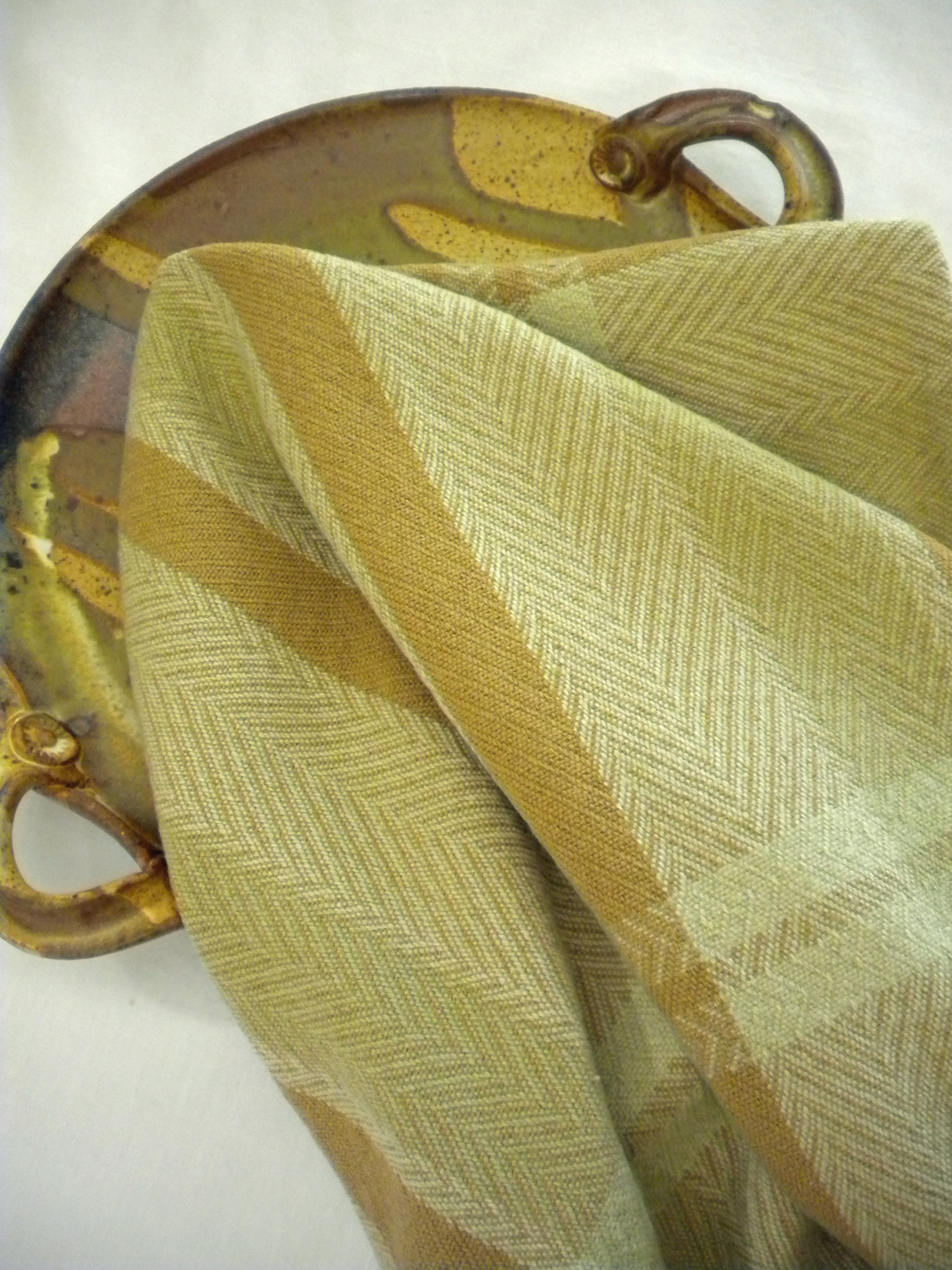
Kitchen Towel in Naturally Colored Cotton Twill

Kitchen Towel in Naturally Colored Cotton Twill

Remembering the towels I wove earlier, I decided to weave another run in naturally colored cotton. Cotton is a great fiber for towels, very absorbent, durable and easy to care for. And twill is my go-to weave structure for just about everything. The towels are off the loom now and I’m almost finished hemming. I’m happy with the feel of the towels and the warm colors of the cotton. And I know they won’t fade!

Color Study Continued

01 Wednesday Jul 2015

Posted by jeanweaves in Color, Towels

≈ 2 Comments

Tags

Color, Cotton, creative inspiration, Weaving

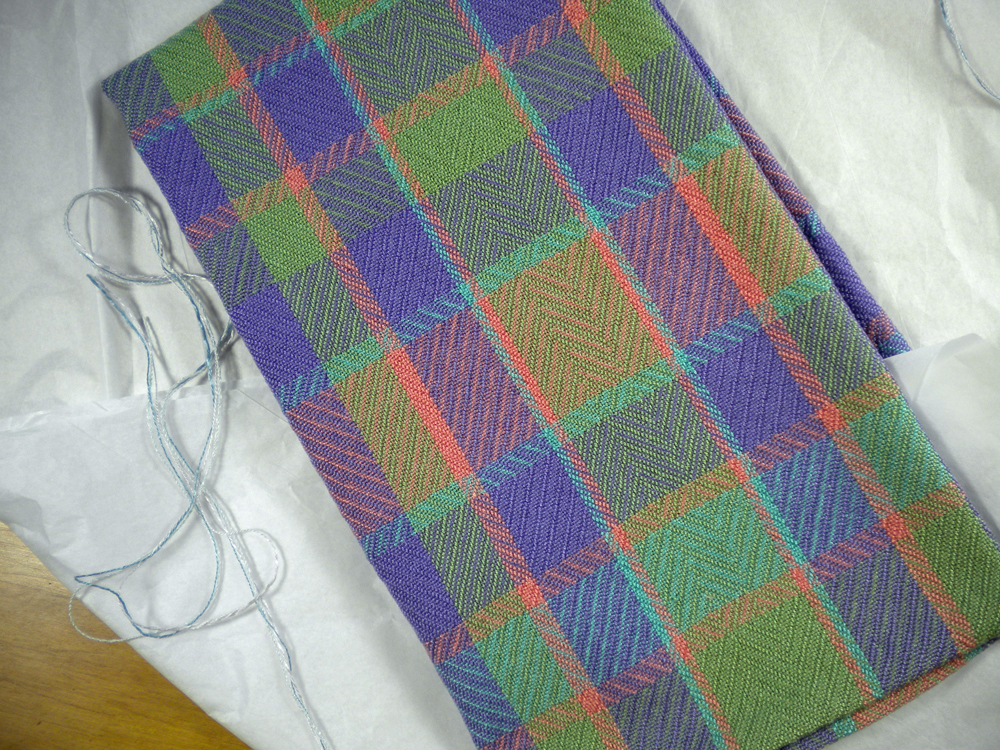
Kitchen Towel in Colors and Checks

Kitchen Towel in Colors and Checks

Continuing last week’s color contemplations, I wove on, and now the warp is finished and off the loom.

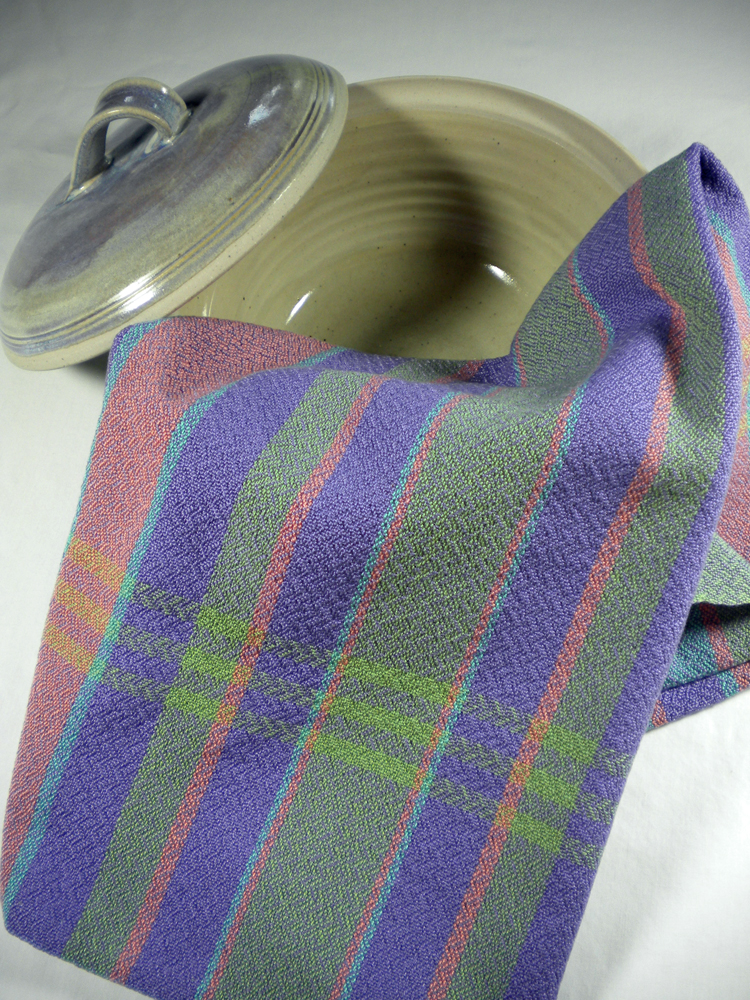
I had wondered if the colors would work. I chose UKI’s Scarab, Quince, Duck, and Lavender. For the record, “Duck” is what I would call a muted turquoise; “Scarab” is what I would call a soft apple green, and “Quince” looks like peach more than orange. And for the most part, I think these colors did play well together. They are similar in value but do come from different regions on the color wheel.

Kitchen Towel Stripes and Lavender

Kitchen Towel Stripes and Lavender

In weaving, it’s not just about how colors will look next to each other, but also how the eye will “read” them from a distance when weft crosses warp. In that respect, two of my choices didn’t work as well as the others. When crossing, Scarab and Duck simply greyed each other out. I was careful not to place them side by side in the warp, but when I used one of them as weft, it necessarily crossed the warp stripe of the other.

There are always surprises.  I’m surprised at how the Scarab pops here. On the cone, it is a soft green, but with the other colors, it fairly jumps off the fabric. And depending on the lighting and what it’s next to, the Quince make look gold or pink.

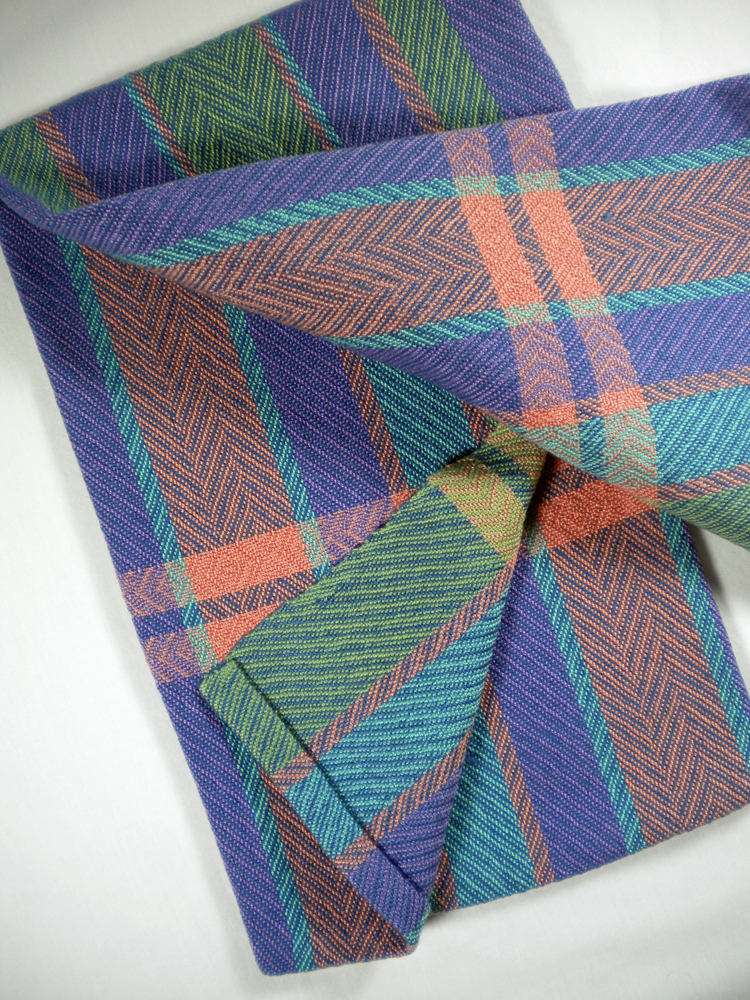
On one pair of towels I used a denim blue weft, a color I thought would recede and allow the warp stripes to stand out. It did just that, as well as softening the whole look in a nice way.

Color is such a subjective thing. What pleases my eye may jar yours. What is soothing or cheerful to one may be distracting and brash to another. While manufacturers may set their “Color of the Year” and expect us to follow their lead, sometimes I just want to break out in my own melody and scheme.

Kitchen Towel Stripes and Denim

Kitchen Towel Stripes and Denim

I have only looked through the window of the whole study of color theory. Someday, I may walk right in and commit to a more thorough exploration, but for now, I note what seems to work on the loom and go on from there. This was a fun project and having made notes on the results, I will continue to learn and continue to be surprised.

What color experiments are you working on?

Hmm…Does that work?

23 Tuesday Jun 2015

Posted by jeanweaves in Color, creating, Planning, Weaving Inspiration

≈ 5 Comments

Tags

Color, creative inspiration, Textiles, Weaving, Yarn

Winding my new warp gives me pause—do these colors work?

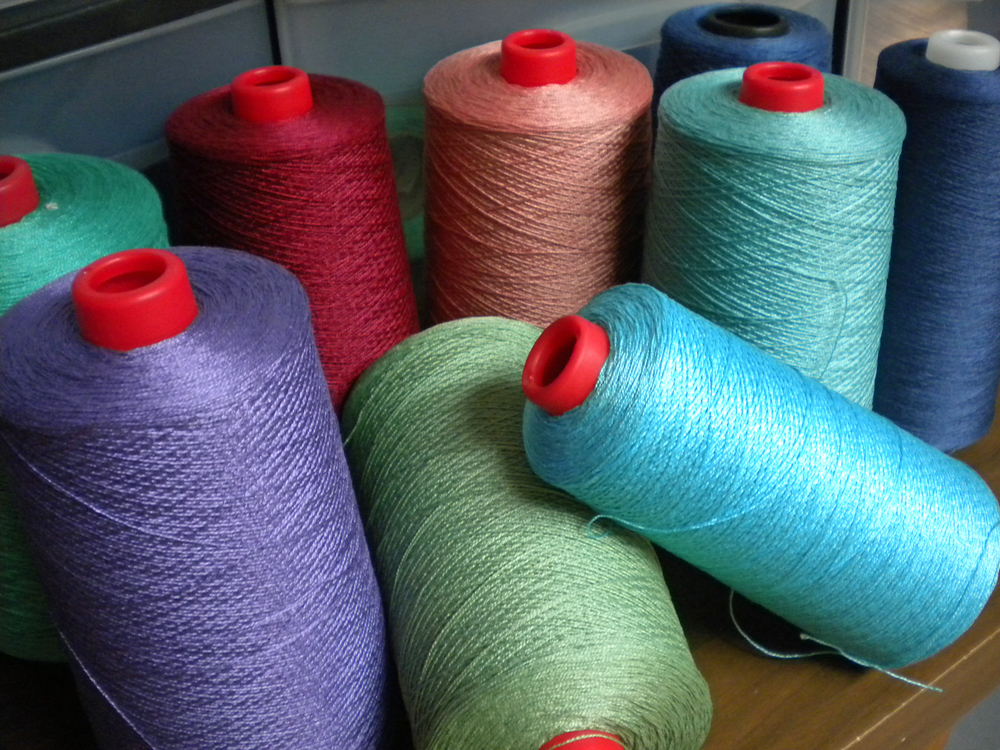
A choice of colors

A choice of colors

Planning colors can be one of the most difficult parts of the weaving process for me. I’ve designed some real ‘dogs’ in my years at the loom, and other times, the colors just glow. I’m definitely more of a “pattern/structure” weaver and a “color/texture” weaver.

Recently I’ve been weaving workshop samples and neutral colors, and really, this week I needed some color. So I went to my shelf and started pulling out cones. Reds, purples, blues, peach, turquoise, green. Which should I choose? Which colors will play nicely together?

Sampling would be the wise route to take, but I’m very impatient to get this one the loom. That may come back to haunt me.

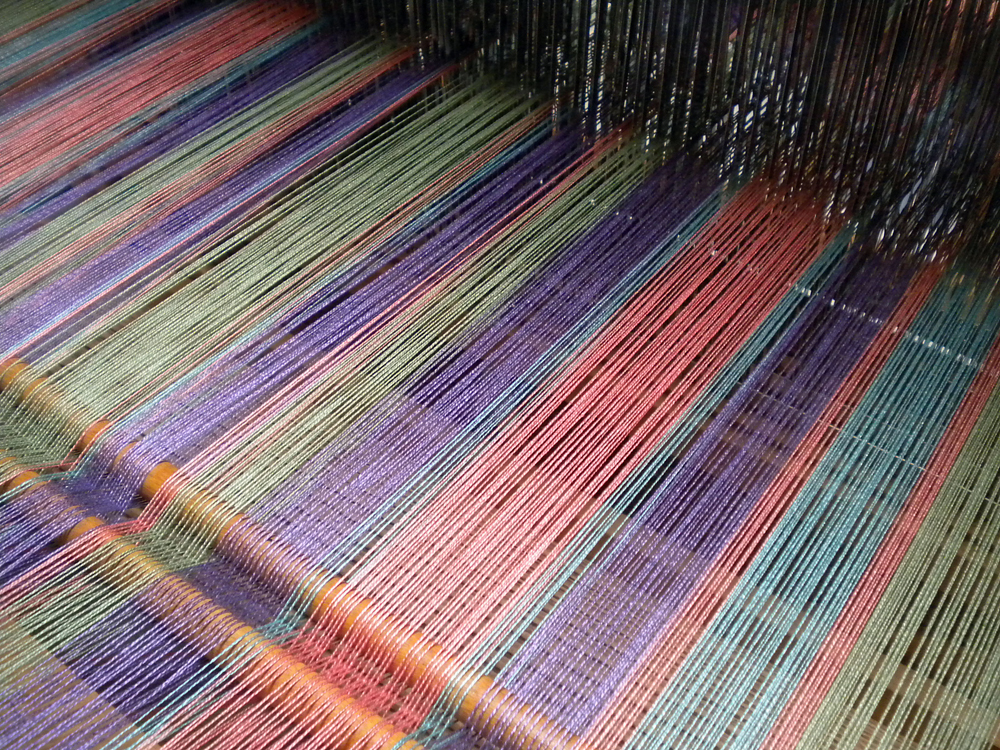
Threaded warp from the back

Threaded warp from the back

I remember hearing Sharon Alderman talk about color—look at what Mother Nature puts together and use that as a starting point.

Okay. I can see some of these colors in my flower garden, but not all of them on the same stem. After some sorting, I settle on UKI’s Quince (a dark peach), Duck (close to turquoise), Lavender, and Scarab (a soft sage green) for towels. (Color names are interesting—can you just imagine someone saying “We’ve already got a green. What should we call this shade?”) As I wind the warp, I have second thoughts, but it’s too late now. Such indecision!

I sley the reed. Hmm…I hope this works.

It takes the better part of a day to thread a broken twill that will make up a vibrant towel warp—I hope! Lots of time to wonder…

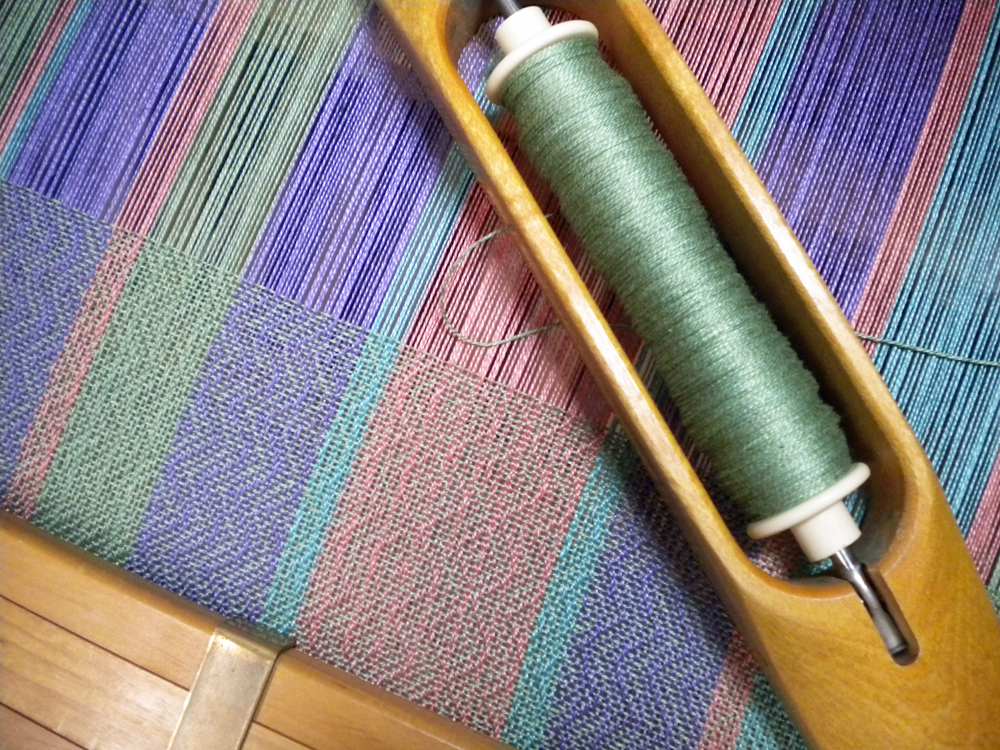
Okay, today I wound the warp onto the back beam and tied the warp to the breast beam—all 642 threads, each 7 yards, 21 inches. The colors of the mercerized cotton glow. A few inches woven show that hey, this might work after all.

Testing the Warp

Testing the Warp

With house guests for the next week and a family wedding to follow, the warp will wait for confirmation. And I will still need to decide on weft colors, but every time I walk by the loom, I’ll think about these colors and dream about some nice colorful towels.

How do you choose the colors for your next project?

Another Take on Doubleweave

19 Tuesday May 2015

Posted by jeanweaves in Doubleweave, Weaving Inspiration

≈ 3 Comments

Tags

creative inspiration, Doubleweave, Handweaving

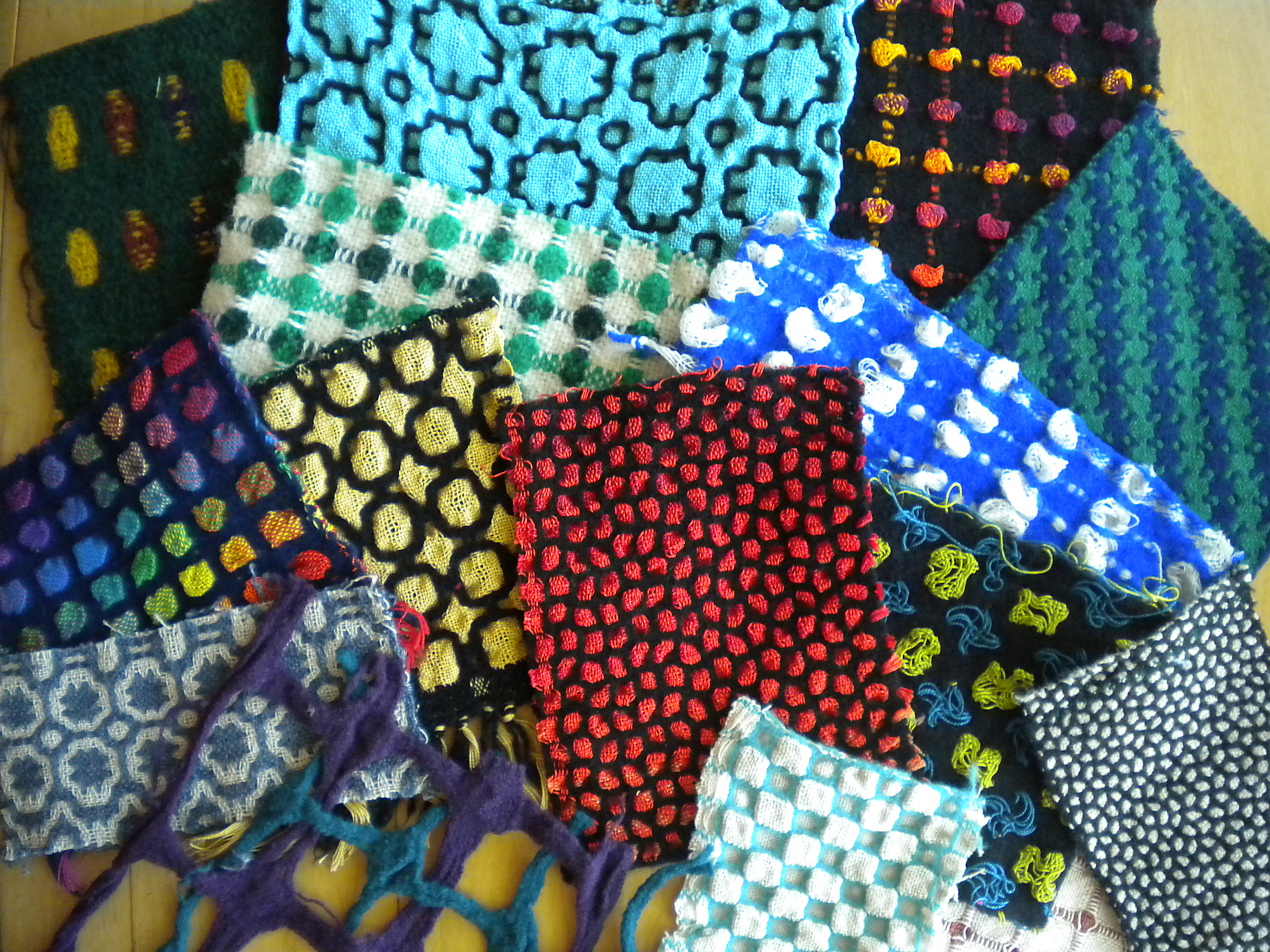
Samples from the Deflected Doubleweave Workshop

Samples from the Deflected Doubleweave Workshop

Three days of weaving camaraderie. Three days of figuring out unfamiliar drafts and different looms. Three days of decoding weaving theory. Three days with well-known weaving teacher and writer, Madelyn Van der Hoogt.

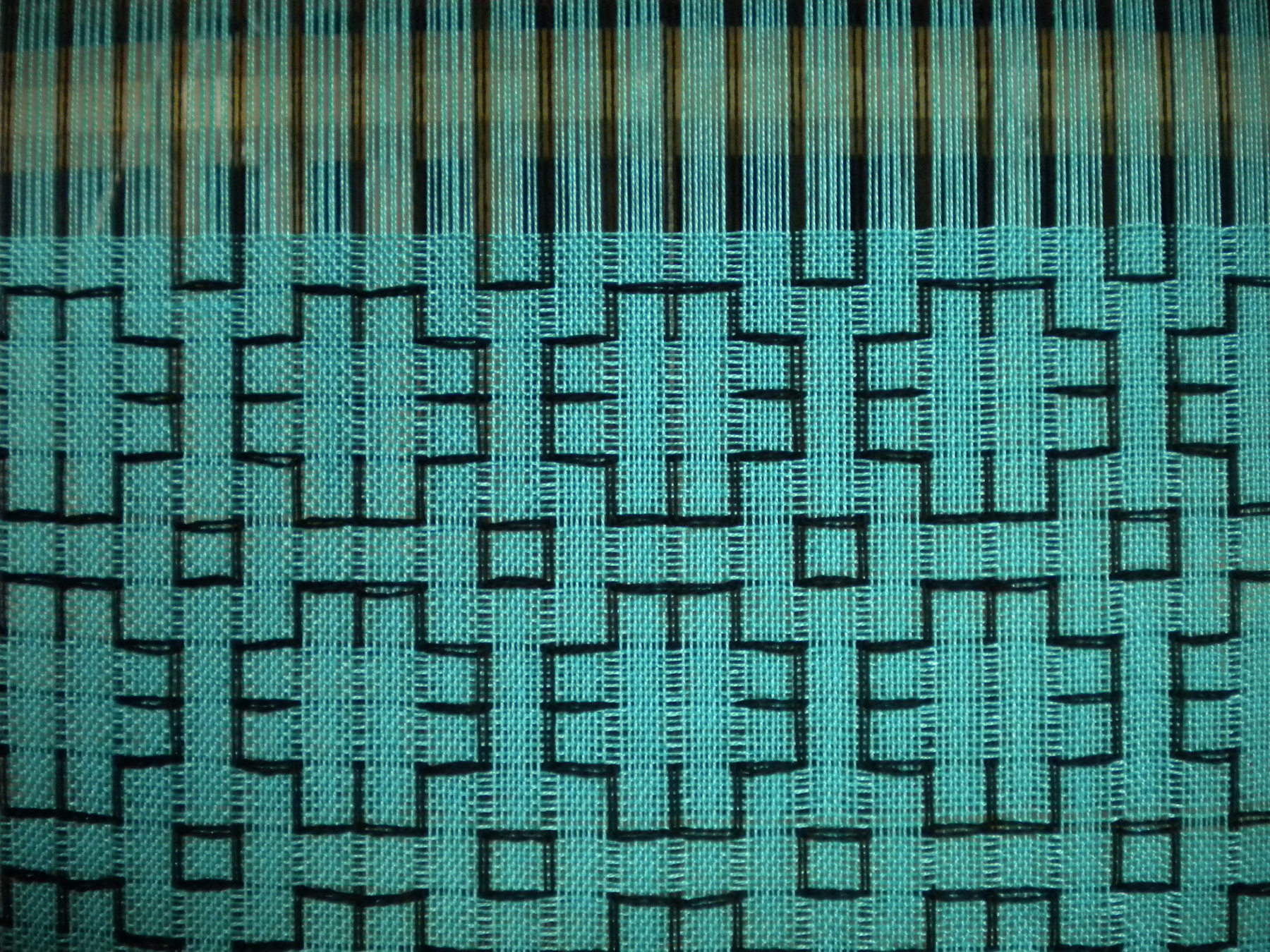
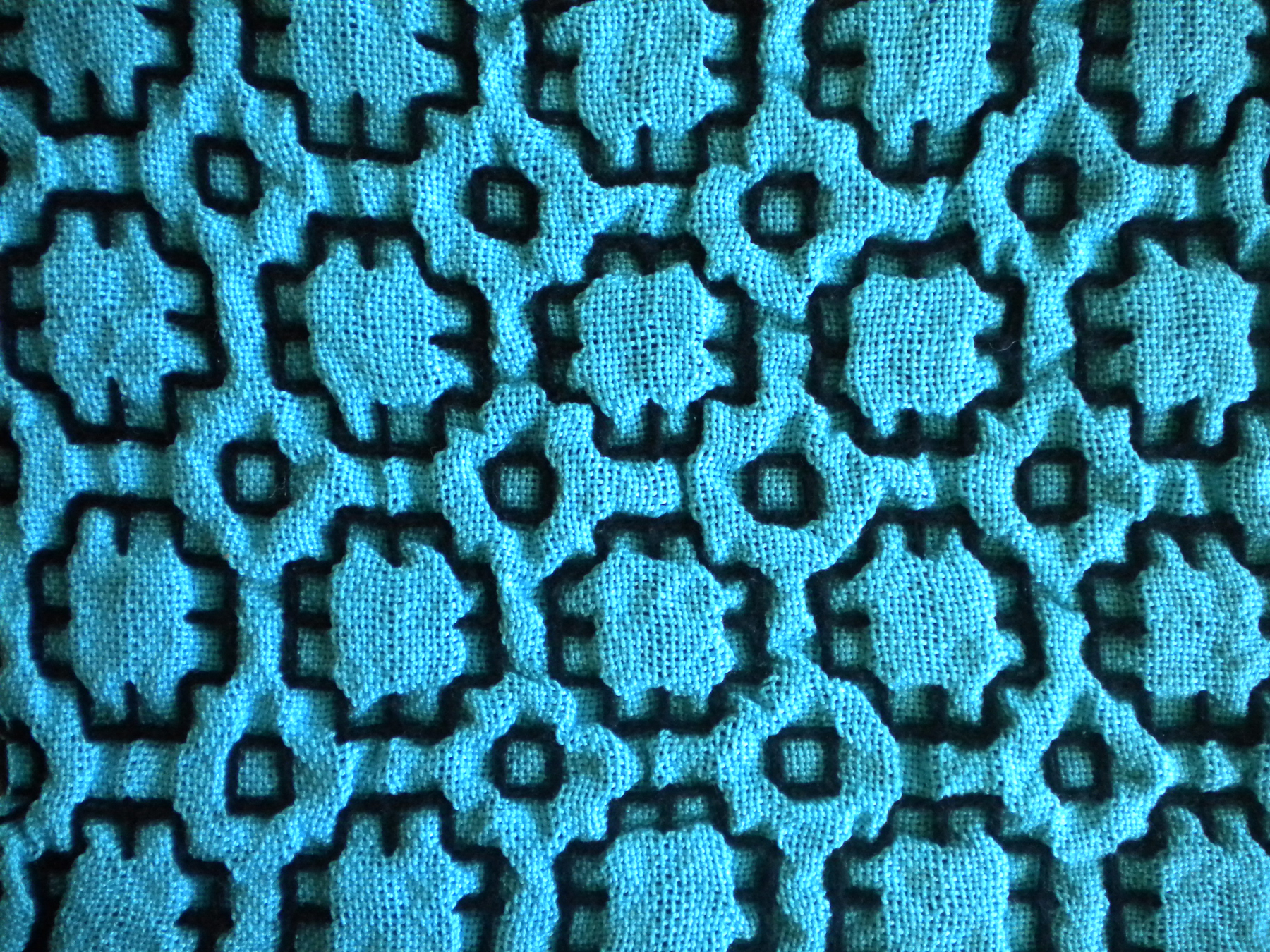
Our guild hosted Madelyn for a three-day workshop on Deflected Doubleweave for Flat and Collapse Fabrics last weekend. Some of us in the workshop have been weaving for years; some for only months. But the drafts challenged and delighted us all as we saw threads go from rectilinear on the loom, to curvy and lumpy after washing.

We each threaded a loom in an assigned draft with fine merino wool, cotton, or a wool/silk blend. Some of the drafts were sett very wide to give the yarn room to move in the finishing process. The warps looked dramatically different from what the final fabric looked like.

Deflected Doubleweave on the loom

Deflected Doubleweave on the loom

We each wove the first sample, cut it off, and washed it to see what the fabric would do. My draft used a fine wool with a 10/2 mercerized cotton. The wool shrunk, of course, which pulled the cotton areas together in puffy figures across the surface; fun! During the course of the weekend, we wove samples on each other’s looms and came away with 16 different examples of yarns doing strange things.

There were samples that looked like mosaics, lacy samples, and polka dot samples. Over and over, we heard to weave square. On some drafts, this meant to barely set the weft in. On other drafts, a normal beat was needed. The trick was to adjust my beat as I moved from a lacy sample to a firm sample. I didn’t always make the adjustment and my samples show it.

In between weaving, Madelyn taught weaving theory—comparing what the threads were actually doing structurally versus what the design looked like. Doubleweave is two independent surfaces connected in some way. It is usually threaded dark-light-dark-light, thread by thread. With four shafts, you can weave light on top and dark on bottom or vice versa. As you use more shafts, you can weave more blocks.

Deflected doubleweave is a block weave; groups of threads from one surface alternate with groups of threads from the other surface. While a drawdown will show you that you have a group of dark threads weaving plain weave over a group of light threads, that drawdown doesn’t show you that because of the sett and floats, those dark threads will slide over the light threads. And the fiber you choose can dramatically change the look of the design. Whether you choose a shrinking yarn for blocks A and C or for blocks B and D will determine whether you get circles, squares, or something entirely different.

Deflected Doubleweave after washing

Deflected Doubleweave after washing

At the end of the third day, we took the warps off our looms, washed them to get the threads to do their “thing”, and passed out everyone’s samples. We discussed what worked, what didn’t and what we could try to get a different result.

What a treat to listen to Madelyn’s stories and explanations of what the threads are actually doing in relation to what they look like they are doing. This isn’t as easy to grasp as it might seem. She admits it. She laughs about trying to put all this into words. That makes us feel better about not “getting it” all the time.

At the end of the workshop, we left with more than just samples. Madelyn gave us much food for thought and inspiration for further exploration.

Hanging Out the Wash

29 Wednesday Apr 2015

Posted by jeanweaves in Nostalgia

≈ 2 Comments

Tags

family, Laundry, Nostalgia, Textiles

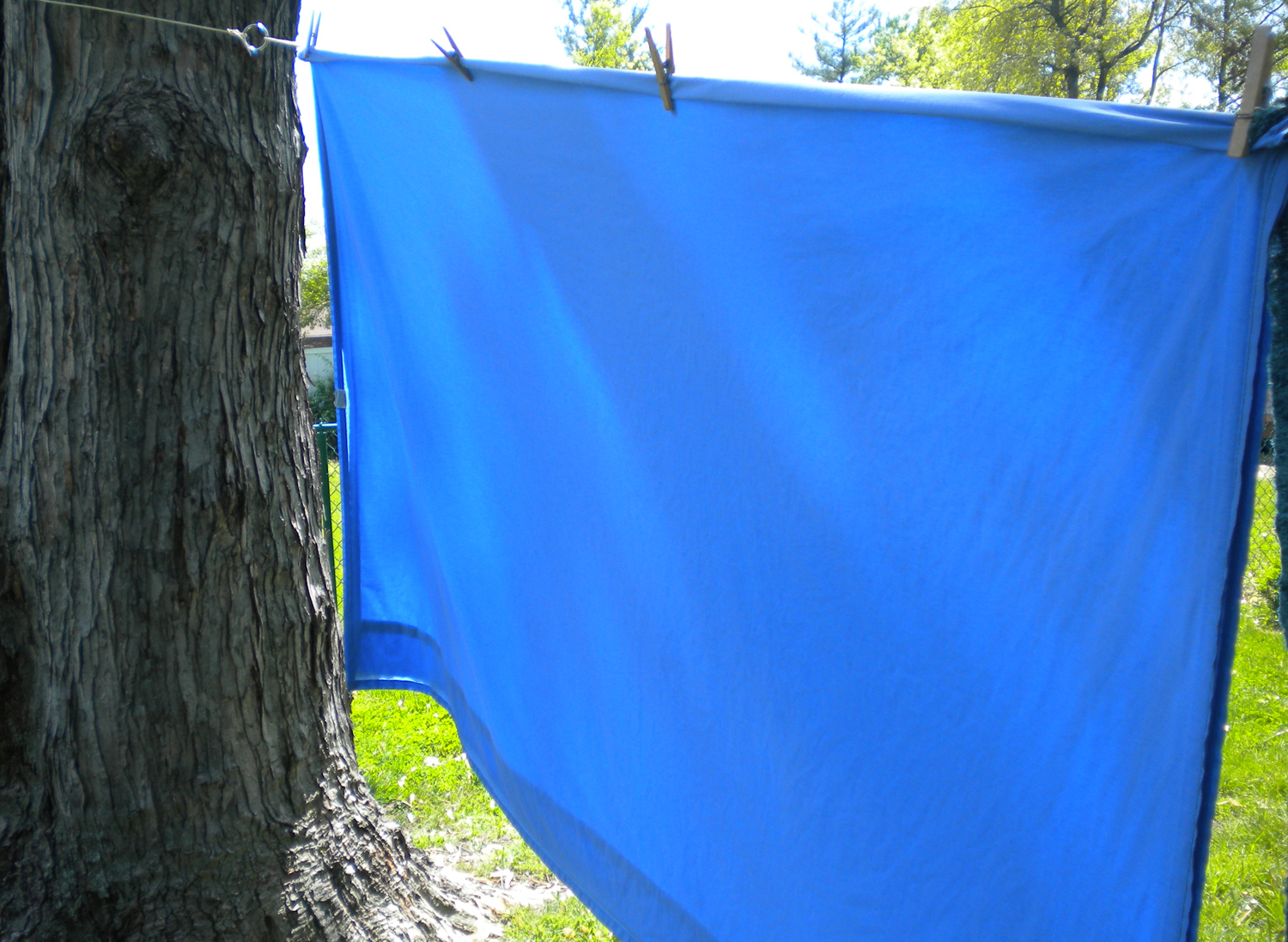
Laundry Day

Catching the warm breezes

Two trees, a piece of rope, some clothespins and a warm, sunny day—a welcome treat that harks back to my growing up years in the country. Yes, I hung out the wash!

When I was a young mother, we had a real clothes line: two t-poles with hooks for six lines. All the cloth diapers dried outside, letting the sun bleach them white again. The sheets billowed gently in the breeze – or whipped in the wind, depending on the day. The rugs hung heavily from the ends near the posts, with the hope that they would not break the lines. Sometimes the kids would run through the wash, playing hide and seek between the shirts and jeans.

It all sounds kind of idyllic now, but at the time, it was just how I learned to do wash.  It was a way to save some money, do my little part to help the environment. Nothing romantic about it at all. Those baskets were heavy to carry up the basement stairs from the washer to the line. It took extra time to hang them out, wait for them to dry, then collect them. Laundry took all day.

And then if clouds rolled in, there was the dash to the line to collect the clothes before it rained.

My mother hung out the wash as did her mother before her. Our line when I was a child was between the house and the garden—another common fixture for rural homes. One of my vivid memories was the spring day my Mom was hanging out the wash and suddenly started calling frantically for my Dad. It seems a family of baby grass snakes hatched under the line that day and Mom didn’t like snakes!

Hanging out the wash was not so much a tradition as a necessity. That was how you dried the laundry. But since outside activities have taken over our lives, efficiency means everything and sometimes we just want to get the laundry done quickly. Hanging out the wash becomes a nostalgic luxury.

But if you have two trees, a piece of rope, some clothespins and a warm, sunny day, indulge yourself! There’s nothing like the smell of laundry fresh off the line!

What are your memories of hanging out wash?

A Weaving Study — Or “How Did They Do That?”

17 Friday Apr 2015

Posted by jeanweaves in Coverlets, Craft History, Doubleweave, Weaving Inspiration

≈ 2 Comments

Tags

Coverlets, Creativity, Doubleweave, Early American Weaving, Weaving

For the last couple months, I’ve been reading The Coverlet Book by Helene Bress (2003, Flower Valley Press, Inc., Gaithersburg, Maryland). What a fascinating study of how our forebears elevated necessary household textiles to works of art!

The Coverlet Book by Helene Bress

The Coverlet Book by Helene Bress

Ms. Bress examined early coverlets and coverlet fragments over the course of many years, documenting the weave structures, the materials used, the design elements, and the history of the pieces if available. She recorded her first impressions of each coverlet or fragment, and analyzed the weaving. There were anomalies in some of the pieces and she delved into the possible reasons without passing modern judgement (21st Century weavers like rules that may not have been important to 18th and 19th Century weavers!)

The first volume is on overshot while the second volume covers twill, doubleweave, summer and winter, blended structures, and various other designs. Some coverlets were woven by professional weavers, but many overshot coverlets were woven at home on simple 4-shaft looms with home-dyed wool and homespun cotton or linen. Some of the earliest designs were Monks Belt – two blocks only. From there, the weavers played around with designs and over time, the designs got more and more elaborate.

Seeing the block designs in these volumes just confirms my fascination with traditional pattern weaves. What an array of designs can spring from one threading! How exciting to see how a pattern changes when the threading starts at a different point in the draft!

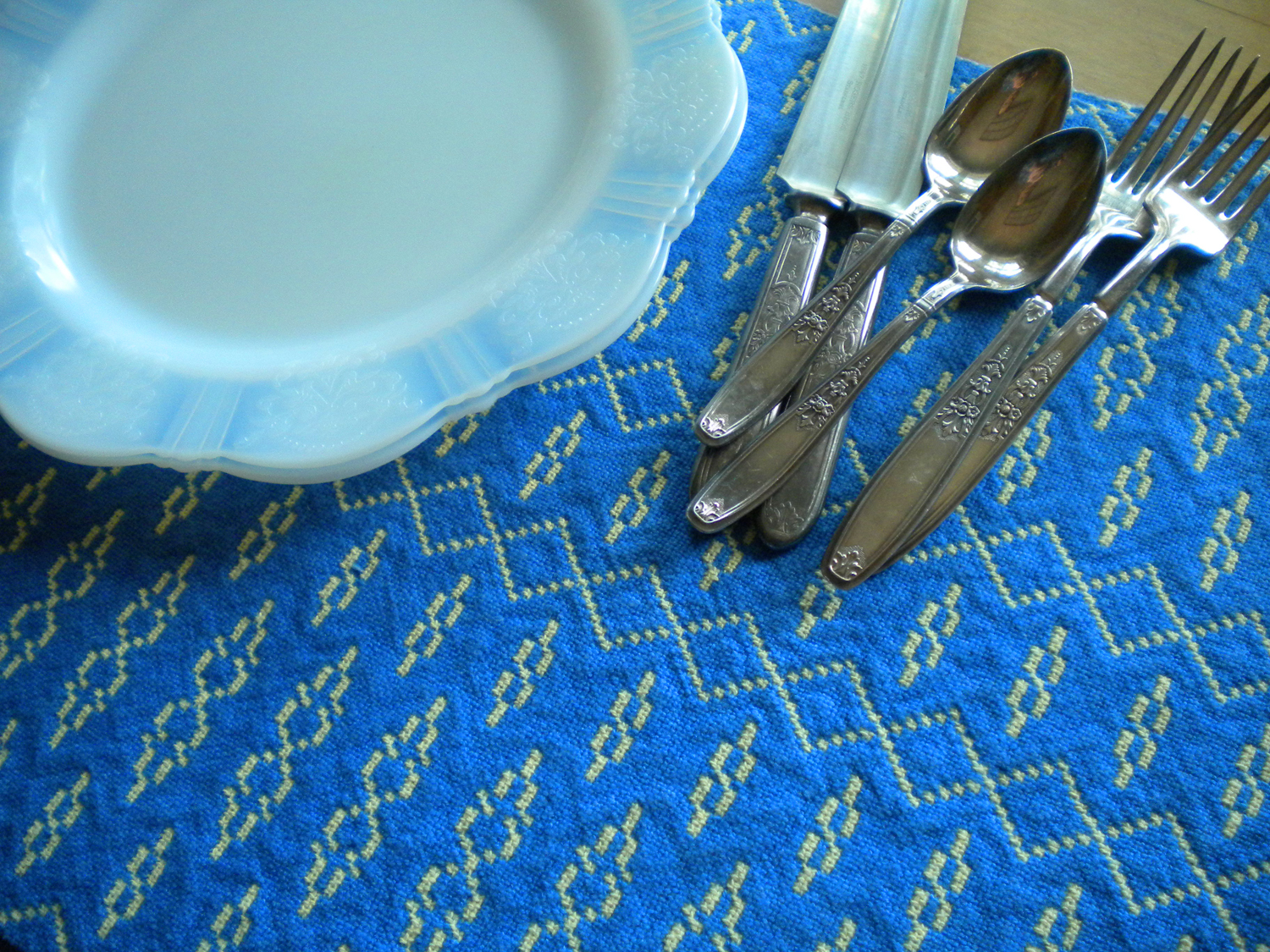
Doubleweave Placemat in Blue and Yellow

Doubleweave Placemat in Blue and Yellow

My current project has been a snowball and pine tree draft that is fairly common in coverlets. However, instead of weaving the blocks to form those snowballs and trees, I wove the blocks in straight order, one following the other, without combining them. From there the design evolved. This week the third rendition came off the loom. Here the blocks are just treadled in point order—zig zag order if you will. I like this pattern, but it is slower to weave because the blocks change constantly.

As I page through The Coverlet Book, I dream about weaving a coverlet. Maybe…someday…who knows! For now I am inspired and will keep exploring!

Placemats, Anyone?

25 Wednesday Mar 2015

Posted by jeanweaves in Placemats

≈ 2 Comments

Tags

Placemats, Textiles, Weaving

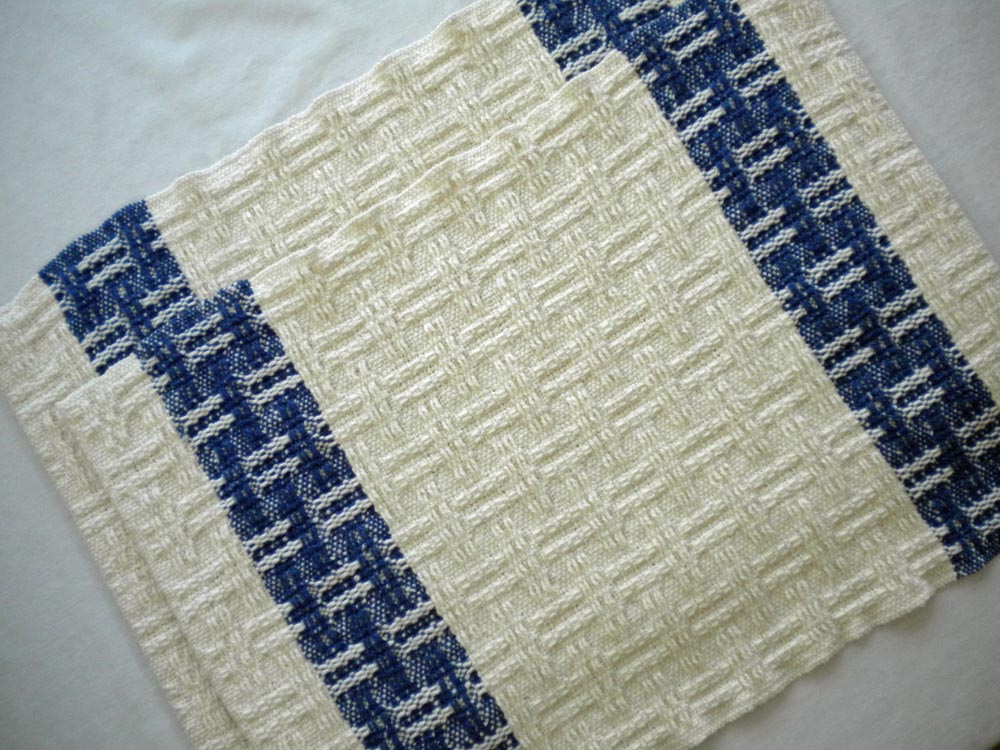
Cotton Placemats in Cream and Blue

Cotton Placemats in Cream and Blue

“So what handwovens do you need right now? What can I weave for you?”

“Well, we could always use more placemats.”

So went a recent conversation I had with a local shop owner. Placemats.

I used to weave a lot of those but over the years, I’ve shifted to towels, scarves, and other linens. I’ve woven note cards, runners, napkins, even some rugs.  But not many placemats.

When I got married, placemats were a popular bridal shower and wedding gift. Placemats are all-purpose. Like tablecloths, you can leave them on the table between meals as an accent. During meals, they protect the table without covering it up completely. And placemats are easy to launder. If you remove a handwoven cotton placemat from the dryer while it’s still slightly damp, you can simple smooth out the wrinkles and let it finish drying flat. Voila!

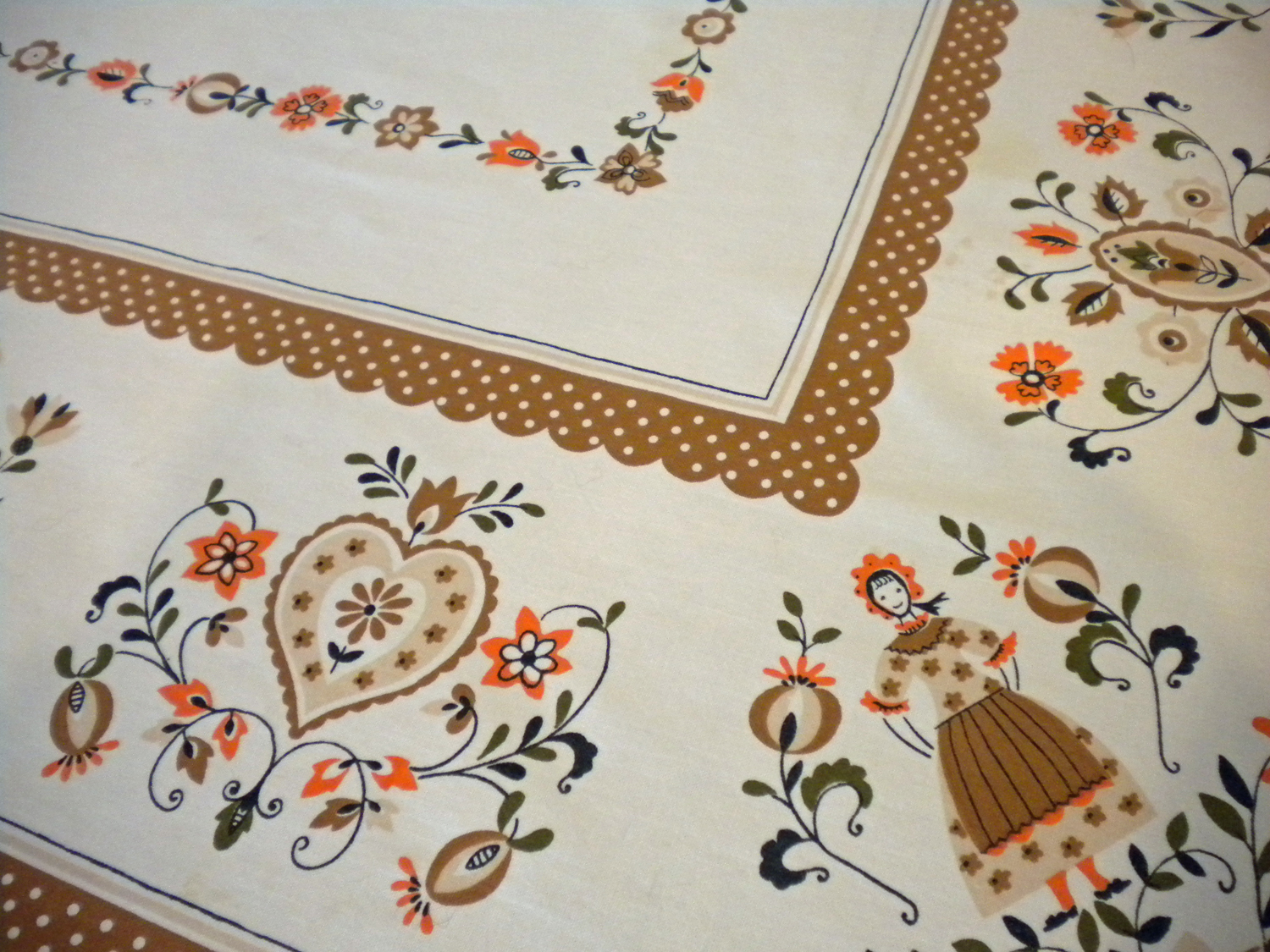
Classic '40's Tablecloth

Classic ’40’s Tablecloth

Back when my Mom got married, tablecloths were the gift of choice. Every bride needed tablecloths for every day, for formal use, for covering the table between meals. Remember those all-purpose printed tablecloths from the ‘40’s and ‘50’s, the ones with flowers around the edges and a center motif? There were tablecloths for every season and they brightened the table, made a meal special and just added a nice touch to the room between meals. Over time, decorating trends and tastes changed and placemats replaced tablecloths in many kitchens and dining rooms.

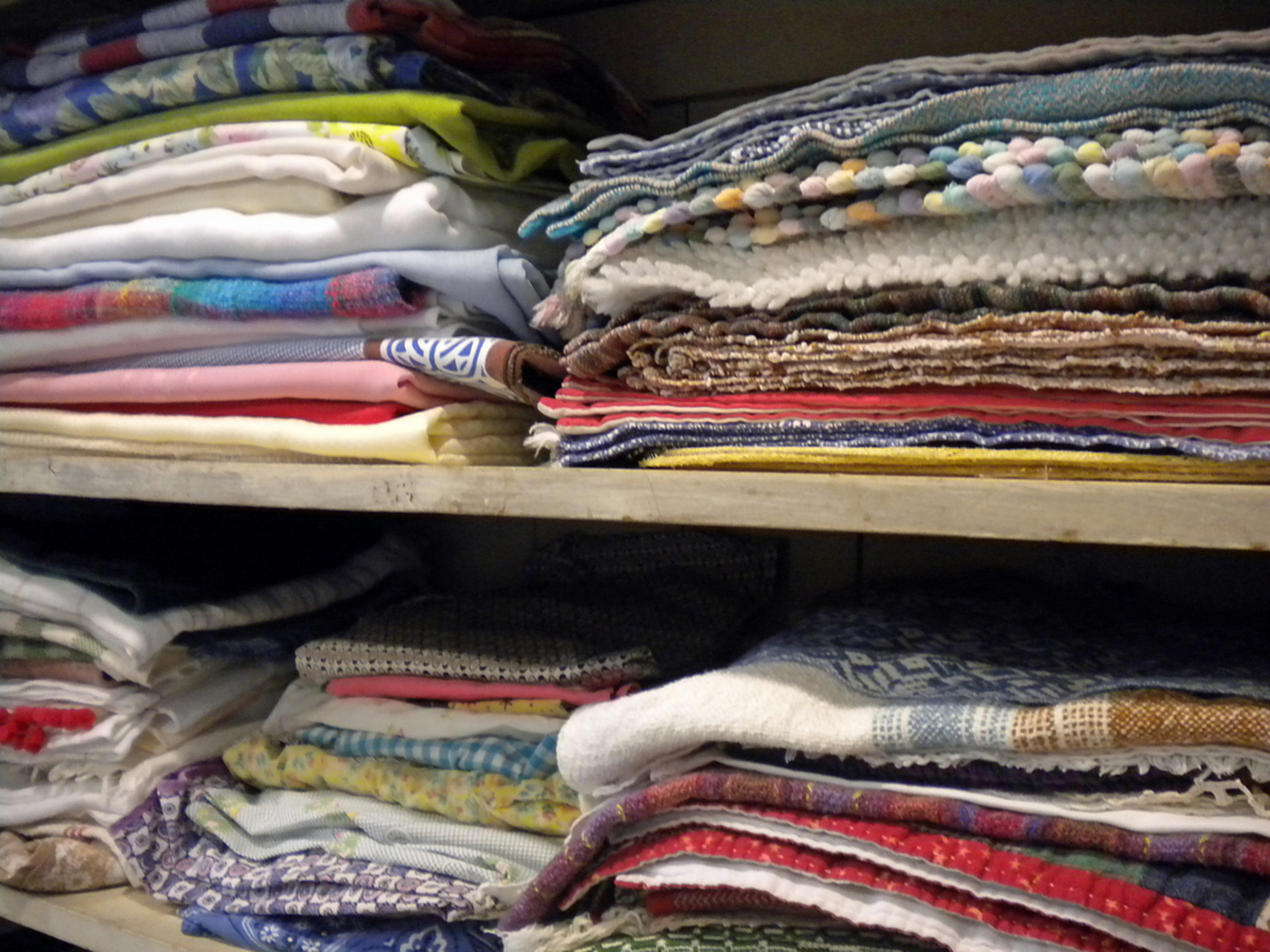
I have a pie cupboard full of table linens — both tablecloths and placemats (more than I actually use, but that’s another story.) The tablecloths came to me from my mother and my mother-in-law and some I received as wedding gifts. I do use them, just not every day.

Placemats and tablecloths for all occasions

Placemats and tablecloths for all occasions

But every day, there are placemats on our table. I have a few favorite sets and some seasonal ones. Some are super easy to care for, others are a little more challenging (like the fake straw ones I received many years ago and still am not quite sure how best to clean them – therefore they don’t get used). There are rag placemats that were made by a women’s cooperative in Latin America, there are fine cotton placemats. There are samples of designs I’ve sold and leftovers from the ends of warps.

I like the old tablecloths from the ‘40’s and ‘50’s. I like the flowers and the sense of style they gave a humble kitchen. There are many still out there in estate sales and flea markets.

But I like my placemats too. So I guess I’ll make some more placemats and as I’m weaving, I’ll imagine how they’ll brighten someone else’s kitchen table.

The Evolution of an Idea

12 Thursday Mar 2015

Posted by jeanweaves in Coverlets, Doubleweave, Weaving Inspiration

≈ 3 Comments

Tags

Coverlets, creative inspiration, Doubleweave, Early American Weaving, Weaving

Block Doubleweave, Second Warp

Block Doubleweave, Second Warp

Every project starts somewhere, inspired by some need, some desire for color, a picture in a book or magazine, a piece in a store window. My Mom tells the story of her grandmother seeing a crocheted doily in a shop window during the Depression, studying it, and then going home to recreate it. Inspiration!

Weaving drafts give the directions that tell the weaver what to do. Drafts consist of four elements:

  1. the threading: the order the threads are arranged
  2. the treadling: which treadle to press when
  3. the tie-up: how those treadles are connected to the shafts
  4. the draw-down: what the pattern will look like with all of the above

    Doubleweave Draft

    Doubleweave Draft

The inspiration for my block doubleweave goes back to a class at Madelyn Van der Hoogt’s Weavers School when it was still in Missouri. I pulled out my class notes and studied the draft. The blocks – the areas where the colors change – form a pine tree and snowball design, but what if I changed the order of those blocks? How would the overall design change?

The easiest way to change a pattern is to treadle it differently, so I played around with the order of those blocks. Weaving the blocks in the same order as they are threaded, “as drawn in,” produces rings in the corners with ovals and diamonds in the center, like the green placemats. But I’m not a production weaver, so after weaving a couple placemats in this design, I started to ponder how to change it yet again without rethreading.

Doubleweave Designs Evolving

Doubleweave Designs Evolving

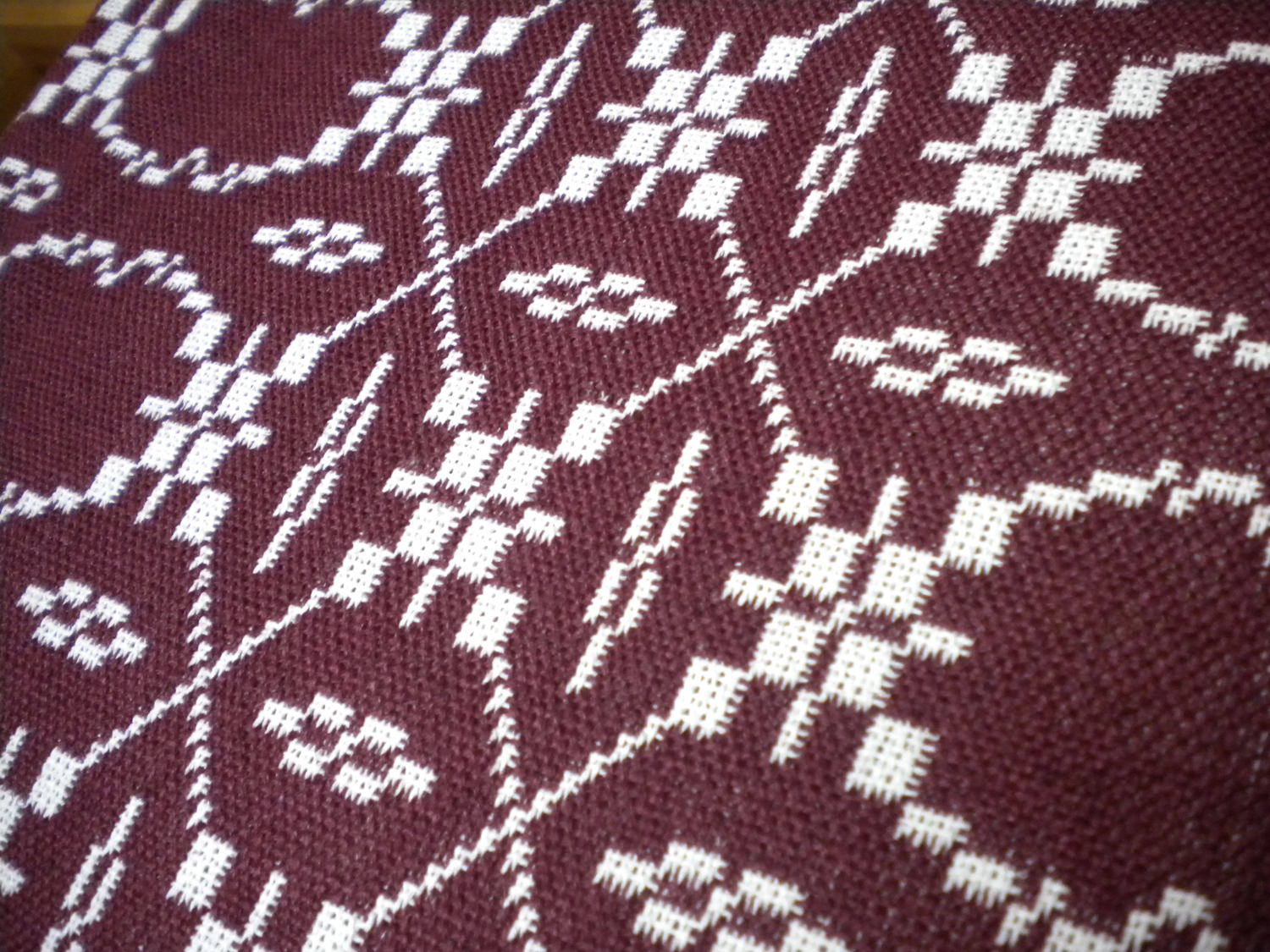
Again, I looked at the block order. What if I treadled just one set of blocks over and over? How about treadling them in point order – back and forth, one repeat of each? There are so many possibilities. I have the second pattern on the loom now in a natural pattern against a deep wine background, and a third set will tie on after it in yet different colors. Three different designs with one threading, just by changing the block order!

This is the evolution of design.

On Drawlooms

21 Saturday Feb 2015

Posted by jeanweaves in Doubleweave, Looms

≈ 5 Comments

Tags

Doubleweave, Looms, Weaving

Patterned Doubleweave in Progress

Patterned Doubleweave in Progress

Drawlooms. Sigh.

When I bought my Glimakra countermarche, I included a drawloom attachment with 20 pattern shafts. These shafts are separate from those that weave the ground cloth. I had worked on one of these looms at the Weavers School in the early ’90’s and fell in love with the intricate design possibilities. Alas, the class looms were set up beforehand and we didn’t go into how to get from frame to warp.

Over the years, I read whatever I could find on drawlooms and their set-up, but my learning style is hands-on and I confess that I often have to read something many times before I can visualize it. It’s only in the execution that things start to click. And sometimes my understanding (or lack thereof) is reflected in the results. Mostly I learned by trial and error. A lot of error.

Gracious, experienced weaving friends held my hand, patiently suggested I needed more weight here or there, and explained that yes, that tie-up is right, just try it. To these I owe so much!

Recently I was going through my old weaving records and found that I had successfully woven opphämta many years ago, just not very much of it. This is a lovely pattern weave on a plain weave or basketweave background. That’s on my to-weave list for this year. And I had looked into figured doubleweave previously too, even though I couldn’t find samples from the drawloom.

The structure I’ve had the most success with has been 5-shaft satin damask. Not all my pieces have been satisfactory, but with each one, I learn more. I look forward to weaving more damask soon.

Threaded Pattern Heddles

Threaded Pattern Heddles

All this is background to what has been a learning curve over the past couple weeks. Using “Dress Your Swedish Drawloom” video with Becky Ashenden of Väv Stuga Weaving School, I set about threading figured doubleweave on my drawloom.

This is a great video with a lot of step by step instruction. I watched it several times, referring back to specific steps. In particular, I noted how she teaches threading the loom while sitting inside the frame. The video clearly explained the positions of each part of threading this way. I’ve read about this before, but never tried it. I should have long ago! It is so much easier on the body—much less stretching and reaching.

And I only dropped all my heddles once, watching in dismay as they slid off the bar in slow motion like a bad movie. O my! But back on the bar they went. I also had difficulty transferring the pattern heddles to the individual lower pattern shaft bars, probably because I didn’t have enough weight on them, which resulted in having to do some rethreading.

The warp threaded through pattern and ground heddles, then through the reed.

The warp threaded through pattern and ground heddles, then through the reed.

It took a couple extra days inside the loom, but the warp is on and the weaving is progressing. I will have to adjust the pattern so that the motif is more of a circle than an oval, but overall, it’s exciting to see the pattern take shape (see above). I’m working with two shades of jade with this warp, but plan on do some more with other hues. After all this work to get it threaded, I want to weave more than just one warp on it!

Then after the doubleweave, it’s on to opphämta and some more damask. Weaving is a learning adventure!

← Older posts
Newer posts →
Shop!

Follow Us

  • Facebook

Galleries

  • Towels to Use and to Give
  • Runners
  • Scarves for Him and Her
  • For the Table
  • Note Cards
  • Animals
  • Throws
  • The Linen Press
  • Privacy Policy

Subscribe

  • RSS - Posts
  • RSS - Comments

Archives

  • September 2020 (2)
  • October 2019 (1)
  • August 2019 (1)
  • July 2019 (2)
  • June 2019 (2)
  • March 2019 (1)
  • November 2018 (2)
  • September 2018 (1)
  • July 2018 (2)
  • May 2018 (2)
  • April 2018 (1)
  • February 2018 (2)
  • January 2018 (1)
  • December 2017 (1)
  • November 2017 (2)
  • October 2017 (3)
  • August 2017 (1)
  • July 2017 (1)
  • June 2017 (2)
  • May 2017 (2)
  • March 2017 (2)
  • February 2017 (2)
  • January 2017 (2)
  • December 2016 (1)
  • November 2016 (1)
  • October 2016 (2)
  • August 2016 (3)
  • June 2016 (1)
  • May 2016 (1)
  • March 2016 (2)
  • February 2016 (1)
  • January 2016 (1)
  • December 2015 (1)
  • November 2015 (3)
  • October 2015 (1)
  • September 2015 (4)
  • August 2015 (1)
  • July 2015 (2)
  • June 2015 (1)
  • May 2015 (1)
  • April 2015 (2)
  • March 2015 (2)
  • February 2015 (2)
  • January 2015 (2)
  • December 2014 (1)
  • November 2014 (3)
  • October 2014 (1)
  • September 2014 (2)
  • August 2014 (1)
  • July 2014 (3)
  • June 2014 (1)
  • May 2014 (2)
  • April 2014 (2)
  • March 2014 (2)
  • February 2014 (2)
  • January 2014 (2)
  • December 2013 (2)
  • November 2013 (1)
  • October 2013 (1)
  • September 2013 (3)
  • August 2013 (1)

Blog at WordPress.com.

Privacy & Cookies: This site uses cookies. By continuing to use this website, you agree to their use.
To find out more, including how to control cookies, see here: Cookie Policy
  • Subscribe Subscribed
    • jeanweaves
    • Join 62 other subscribers
    • Already have a WordPress.com account? Log in now.
    • jeanweaves
    • Subscribe Subscribed
    • Sign up
    • Log in
    • Report this content
    • View site in Reader
    • Manage subscriptions
    • Collapse this bar
 

Loading Comments...