• Home
  • Shop
  • About
  • Exhibits
  • Contact me

jeanweaves

~ Jean Williams, Handweaver

jeanweaves

Tag Archives: Weaving

How Long?

22 Thursday Oct 2015

Posted by jeanweaves in creating, Planning, Towels

≈ 1 Comment

Tags

creative inspiration, Towels, Weaving

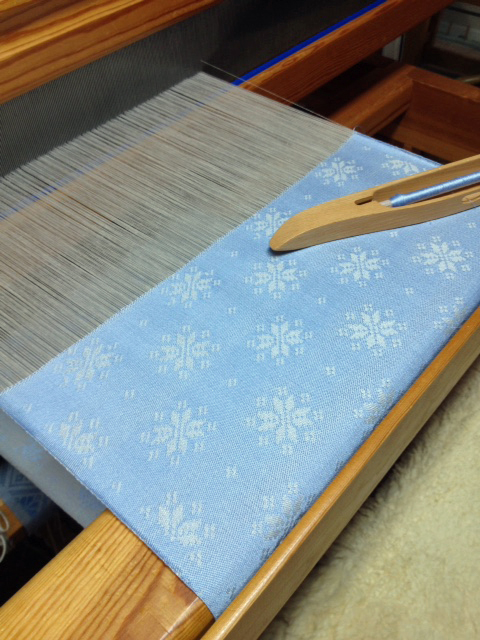
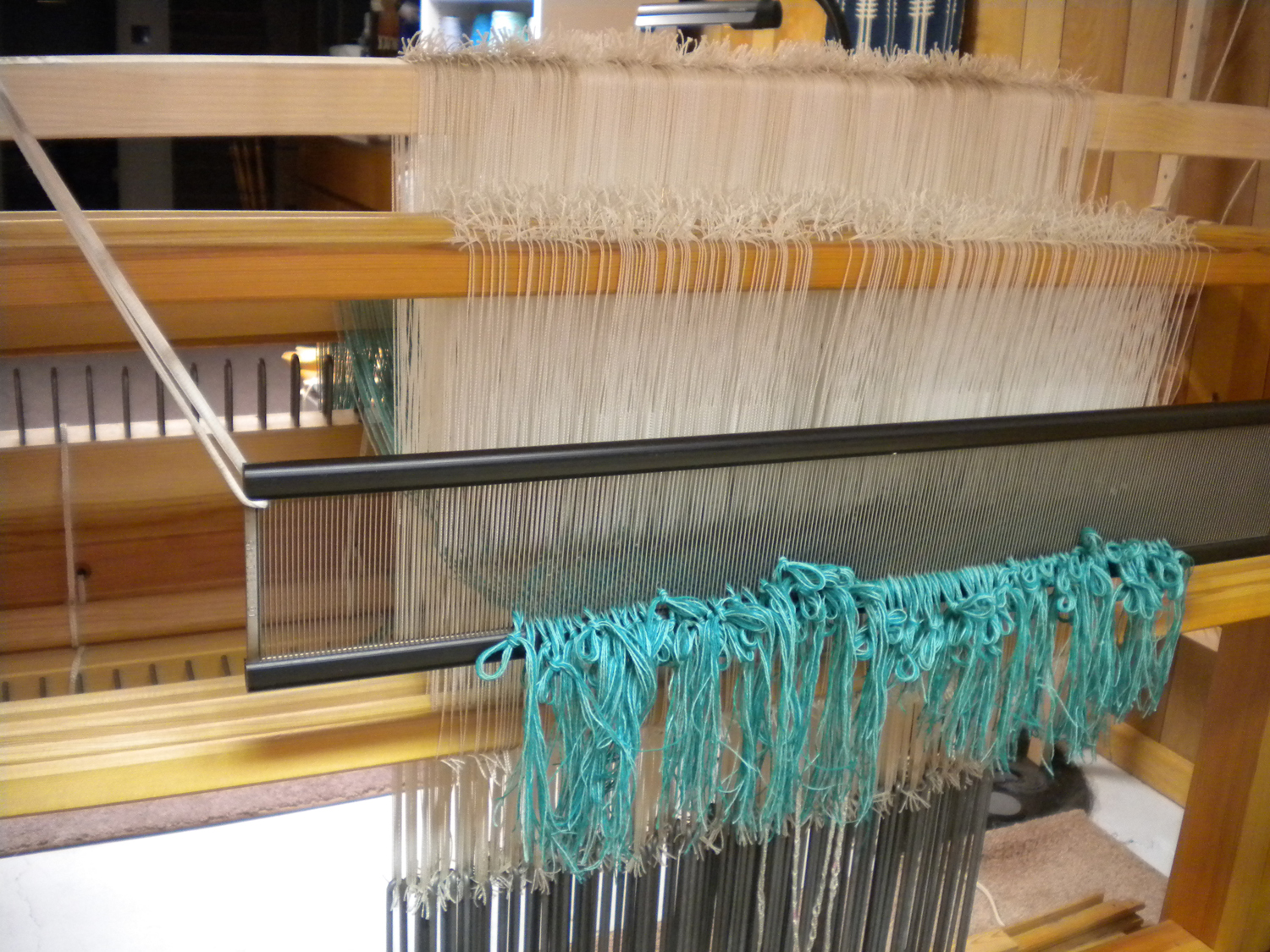
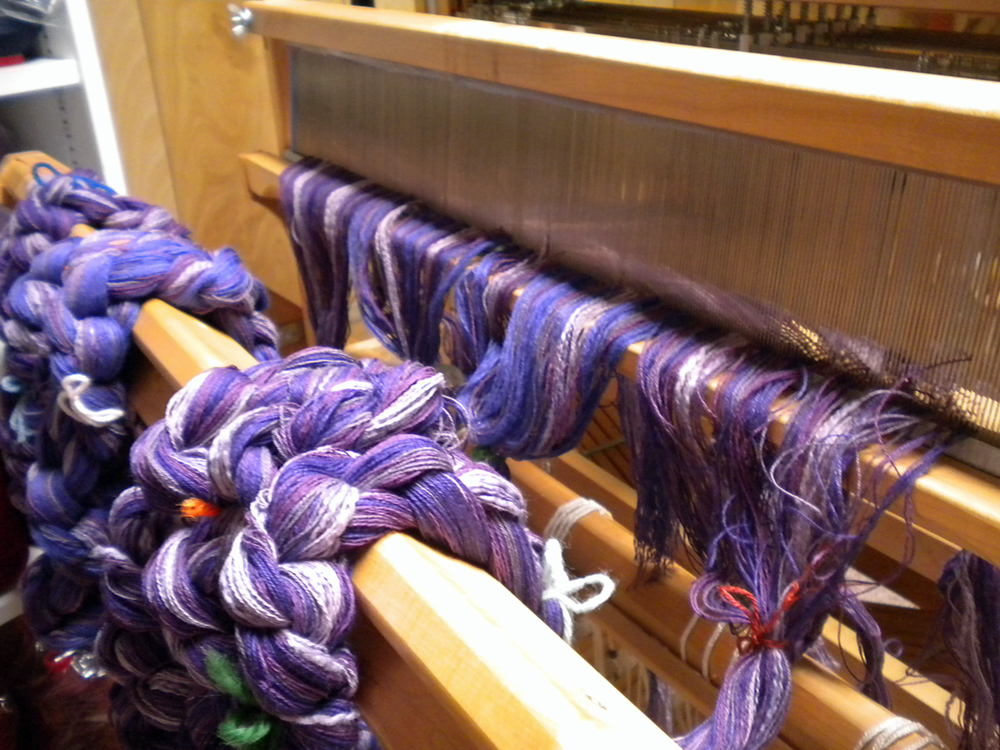
View from the front, warp chains threaded through the reed.

View from the front, warp chains threaded through the reed.

“How long does it take to weave that?

It’s a common question I hear. So, do you want the long answer or the short answer?

The short answer to the question? “About an hour per towel.” The long answer? “It depends.”

I have tried to time projects just to get a better idea on how to answer, but where do I start?

The seed for each warp often springs from an earlier project. As I weave, I consider how I could choose a slightly different colorway or wonder what would happen if I treadle this threading as if it were a different structure entirely, weaving an overshot as if it were a lace weave for instance. So the planning is sort of fluid and therefore, hard to “time.” Putting it into an actual planning sheet doesn’t take long in itself, but my indecision can really take a while to ferment into a cohesive plan.

Then there’s the time it takes to measure the warp. I typically weave 8 or 9 towels at a time. This can run anywhere from 9 to 10 yards. If I use a finer thread, I will need more of them to get a towel 20-24” wide. The warp I measured the other day needed 568 threads, each 10 yards, 8” long. And if there are multiple color changes, that takes time too. To make it easier to handle, I break that number into four or five “bouts” or groups of threads, chain them up and take them to the loom. It took maybe about 3 hours to wind that warp. (You see? Not very exact.)
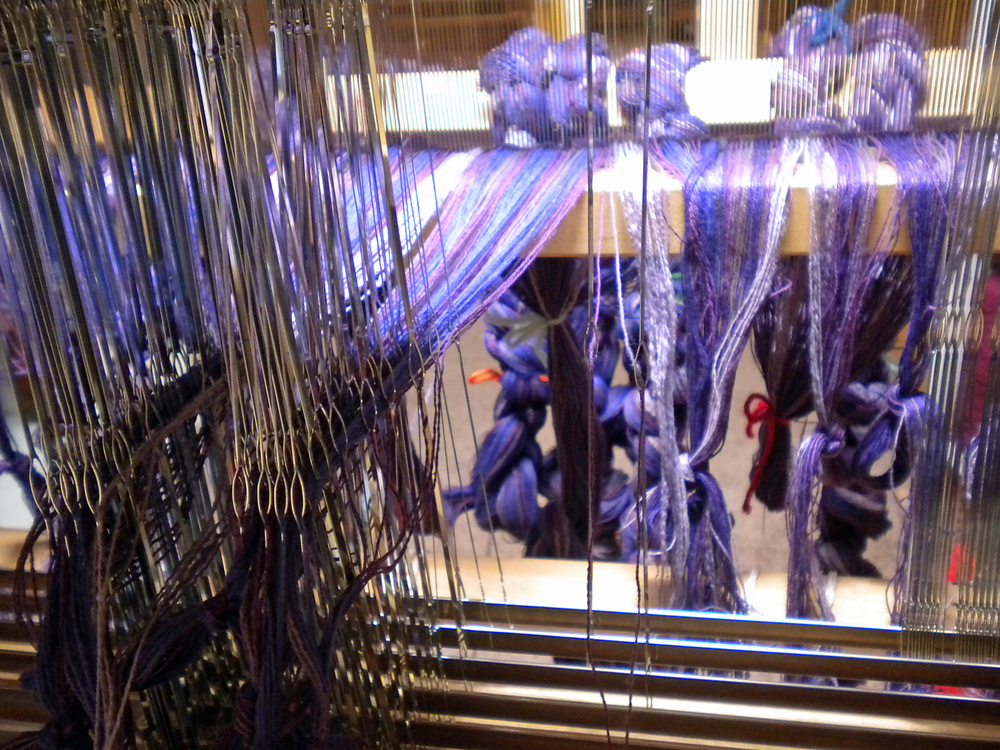
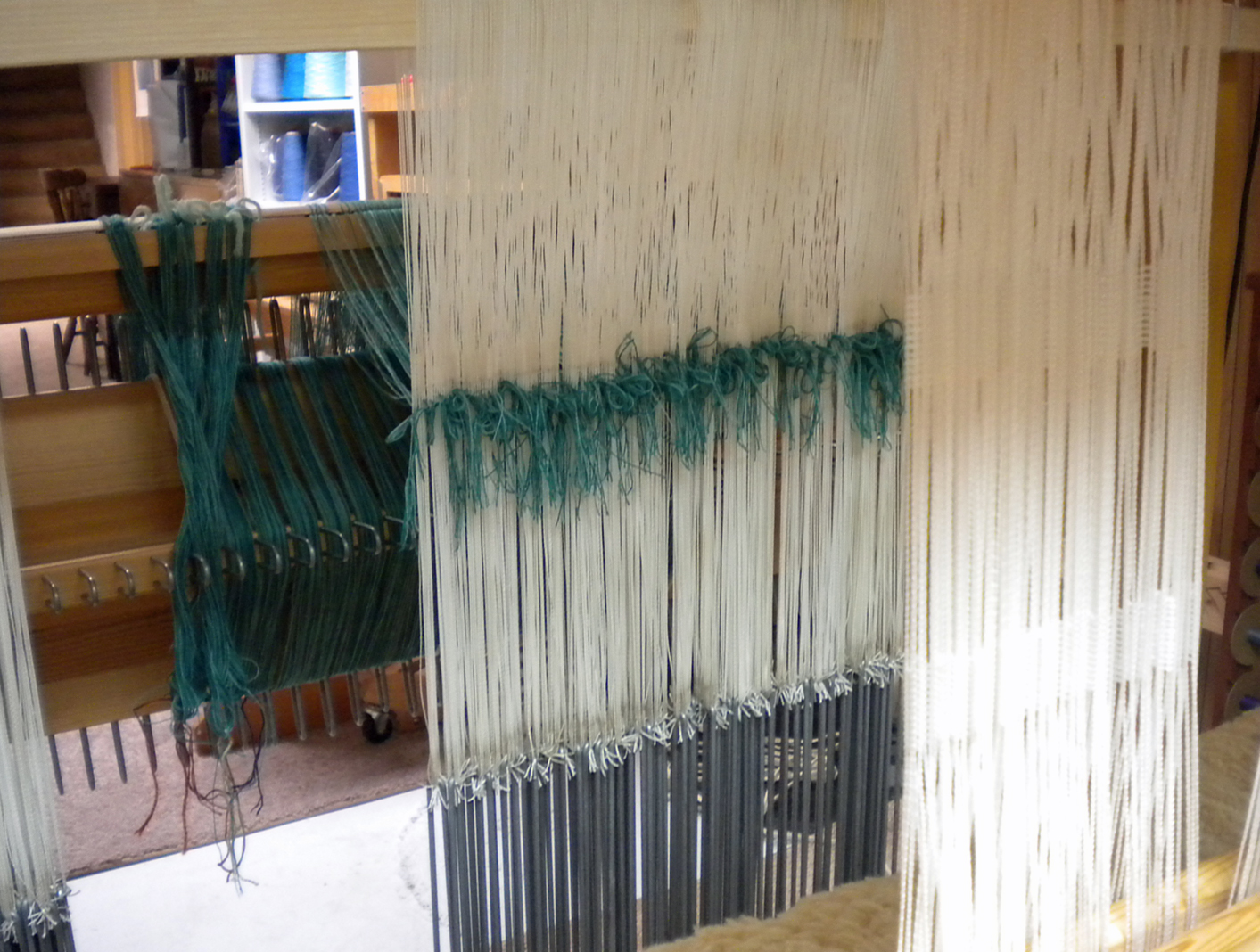
View from the back of the threads coming through the reed and the heddles.

View from the back of the threads coming through the reed and the heddles.

Once at the loom, every thread has to go through the reed and a heddle—in the right order!  Sleying the reed usually doesn’t take as long, typically about an hour or so, again depending on the fineness of the threads and how many go through each dent (slot). Threading the heddles, though, can take the better part of a day and half. Not as young as I used to be and I have to get up and stretch more often.

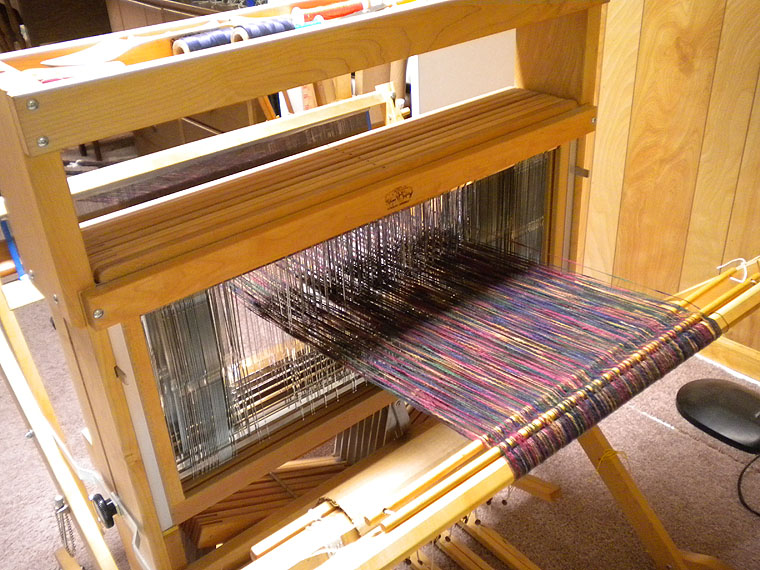
After the warp is threaded, it has to be wound onto the warp beam. Here is where I find out if I’ve inadvertently crossed any threads between the reed and the heddles. If I don’t have tangles, the winding on goes pretty quickly—about an hour or so, depending on the length of the warp. After I tie it onto the breast beam, spread the warp, and adjust the tension, I’m ready to weave. This is the fun part.DSCN1466
So the next question, sometime spoken, sometimes not, is “Why do you do something by hand that can be done so much cheaper commercially?”

There is a value in the connection between the hand and the product. We’ve gotten so far away of an item’s source that we don’t care about it anymore. But if we know that a person took the time to choose the colors and plan how those threads will cross, will we not see that cloth in a different light? Will we not appreciate that item more and elevate the task it’s used in to be more than it was? Whether it’s a handmade quilt, or homemade jam, or handspun yarn, or handwoven towel, it’s the “hand-“ and the “home-“ that make those items more valuable because someone took the time.

Besides I love to weave.

How long does it take you to do what you love?
A Satin by Any Other Name…

25 Friday Sep 2015

Posted by jeanweaves in Damask, Satin, Terminology

≈ 3 Comments

Tags

Damask, Satin, Textiles, Weaving

My apologies to William Shakespeare:

“What’s in a name? That which we call a rose
By any other name would still smell as sweet.”

Act II Scene II, Romeo and Juliet

What do you picture when you think of satin? Something smooth, with a sheen that reflects the candlelight? A fabric somewhat heavy but with a lovely drape? What is satin?

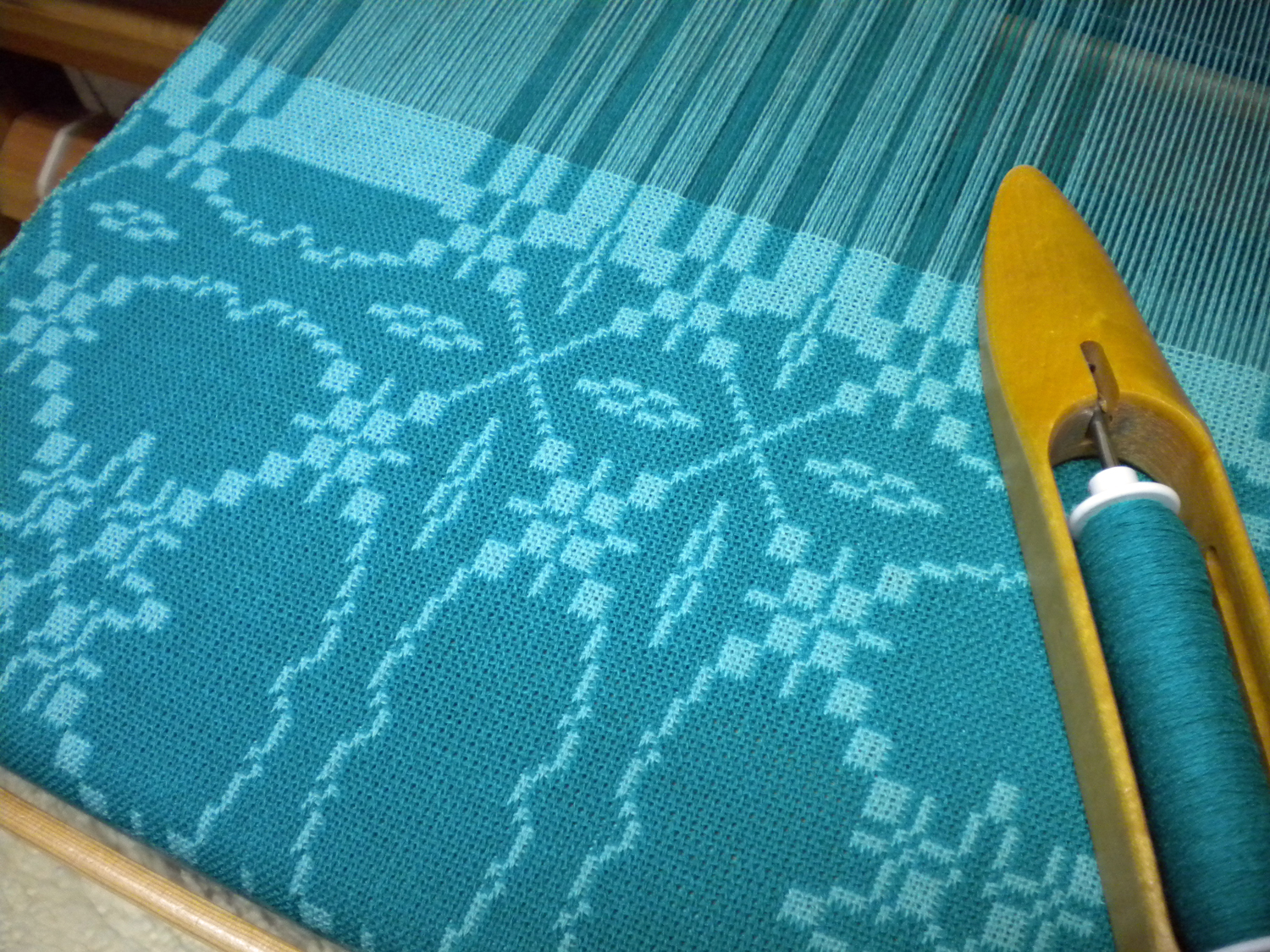
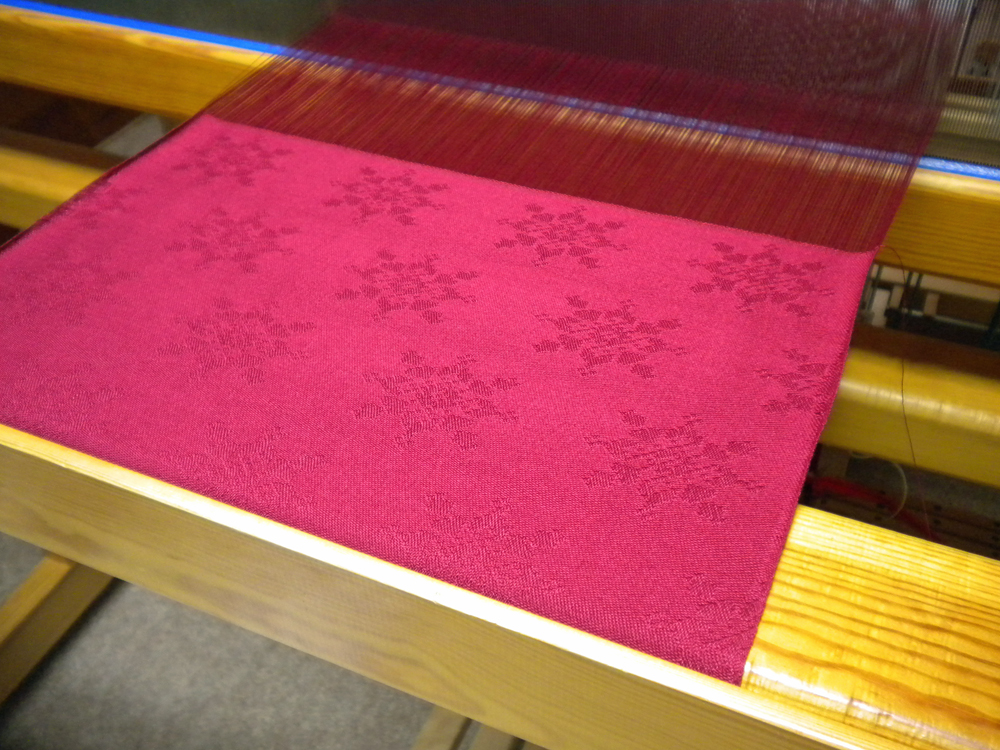
Red Damask on the loom

Red Damask on the loom

What do you think of when you hear “damask”? Do you see figured tablecloths on your grandmother’s holiday table? Do you see a dense fabric in a single color or an elaborate upholstery for the sofa?

In popular usage, satin is that shiny, slippery fabric commonly used in wedding gowns – and sometimes sheets, although I’m told that satin sheets don’t live up to their hype. Damask can be heavy suiting, upholstery, or table linens.

In weaving terminology, satin is “a weave with warp floats on one surface of the cloth and weft floats on the other.”  (van der Hoogt,  Madelyn, The Complete Book of Drafting for Handweavers. Coupeville, Washington: Shuttlecraft Books, Inc., 1993).

Snowflake Damask Runner

Snowflake Damask Runner

“Satins have one binding point only on each warp thread within the repeat.” (Cyrus, Ulla, Manual of Swedish Handweaving. Boston, Massachusetts: Charles T. Branford Company, 1956). Having only that single binding point produces long floats which reflect the light, thus giving satin its sheen. Using fine threads with more luster accentuates that characteristic of satin. Satin is closely related to twill but because those tie-down threads are scattered, there is no characteristic diagonal line.

Handwoven satin is not as fine as machine-produced satin, mainly because factory-produced cloth uses much finer threads than are available to handweavers. Nonetheless, handwoven satin produces a lovely fabric!

“Damask is a self-patterned weave which…is based on interchanging areas of warp and weft emphasis.” (Johansson, Lillemor, Damask and Opphämta. Stockholm, Sweden: LTs Förlag 1982). Satin is often used in weaving damask, but other weave structures can be used in one of the faces, satin with twill for example.

I’ve dabbled in weaving satin damask for many years and each time I thread the loom, I learn something else. This summer, I’ve learned a new way to weight my ground shafts so they come back to a neutral position (simple elastic straps). I’ve also played around with some floral motifs gleaned from early weaving manuscripts.

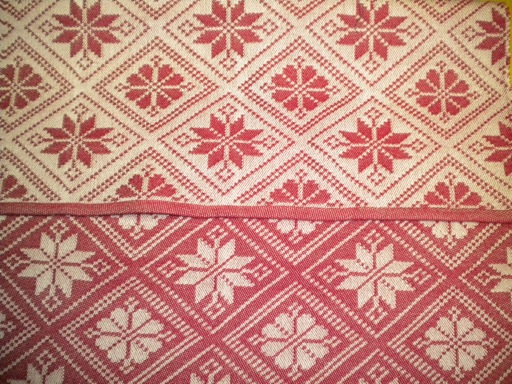
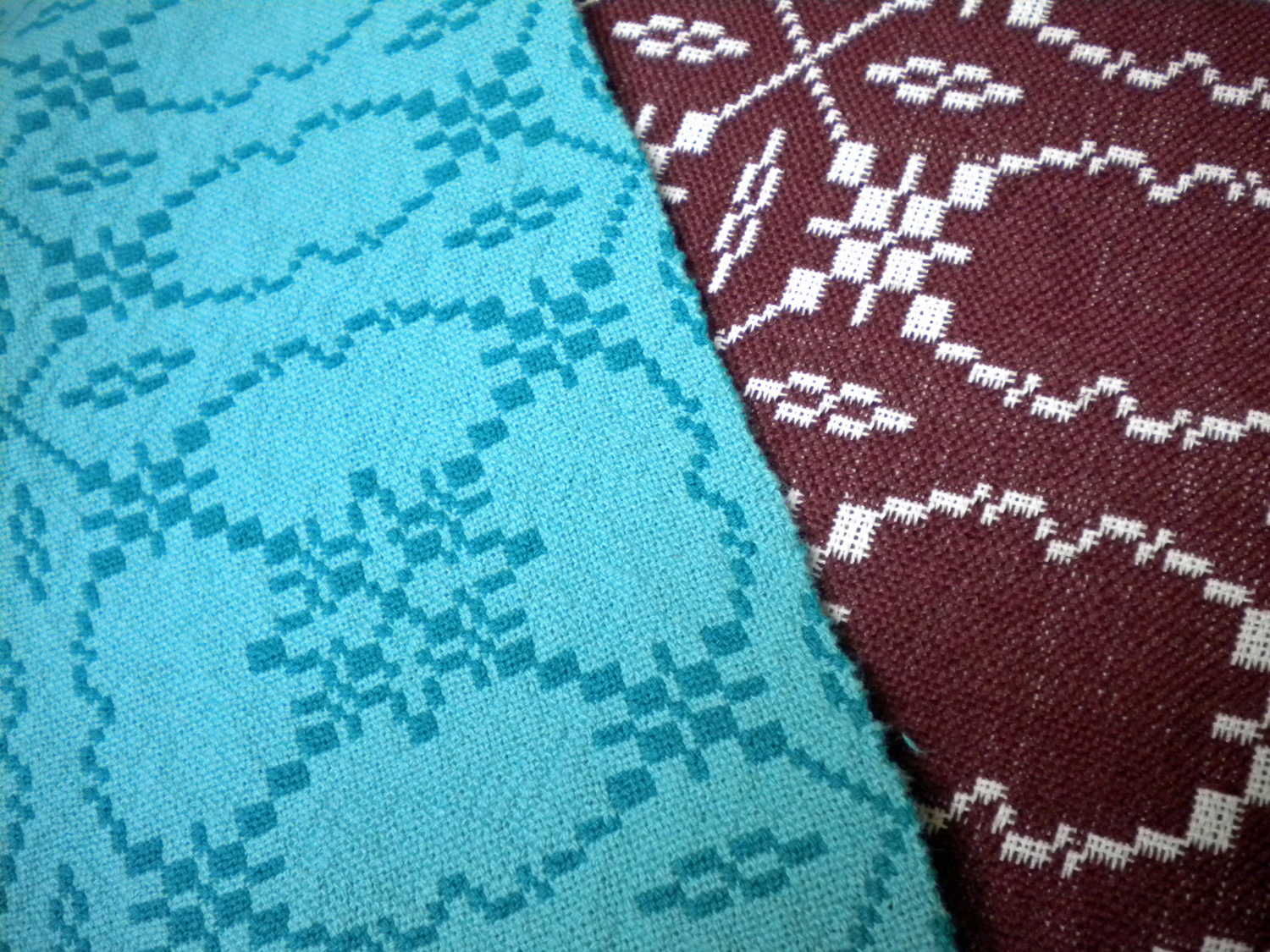
Red and White Dräll (as opposed to "damask"), front and back

Red and White Dräll (as opposed to “damask”), front and back

I feel like I have so much to learn about these structures. Case in point, in researching for this blog, I realized that I have been using the term “damask” exclusively when some of what I weave is more correctly classified as dräll weave which uses repeating blocks for patterning whereas “the patterning in damask is…freer and richer than the geometrical figures in dräll.” (Johansson).

I’d like to see how 8-shaft satin differs in look from 5-shaft satin. That experiment is yet to come. A friend also noted that a lot of early manuscripts show drafts that combine satin on one face with a different weave on the other face. Intriguing.  That too begs to be studied.

What do you think of when you hear “satin” and “damask”? Let me know.

The Wool Review

03 Thursday Sep 2015

Posted by jeanweaves in Scarves, Wool

≈ 2 Comments

Tags

Scarves, Weaving, Wool, Yarn

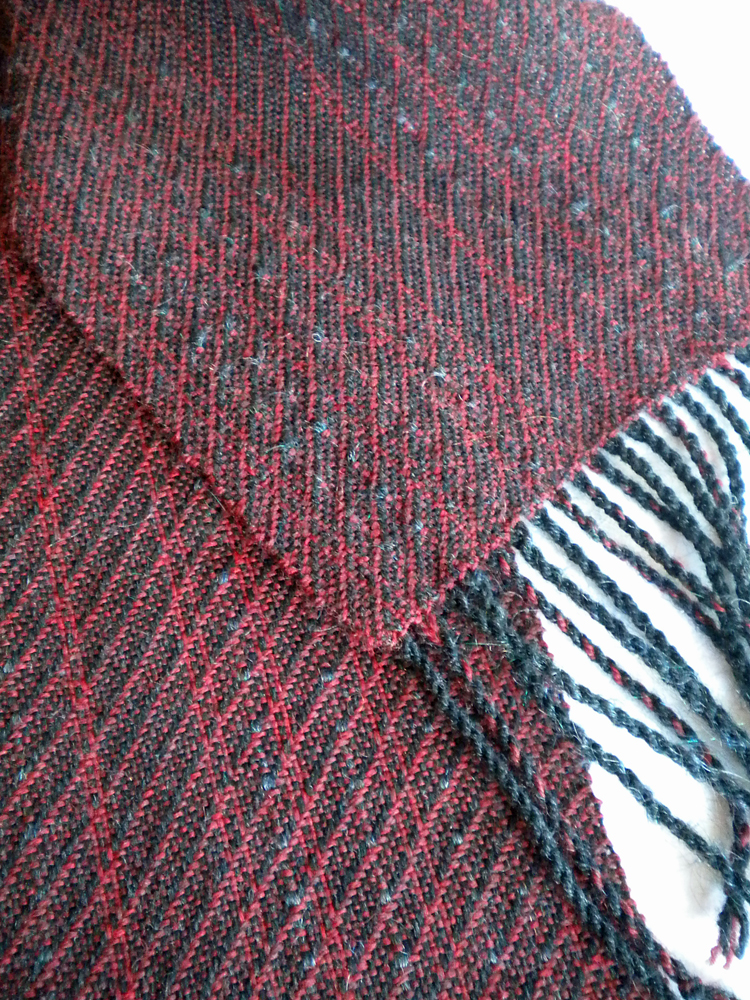
Cranberry Scarf

Cranberry Scarf

This week I’ve been working on some wool scarves since we are moving into the cooler fall weather. I had some slate Shetland wool and some cranberry Jaggerspun wool, both 2/8 weight, that I thought would go well together. And for an added interest, I put in a few threads of some iridescent black rayon which has quite a “hairy” look. I thought a little fluff in the scarves would be nice.

I sett the warp fairly loose, just 16 ends per inch, to give the wool room to bloom in the finishing process. (What a difference from the 52 epi satin weave on my other loom!) I also focused on beating very lightly, 15 picks per inch. I didn’t want to make a stiff board – I’ve done that before and that scarf was not very pleasing!

I haven’t woven that much in wool and I approach the finishing cautiously. Wet-finishing (basically washing) is necessary to make the fiber bloom. The combination of heat and agitation opens up the fiber. Not enough agitation and the fiber remains somewhat stiff. Too much agitation and it felts. So I had to experiment to find the “Goldilocks” amount of finishing for this wool. What is “just right?”

Cranberry sample

Cranberry sample

Fortunately, I had half a yard of warp at the end that I could play with, so I wove it up the same as the scarves and took it to the wash machine. It didn’t look like it was finished yet after one minute of agitation, so I left it in for another minute. Then I laid the sample out to dry flat.

The wool opened up nicely, resulting in a soft and light-weight fabric. The rayon fibers did not fluff like I’d expected, so I gave the surface a little brushing. More vigorous brushing would be necessary if I really want the rayon to come to the surface. It will probably work its way out as the scarves are worn, but for now, the rayon just gives the surface a slightly grey cast. The rayon also didn’t shrink up the same as the wool, so there is a little rippling. That is to be expected when combining different fibers, but I’m glad I didn’t use too much of it.

Now I had a little more confidence in how to finish the actual scarves. I chose to agitate in very warm water for 1 ½ minutes only and rinse in the same temperature water. This is not a project I could pop in the washer and walk away—it needed to be watched to prevent felting.

Slate Scarf

Slate Scarf

All in all, this was a good learning experience. I may have more wool to work with in the future since I have lots of fiber to spin in my closet. From this comfortable starting place, I can consider more wool projects in the coming year.

What is your latest learning project? Share your progress!

A Weaver of a Different Sort

01 Tuesday Sep 2015

Posted by jeanweaves in Nature

≈ 2 Comments

Tags

Weaving

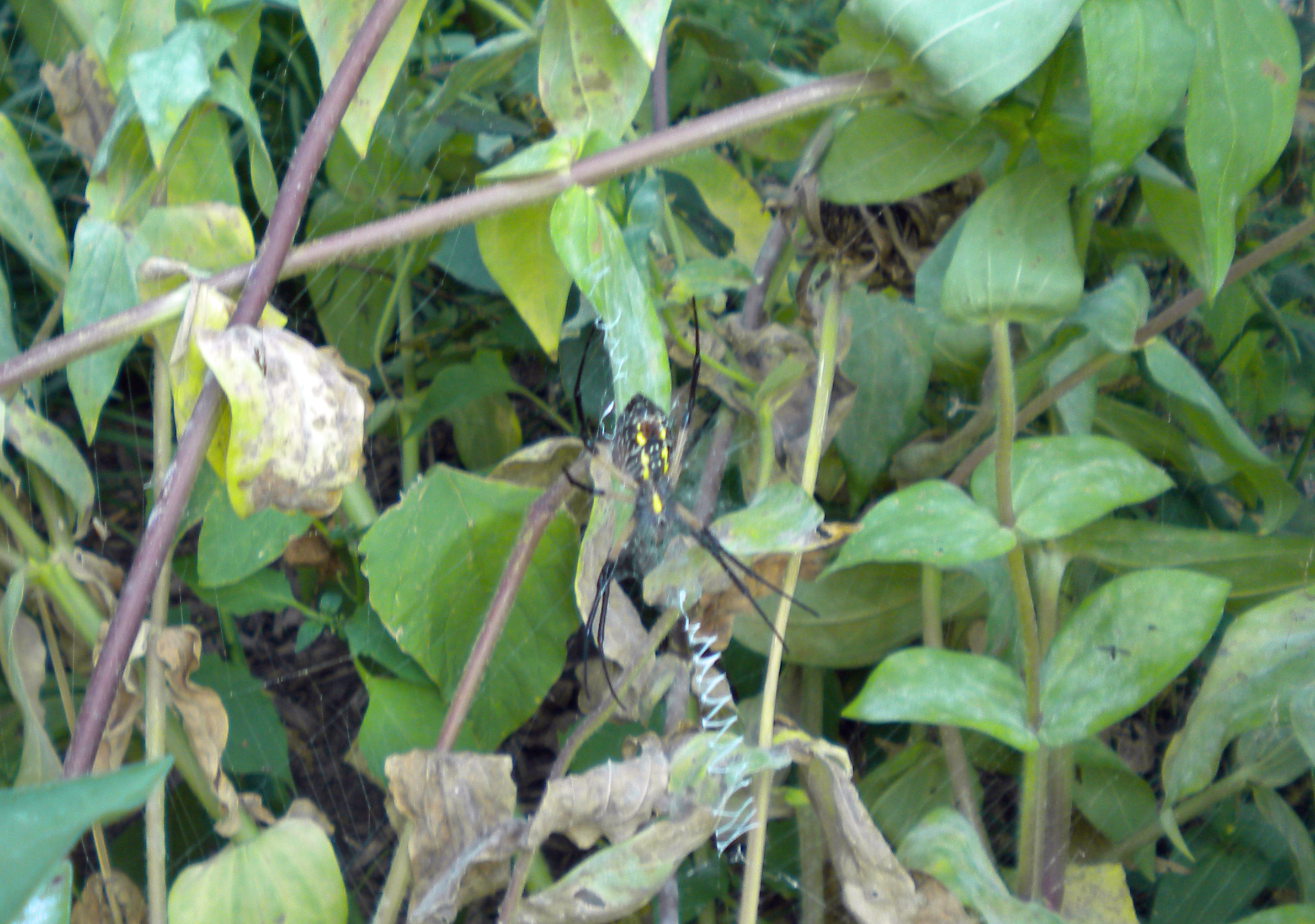
I’m going to come clean right off the bat here—I don’t like spiders. My family can tell many stories of my antics growing up on the farm, where there were plenty of spiders, and the lengths I went to just to avoid them. Even as an adult, I don’t like them. But the Good Lord created them for a purpose, so I just steer clear of them.

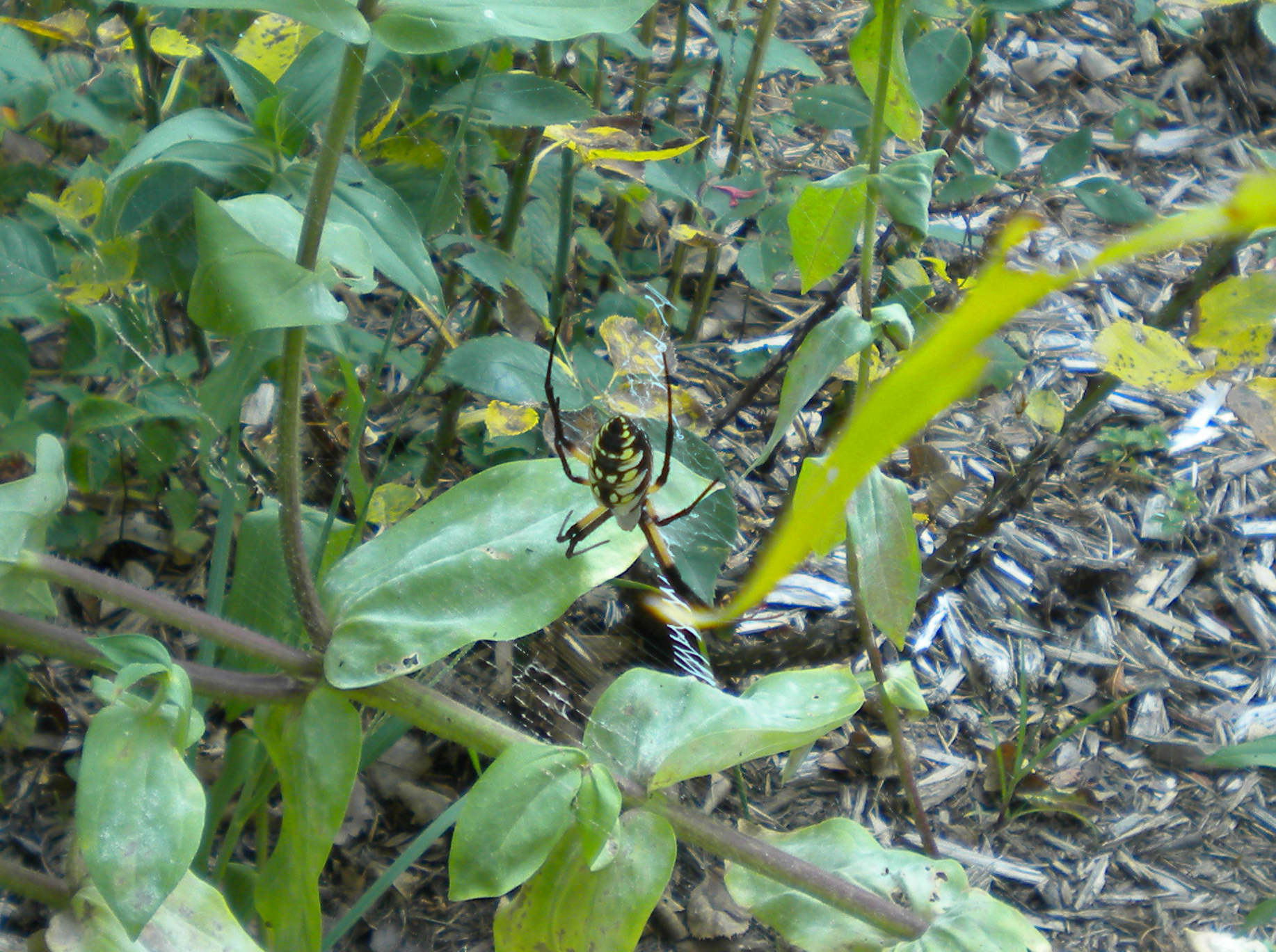
A weaver of a different sort

A weaver of a different sort

Then last weekend I noticed this “lovely” in amongst my fading zinnias. My husband says it is a golden orb spider. She is a weaver of a different sort.

She (he?) is really lovely in her own way. She must be 2” to 2.5” long and her web extends at least a couple feet from stem to stem.  But at the same time, she makes me shudder. I have never seen a spider so big. Fall is on the way here in mid-Missouri and spiders have grown large over the summer months.

Golden orb spider

Golden orb spider

Needless to say, the zinnias will have to fend for themselves until after a frost.

Color Study Continued

01 Wednesday Jul 2015

Posted by jeanweaves in Color, Towels

≈ 2 Comments

Tags

Color, Cotton, creative inspiration, Weaving

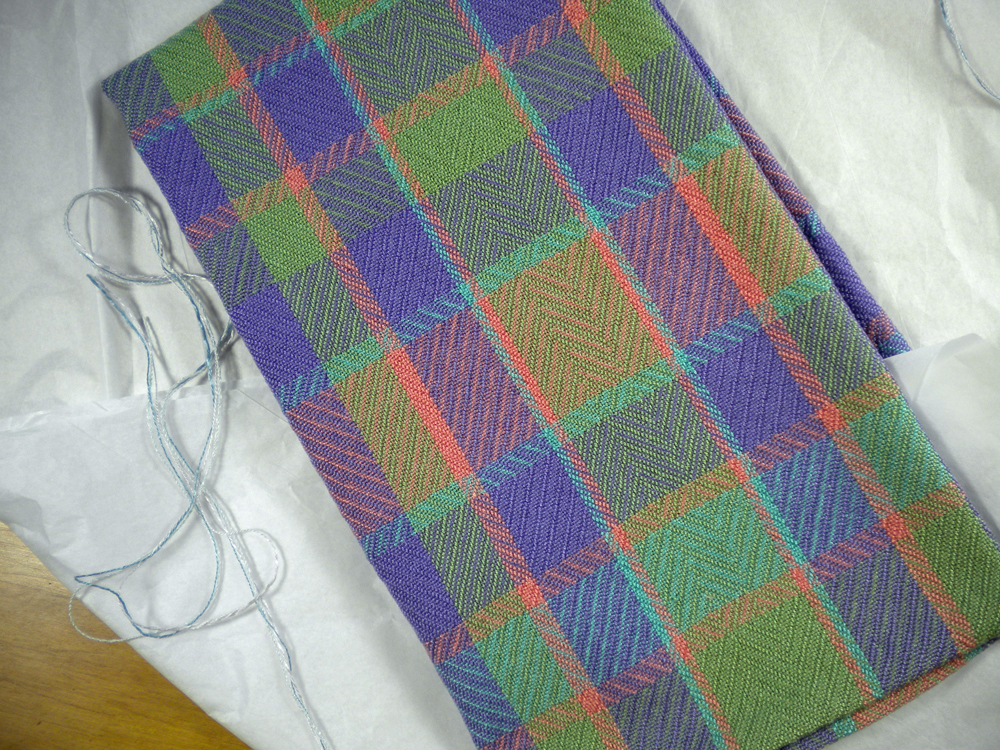
Kitchen Towel in Colors and Checks

Kitchen Towel in Colors and Checks

Continuing last week’s color contemplations, I wove on, and now the warp is finished and off the loom.

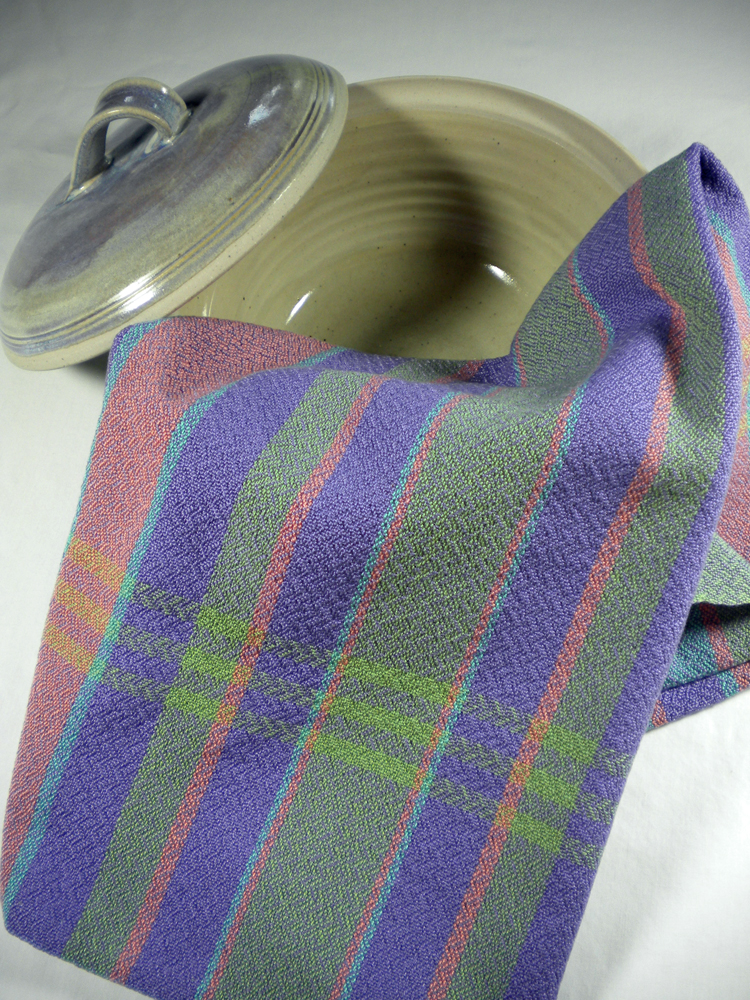
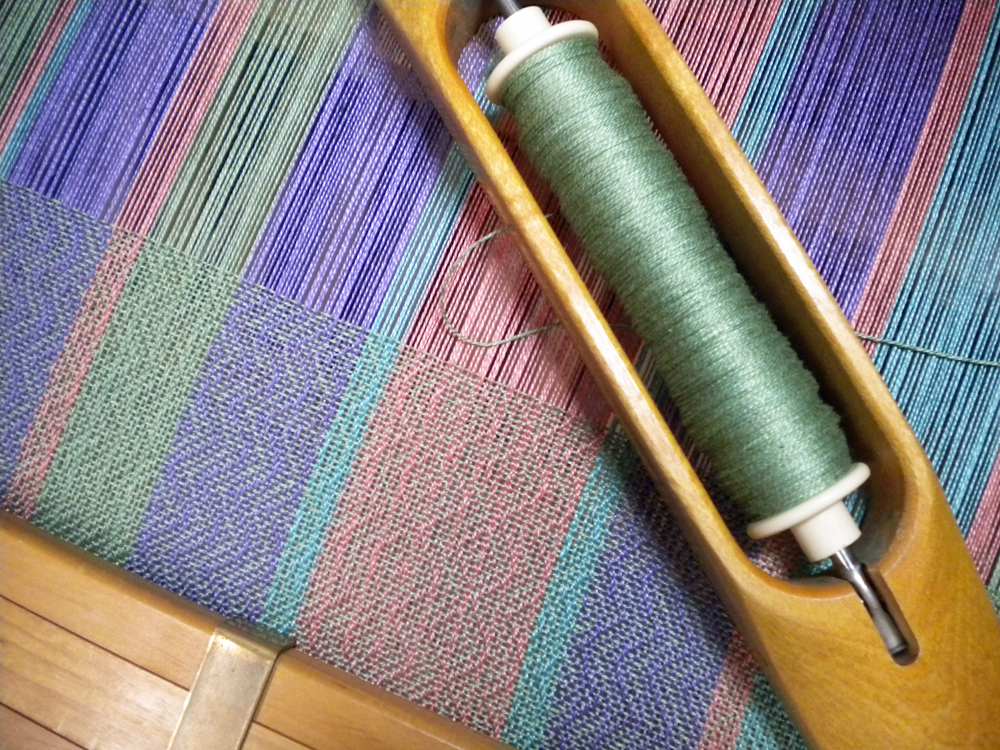
I had wondered if the colors would work. I chose UKI’s Scarab, Quince, Duck, and Lavender. For the record, “Duck” is what I would call a muted turquoise; “Scarab” is what I would call a soft apple green, and “Quince” looks like peach more than orange. And for the most part, I think these colors did play well together. They are similar in value but do come from different regions on the color wheel.

Kitchen Towel Stripes and Lavender

Kitchen Towel Stripes and Lavender

In weaving, it’s not just about how colors will look next to each other, but also how the eye will “read” them from a distance when weft crosses warp. In that respect, two of my choices didn’t work as well as the others. When crossing, Scarab and Duck simply greyed each other out. I was careful not to place them side by side in the warp, but when I used one of them as weft, it necessarily crossed the warp stripe of the other.

There are always surprises.  I’m surprised at how the Scarab pops here. On the cone, it is a soft green, but with the other colors, it fairly jumps off the fabric. And depending on the lighting and what it’s next to, the Quince make look gold or pink.

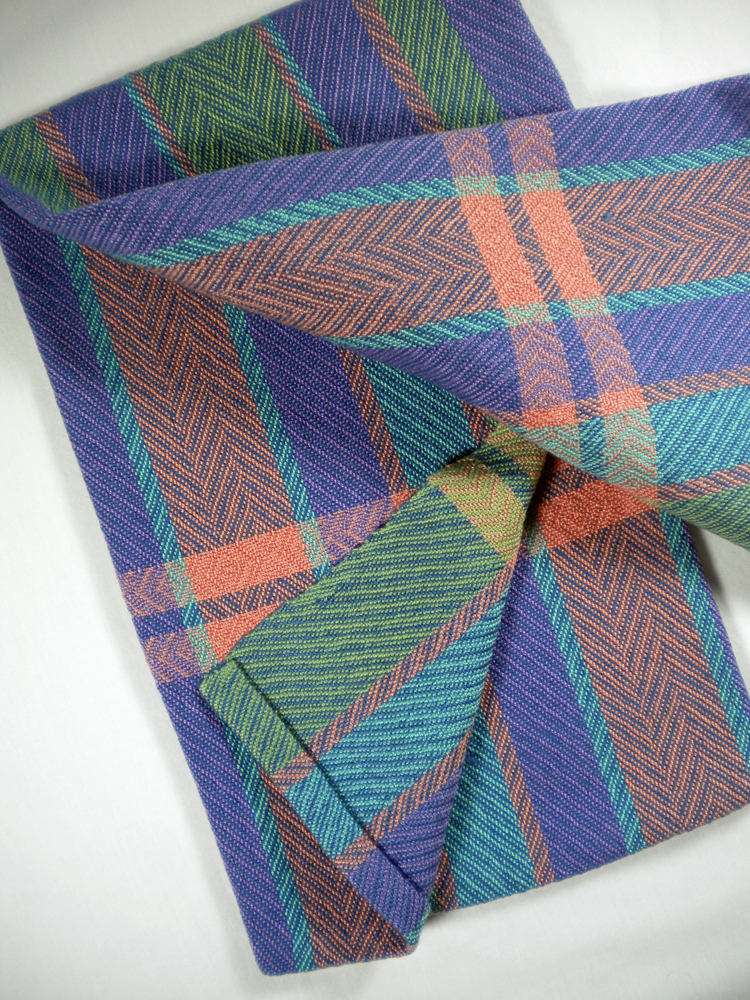
On one pair of towels I used a denim blue weft, a color I thought would recede and allow the warp stripes to stand out. It did just that, as well as softening the whole look in a nice way.

Color is such a subjective thing. What pleases my eye may jar yours. What is soothing or cheerful to one may be distracting and brash to another. While manufacturers may set their “Color of the Year” and expect us to follow their lead, sometimes I just want to break out in my own melody and scheme.

Kitchen Towel Stripes and Denim

Kitchen Towel Stripes and Denim

I have only looked through the window of the whole study of color theory. Someday, I may walk right in and commit to a more thorough exploration, but for now, I note what seems to work on the loom and go on from there. This was a fun project and having made notes on the results, I will continue to learn and continue to be surprised.

What color experiments are you working on?

Hmm…Does that work?

23 Tuesday Jun 2015

Posted by jeanweaves in Color, creating, Planning, Weaving Inspiration

≈ 5 Comments

Tags

Color, creative inspiration, Textiles, Weaving, Yarn

Winding my new warp gives me pause—do these colors work?

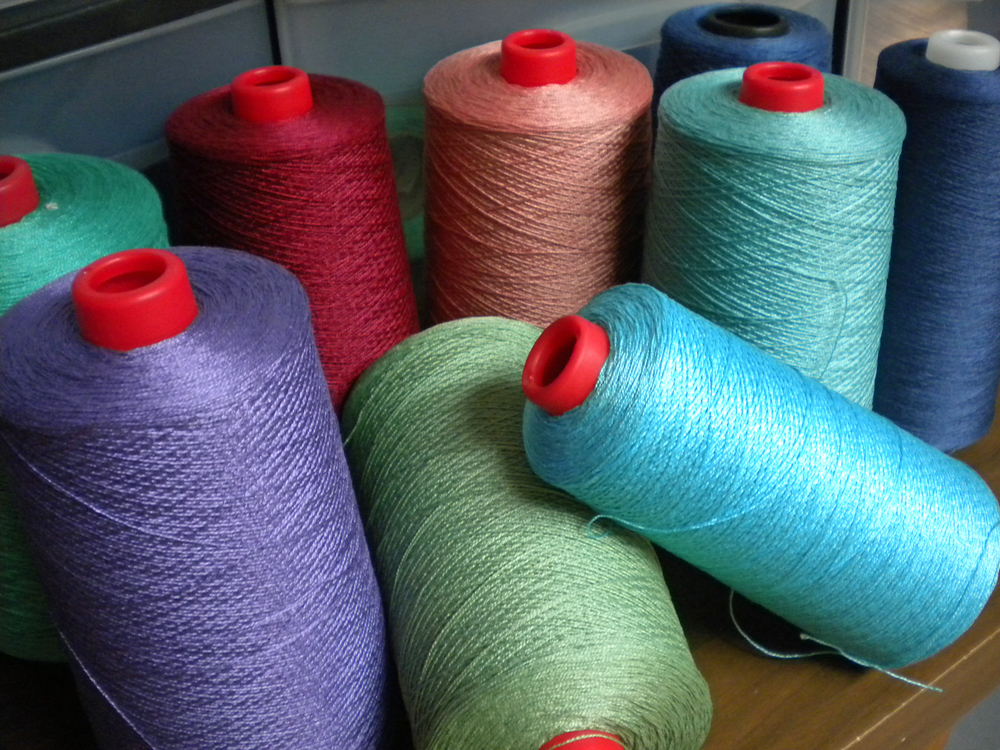
A choice of colors

A choice of colors

Planning colors can be one of the most difficult parts of the weaving process for me. I’ve designed some real ‘dogs’ in my years at the loom, and other times, the colors just glow. I’m definitely more of a “pattern/structure” weaver and a “color/texture” weaver.

Recently I’ve been weaving workshop samples and neutral colors, and really, this week I needed some color. So I went to my shelf and started pulling out cones. Reds, purples, blues, peach, turquoise, green. Which should I choose? Which colors will play nicely together?

Sampling would be the wise route to take, but I’m very impatient to get this one the loom. That may come back to haunt me.

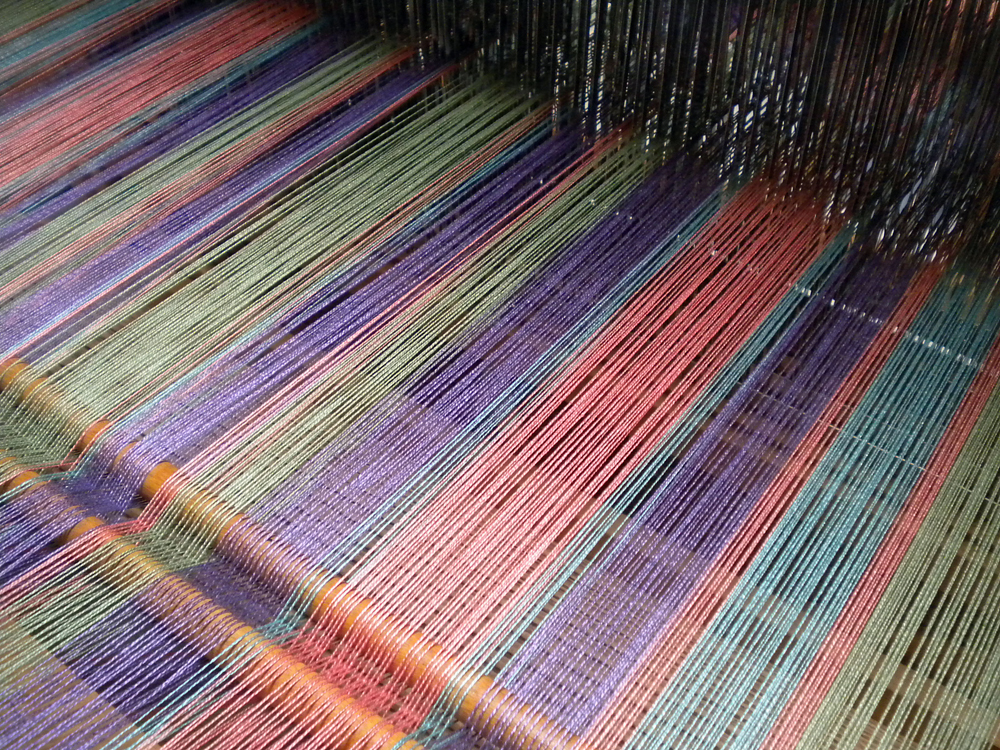
Threaded warp from the back

Threaded warp from the back

I remember hearing Sharon Alderman talk about color—look at what Mother Nature puts together and use that as a starting point.

Okay. I can see some of these colors in my flower garden, but not all of them on the same stem. After some sorting, I settle on UKI’s Quince (a dark peach), Duck (close to turquoise), Lavender, and Scarab (a soft sage green) for towels. (Color names are interesting—can you just imagine someone saying “We’ve already got a green. What should we call this shade?”) As I wind the warp, I have second thoughts, but it’s too late now. Such indecision!

I sley the reed. Hmm…I hope this works.

It takes the better part of a day to thread a broken twill that will make up a vibrant towel warp—I hope! Lots of time to wonder…

Okay, today I wound the warp onto the back beam and tied the warp to the breast beam—all 642 threads, each 7 yards, 21 inches. The colors of the mercerized cotton glow. A few inches woven show that hey, this might work after all.

Testing the Warp

Testing the Warp

With house guests for the next week and a family wedding to follow, the warp will wait for confirmation. And I will still need to decide on weft colors, but every time I walk by the loom, I’ll think about these colors and dream about some nice colorful towels.

How do you choose the colors for your next project?

A Weaving Study — Or “How Did They Do That?”

17 Friday Apr 2015

Posted by jeanweaves in Coverlets, Craft History, Doubleweave, Weaving Inspiration

≈ 2 Comments

Tags

Coverlets, Creativity, Doubleweave, Early American Weaving, Weaving

For the last couple months, I’ve been reading The Coverlet Book by Helene Bress (2003, Flower Valley Press, Inc., Gaithersburg, Maryland). What a fascinating study of how our forebears elevated necessary household textiles to works of art!

The Coverlet Book by Helene Bress

The Coverlet Book by Helene Bress

Ms. Bress examined early coverlets and coverlet fragments over the course of many years, documenting the weave structures, the materials used, the design elements, and the history of the pieces if available. She recorded her first impressions of each coverlet or fragment, and analyzed the weaving. There were anomalies in some of the pieces and she delved into the possible reasons without passing modern judgement (21st Century weavers like rules that may not have been important to 18th and 19th Century weavers!)

The first volume is on overshot while the second volume covers twill, doubleweave, summer and winter, blended structures, and various other designs. Some coverlets were woven by professional weavers, but many overshot coverlets were woven at home on simple 4-shaft looms with home-dyed wool and homespun cotton or linen. Some of the earliest designs were Monks Belt – two blocks only. From there, the weavers played around with designs and over time, the designs got more and more elaborate.

Seeing the block designs in these volumes just confirms my fascination with traditional pattern weaves. What an array of designs can spring from one threading! How exciting to see how a pattern changes when the threading starts at a different point in the draft!

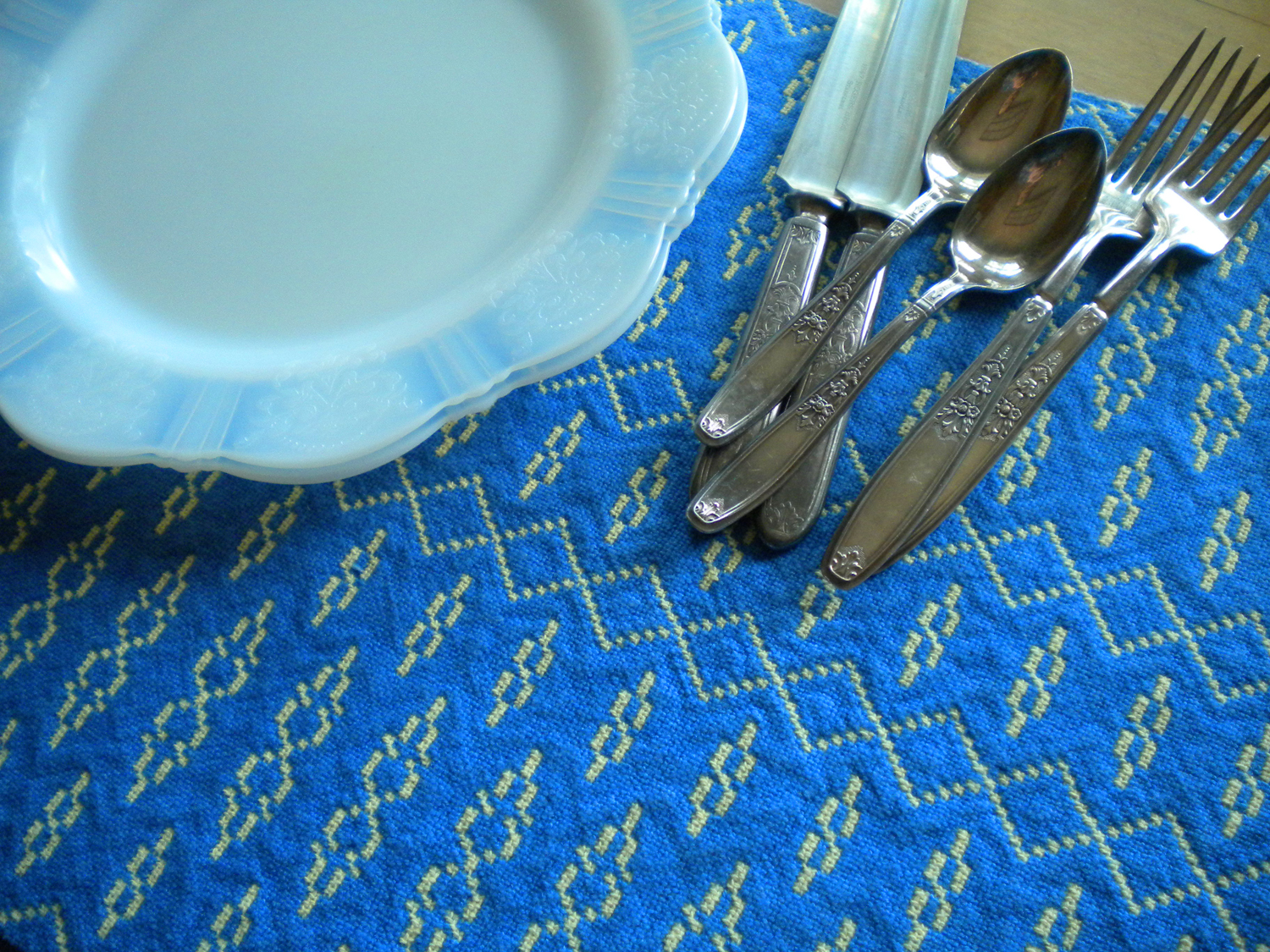
Doubleweave Placemat in Blue and Yellow

Doubleweave Placemat in Blue and Yellow

My current project has been a snowball and pine tree draft that is fairly common in coverlets. However, instead of weaving the blocks to form those snowballs and trees, I wove the blocks in straight order, one following the other, without combining them. From there the design evolved. This week the third rendition came off the loom. Here the blocks are just treadled in point order—zig zag order if you will. I like this pattern, but it is slower to weave because the blocks change constantly.

As I page through The Coverlet Book, I dream about weaving a coverlet. Maybe…someday…who knows! For now I am inspired and will keep exploring!

Placemats, Anyone?

25 Wednesday Mar 2015

Posted by jeanweaves in Placemats

≈ 2 Comments

Tags

Placemats, Textiles, Weaving

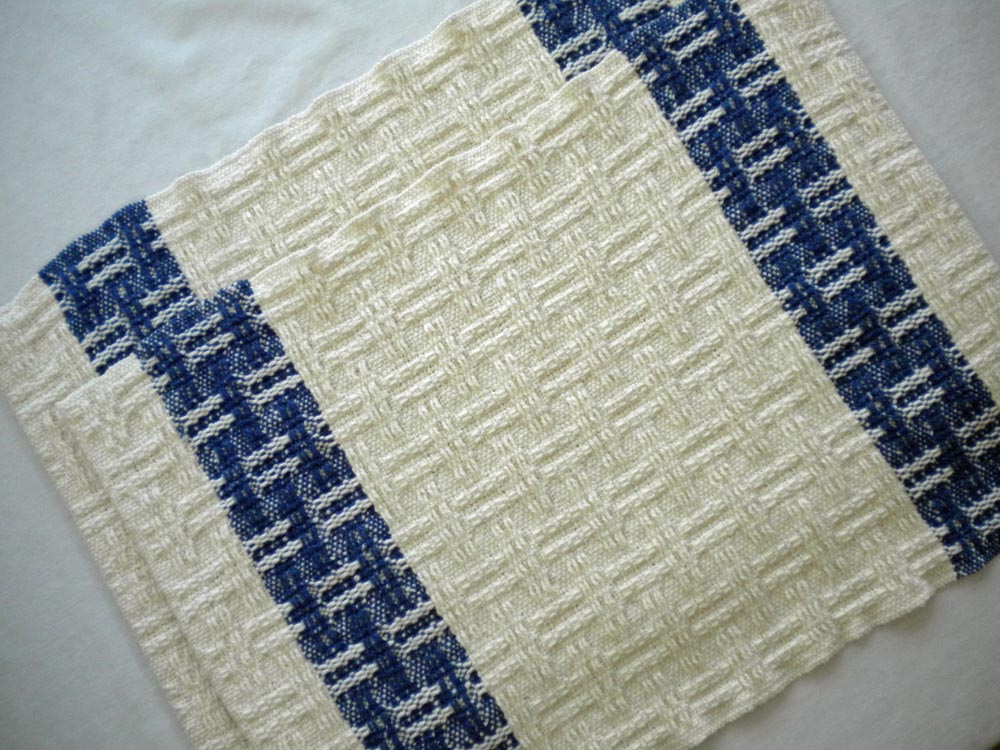
Cotton Placemats in Cream and Blue

Cotton Placemats in Cream and Blue

“So what handwovens do you need right now? What can I weave for you?”

“Well, we could always use more placemats.”

So went a recent conversation I had with a local shop owner. Placemats.

I used to weave a lot of those but over the years, I’ve shifted to towels, scarves, and other linens. I’ve woven note cards, runners, napkins, even some rugs.  But not many placemats.

When I got married, placemats were a popular bridal shower and wedding gift. Placemats are all-purpose. Like tablecloths, you can leave them on the table between meals as an accent. During meals, they protect the table without covering it up completely. And placemats are easy to launder. If you remove a handwoven cotton placemat from the dryer while it’s still slightly damp, you can simple smooth out the wrinkles and let it finish drying flat. Voila!

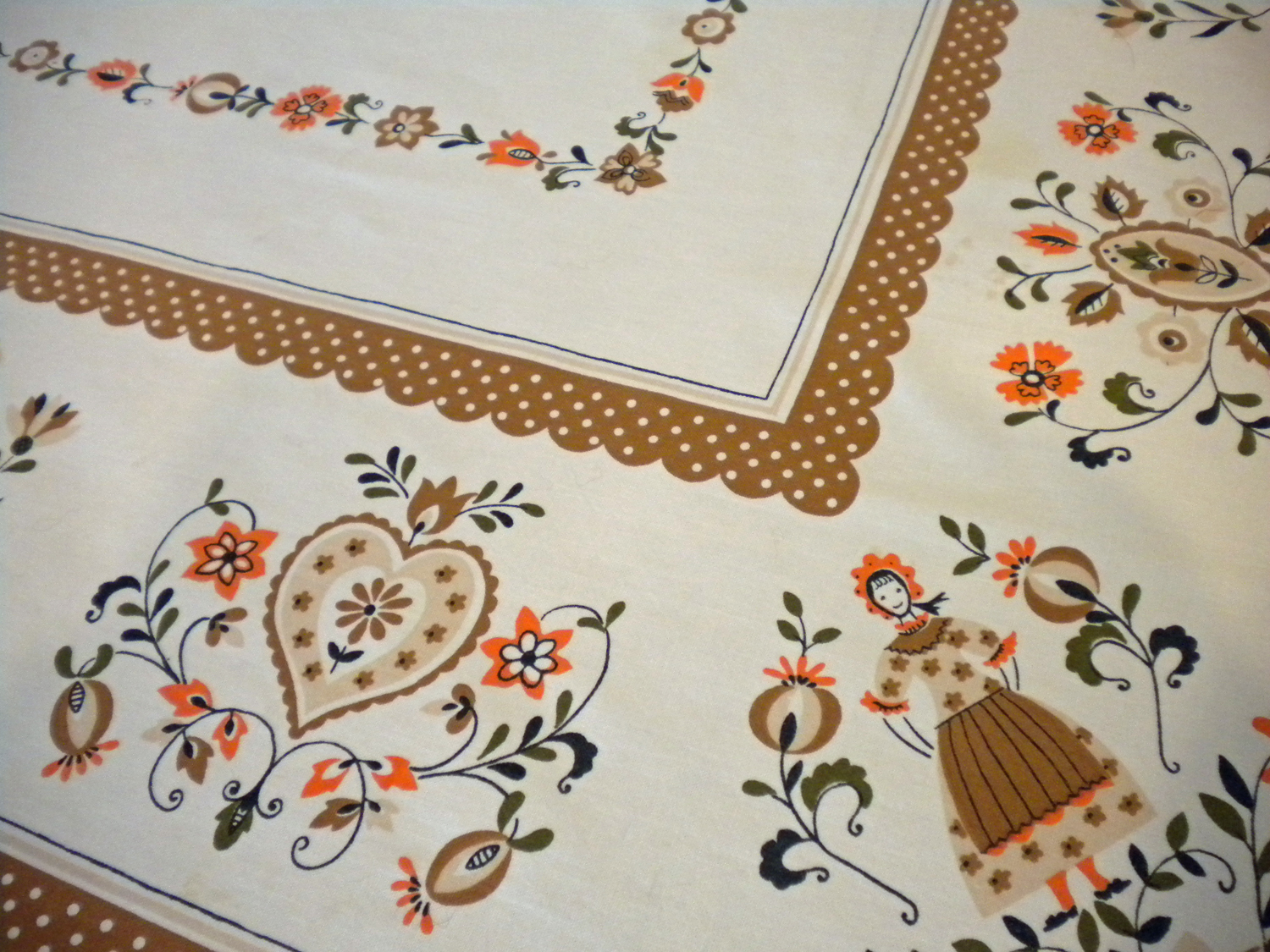
Classic '40's Tablecloth

Classic ’40’s Tablecloth

Back when my Mom got married, tablecloths were the gift of choice. Every bride needed tablecloths for every day, for formal use, for covering the table between meals. Remember those all-purpose printed tablecloths from the ‘40’s and ‘50’s, the ones with flowers around the edges and a center motif? There were tablecloths for every season and they brightened the table, made a meal special and just added a nice touch to the room between meals. Over time, decorating trends and tastes changed and placemats replaced tablecloths in many kitchens and dining rooms.

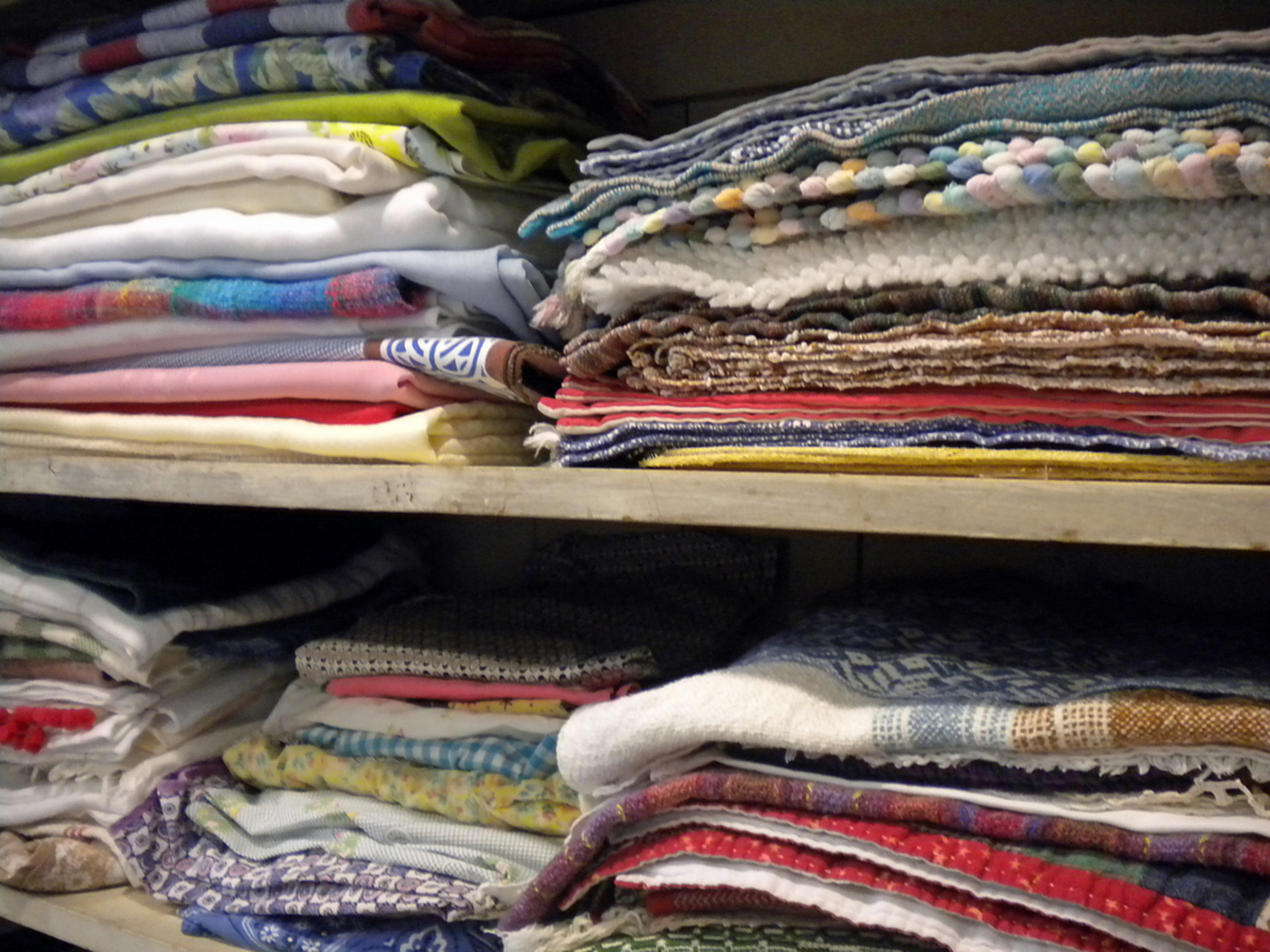
I have a pie cupboard full of table linens — both tablecloths and placemats (more than I actually use, but that’s another story.) The tablecloths came to me from my mother and my mother-in-law and some I received as wedding gifts. I do use them, just not every day.

Placemats and tablecloths for all occasions

Placemats and tablecloths for all occasions

But every day, there are placemats on our table. I have a few favorite sets and some seasonal ones. Some are super easy to care for, others are a little more challenging (like the fake straw ones I received many years ago and still am not quite sure how best to clean them – therefore they don’t get used). There are rag placemats that were made by a women’s cooperative in Latin America, there are fine cotton placemats. There are samples of designs I’ve sold and leftovers from the ends of warps.

I like the old tablecloths from the ‘40’s and ‘50’s. I like the flowers and the sense of style they gave a humble kitchen. There are many still out there in estate sales and flea markets.

But I like my placemats too. So I guess I’ll make some more placemats and as I’m weaving, I’ll imagine how they’ll brighten someone else’s kitchen table.

The Evolution of an Idea

12 Thursday Mar 2015

Posted by jeanweaves in Coverlets, Doubleweave, Weaving Inspiration

≈ 3 Comments

Tags

Coverlets, creative inspiration, Doubleweave, Early American Weaving, Weaving

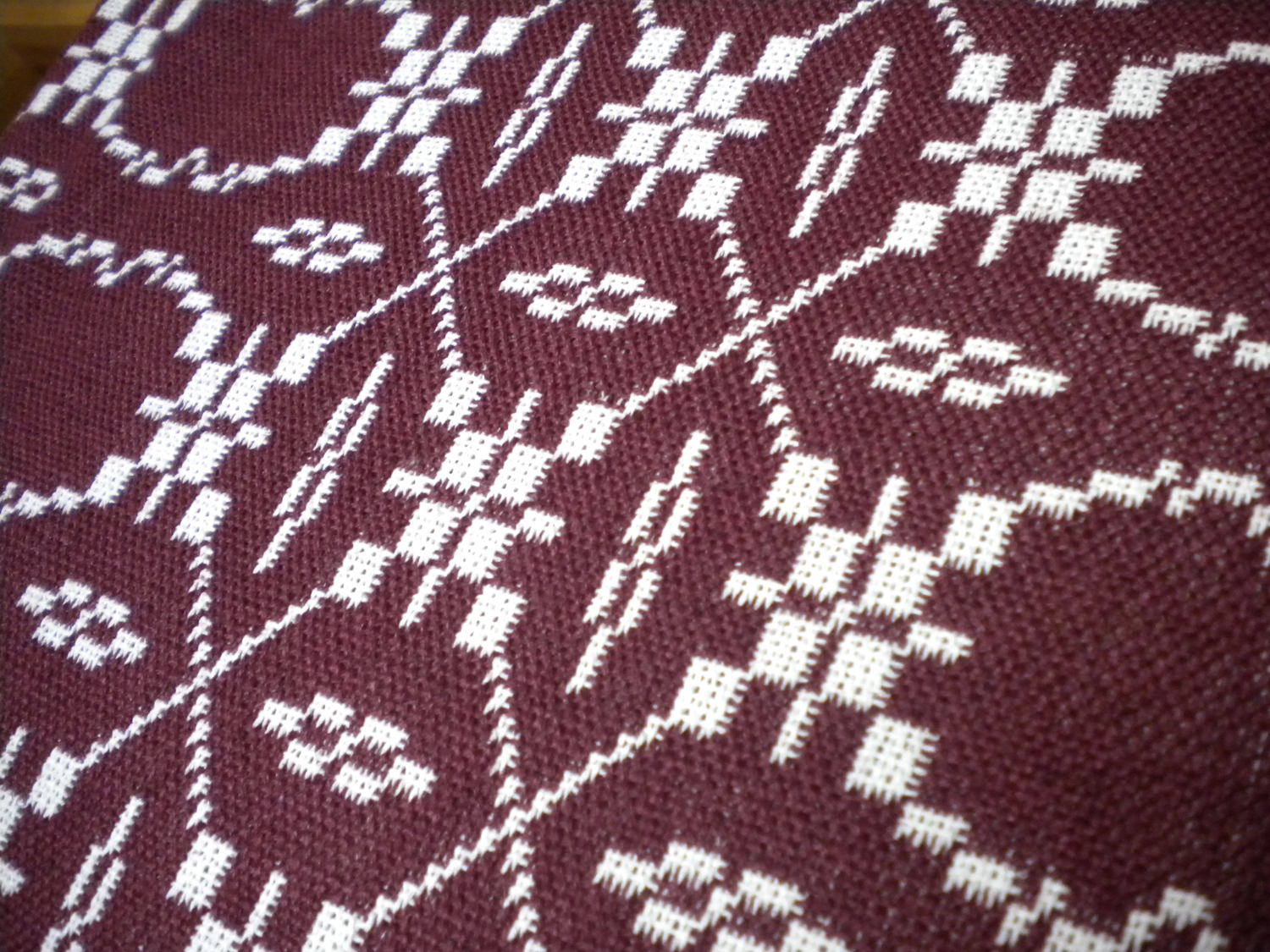
Block Doubleweave, Second Warp

Block Doubleweave, Second Warp

Every project starts somewhere, inspired by some need, some desire for color, a picture in a book or magazine, a piece in a store window. My Mom tells the story of her grandmother seeing a crocheted doily in a shop window during the Depression, studying it, and then going home to recreate it. Inspiration!

Weaving drafts give the directions that tell the weaver what to do. Drafts consist of four elements:

  1. the threading: the order the threads are arranged
  2. the treadling: which treadle to press when
  3. the tie-up: how those treadles are connected to the shafts
  4. the draw-down: what the pattern will look like with all of the above

    Doubleweave Draft

    Doubleweave Draft

The inspiration for my block doubleweave goes back to a class at Madelyn Van der Hoogt’s Weavers School when it was still in Missouri. I pulled out my class notes and studied the draft. The blocks – the areas where the colors change – form a pine tree and snowball design, but what if I changed the order of those blocks? How would the overall design change?

The easiest way to change a pattern is to treadle it differently, so I played around with the order of those blocks. Weaving the blocks in the same order as they are threaded, “as drawn in,” produces rings in the corners with ovals and diamonds in the center, like the green placemats. But I’m not a production weaver, so after weaving a couple placemats in this design, I started to ponder how to change it yet again without rethreading.

Doubleweave Designs Evolving

Doubleweave Designs Evolving

Again, I looked at the block order. What if I treadled just one set of blocks over and over? How about treadling them in point order – back and forth, one repeat of each? There are so many possibilities. I have the second pattern on the loom now in a natural pattern against a deep wine background, and a third set will tie on after it in yet different colors. Three different designs with one threading, just by changing the block order!

This is the evolution of design.

On Drawlooms

21 Saturday Feb 2015

Posted by jeanweaves in Doubleweave, Looms

≈ 5 Comments

Tags

Doubleweave, Looms, Weaving

Patterned Doubleweave in Progress

Patterned Doubleweave in Progress

Drawlooms. Sigh.

When I bought my Glimakra countermarche, I included a drawloom attachment with 20 pattern shafts. These shafts are separate from those that weave the ground cloth. I had worked on one of these looms at the Weavers School in the early ’90’s and fell in love with the intricate design possibilities. Alas, the class looms were set up beforehand and we didn’t go into how to get from frame to warp.

Over the years, I read whatever I could find on drawlooms and their set-up, but my learning style is hands-on and I confess that I often have to read something many times before I can visualize it. It’s only in the execution that things start to click. And sometimes my understanding (or lack thereof) is reflected in the results. Mostly I learned by trial and error. A lot of error.

Gracious, experienced weaving friends held my hand, patiently suggested I needed more weight here or there, and explained that yes, that tie-up is right, just try it. To these I owe so much!

Recently I was going through my old weaving records and found that I had successfully woven opphämta many years ago, just not very much of it. This is a lovely pattern weave on a plain weave or basketweave background. That’s on my to-weave list for this year. And I had looked into figured doubleweave previously too, even though I couldn’t find samples from the drawloom.

The structure I’ve had the most success with has been 5-shaft satin damask. Not all my pieces have been satisfactory, but with each one, I learn more. I look forward to weaving more damask soon.

Threaded Pattern Heddles

Threaded Pattern Heddles

All this is background to what has been a learning curve over the past couple weeks. Using “Dress Your Swedish Drawloom” video with Becky Ashenden of Väv Stuga Weaving School, I set about threading figured doubleweave on my drawloom.

This is a great video with a lot of step by step instruction. I watched it several times, referring back to specific steps. In particular, I noted how she teaches threading the loom while sitting inside the frame. The video clearly explained the positions of each part of threading this way. I’ve read about this before, but never tried it. I should have long ago! It is so much easier on the body—much less stretching and reaching.

And I only dropped all my heddles once, watching in dismay as they slid off the bar in slow motion like a bad movie. O my! But back on the bar they went. I also had difficulty transferring the pattern heddles to the individual lower pattern shaft bars, probably because I didn’t have enough weight on them, which resulted in having to do some rethreading.

The warp threaded through pattern and ground heddles, then through the reed.

The warp threaded through pattern and ground heddles, then through the reed.

It took a couple extra days inside the loom, but the warp is on and the weaving is progressing. I will have to adjust the pattern so that the motif is more of a circle than an oval, but overall, it’s exciting to see the pattern take shape (see above). I’m working with two shades of jade with this warp, but plan on do some more with other hues. After all this work to get it threaded, I want to weave more than just one warp on it!

Then after the doubleweave, it’s on to opphämta and some more damask. Weaving is a learning adventure!

← Older posts
Newer posts →
Shop!

Follow Us

  • Facebook

Galleries

  • Towels to Use and to Give
  • Runners
  • Scarves for Him and Her
  • For the Table
  • Note Cards
  • Animals
  • Throws
  • The Linen Press
  • Privacy Policy

Subscribe

  • RSS - Posts
  • RSS - Comments

Archives

  • September 2020 (2)
  • October 2019 (1)
  • August 2019 (1)
  • July 2019 (2)
  • June 2019 (2)
  • March 2019 (1)
  • November 2018 (2)
  • September 2018 (1)
  • July 2018 (2)
  • May 2018 (2)
  • April 2018 (1)
  • February 2018 (2)
  • January 2018 (1)
  • December 2017 (1)
  • November 2017 (2)
  • October 2017 (3)
  • August 2017 (1)
  • July 2017 (1)
  • June 2017 (2)
  • May 2017 (2)
  • March 2017 (2)
  • February 2017 (2)
  • January 2017 (2)
  • December 2016 (1)
  • November 2016 (1)
  • October 2016 (2)
  • August 2016 (3)
  • June 2016 (1)
  • May 2016 (1)
  • March 2016 (2)
  • February 2016 (1)
  • January 2016 (1)
  • December 2015 (1)
  • November 2015 (3)
  • October 2015 (1)
  • September 2015 (4)
  • August 2015 (1)
  • July 2015 (2)
  • June 2015 (1)
  • May 2015 (1)
  • April 2015 (2)
  • March 2015 (2)
  • February 2015 (2)
  • January 2015 (2)
  • December 2014 (1)
  • November 2014 (3)
  • October 2014 (1)
  • September 2014 (2)
  • August 2014 (1)
  • July 2014 (3)
  • June 2014 (1)
  • May 2014 (2)
  • April 2014 (2)
  • March 2014 (2)
  • February 2014 (2)
  • January 2014 (2)
  • December 2013 (2)
  • November 2013 (1)
  • October 2013 (1)
  • September 2013 (3)
  • August 2013 (1)

Blog at WordPress.com.

Privacy & Cookies: This site uses cookies. By continuing to use this website, you agree to their use.
To find out more, including how to control cookies, see here: Cookie Policy
  • Subscribe Subscribed
    • jeanweaves
    • Join 62 other subscribers
    • Already have a WordPress.com account? Log in now.
    • jeanweaves
    • Subscribe Subscribed
    • Sign up
    • Log in
    • Report this content
    • View site in Reader
    • Manage subscriptions
    • Collapse this bar
 

Loading Comments...